

30-05-2026 21:12
Philippe PELLICIERSur branche de mélèze (Larix) près de la neige,
31-05-2026 10:35
Hulda Caroline HolteHello,I collected this species growing on a rather
25-05-2026 16:35
 Bernard CLESSE
Bonjour à toutes et tous,J'ai trouvé récemment,
29-05-2026 15:35
daniel FERREBonjour à tous,Je voudrais votre aide pour cette
28-05-2026 16:15
James MitchellHello,Does anyone have the original publication of
28-05-2026 11:06
Thomas Læssøehttps://svampe.databasen.org/observations/10596750
23-05-2026 11:44
 Charles Grapinet
Hello, I am having trouble identifying this copro
25-05-2026 16:44
François BartholomeeusenHi forum members,During an excursion organised by
26-05-2026 21:25
Dirk GerstnerHello everyone, I'm completely stumped by this li
Hello forummembers,
I found several FRB's in two different places (distance +/- 500 m) on the dried banks of two different brooks
a) 24/06/2015 Staatsbos Sevendonk Turnhout, Belgium
b) 26/06/2015 Winkelsbroek Turnhout, Belgium
Macroscopic features:
Substrate: found on the dried banks of two brooks on a muddy soil full of plants and herbal roots (a = bare soil, b = soil full of leaf litter).
FRB: sessile, flat to cushion-shaped with diameter smaller than 5 mm; dark yellow to orange colored with a jagged edge slightly paler, alone or in bundles (squeezed together)
Microscopic features (all dimensions in water): fresh material in water and in Melzer.
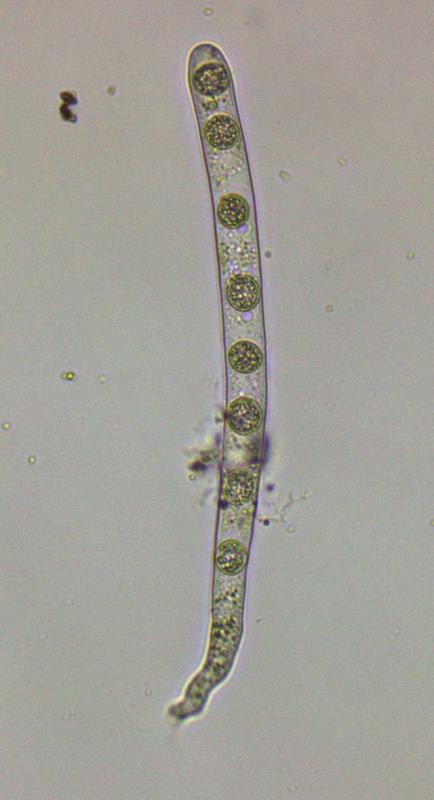
asci : cylindrical, uniseriate; IKI-; croziers present
a) 267,47-294,88 x 15,04-23,32 µm
b) 217,36-261,03 x 15,26-24,11 µm
spore: hyaline, globose tot broadly ellipsoid with spines:
a) 16,23-17,64 x 13,23-16,14 µm; spines: 1,79-3,42 µm; Q= 1.016
b) 15,93-18,91 x 17,03-18.06 µm; spines: 2,89-4,37 µm; Q= 1.11
Paraphyses : 320 x 5.8 µm, top irregular clavate (8-12 µm) with pale orange content; slender, filiform with septs
Texture: globulosa, angularis
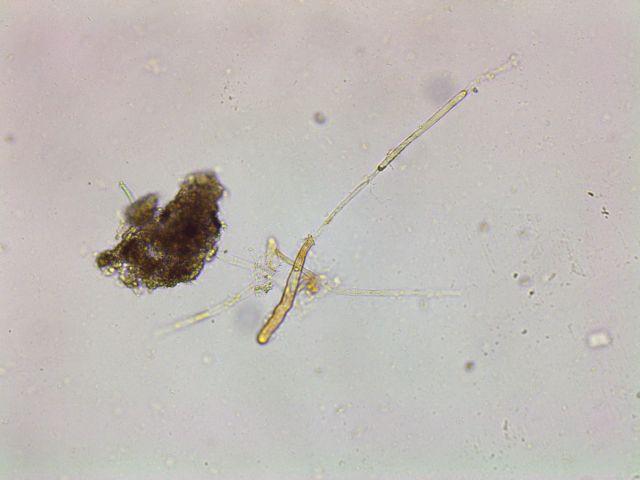
Marginal cells: 147-170 x 21-30 µm; elongated cells with 5 septs, constricted en rounded top.
After reading about the genus Ramsbottomia (Dieter Benkert, Nicolas Van Vooren and Yannick Mourgues, I think it is Ramsbottomia crechqueraultii.
Being an amateur I am somewhat confused. The difference between globose and broadly ellipsoid, the difference in spore length of 1 to 4 µm is susceptible to interpretation. Furthermore in Mycobank the current name is Lamprospora...
I hope I have got the right determination? I still have to learn much and accept that not everything is clarified!
Kind regards,
François


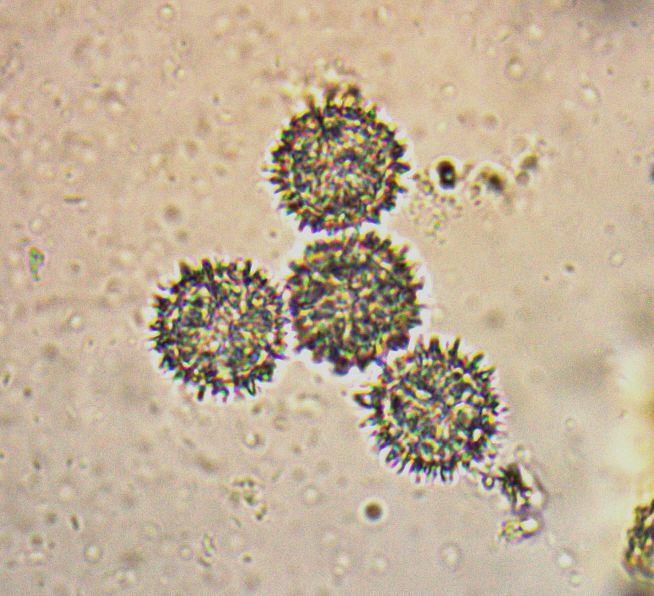


Votre champignon, avec ses spores échinulées correspond parfaitement à Ramsbottomia crechqueraultiiI Il n'entretient aucun rapport avec les mouses même si, parfois, on en trouve quelques unes à son voisinage. De ce fait, il a été exclu des Lamprospora.
Le genre Ramsbottomia a été créé pour ces espèces à spores rondes (ornées d'épines voire de très fortes épines), non muscicoles, pouvant présenter quelques poils comme sur votre photo
Amicalement
Gilbert
Je vous remercie beaucoup pour votre réponse rapide.
Cordialement,
François