Accès membres

Mot de passe perdu? S'inscrire

11-02-2019 23:39

Edouard Evangelisti Edouard Evangelisti

Dear all, Would you agree this is likely a Hyalos

11-02-2019 21:13

Eduard Osieck

Could somebody provide: Petrini, Candoussau &

12-02-2019 19:17

Ethan Crenson

Found in New York City recently on what I believe

12-02-2019 12:30

Camille Mertens

Bonjour à tous.Pouvez-vous me donner votre avis s

20-08-2012 23:32

Chris Yeates Chris Yeates

I am struggling with a "Pestalotiopsis" on Cryptom

10-02-2019 23:20

Miguel Ãngel Ribes Miguel Ángel Ribes

Good nightA friend brings me this species growing

06-02-2019 18:52

Riet van Oosten Riet van Oosten

Hello, Found by a mushroomfriend, on Urtica. Cou

07-02-2019 20:14

Eduard Osieck

Does any body recognise these rather large stromat

10-02-2019 20:12

Martzuku Eleni

Under olive tree, near burnt ground. Small, up to

30-01-2019 19:57

Eduard Osieck

This hyphomycete with rather large synnemata (up t
« < 618 619 620 621 622 > »
Hyaloscypha sp. ?
Edouard Evangelisti, 11-02-2019 23:39
Edouard Evangelisti
Dear all,

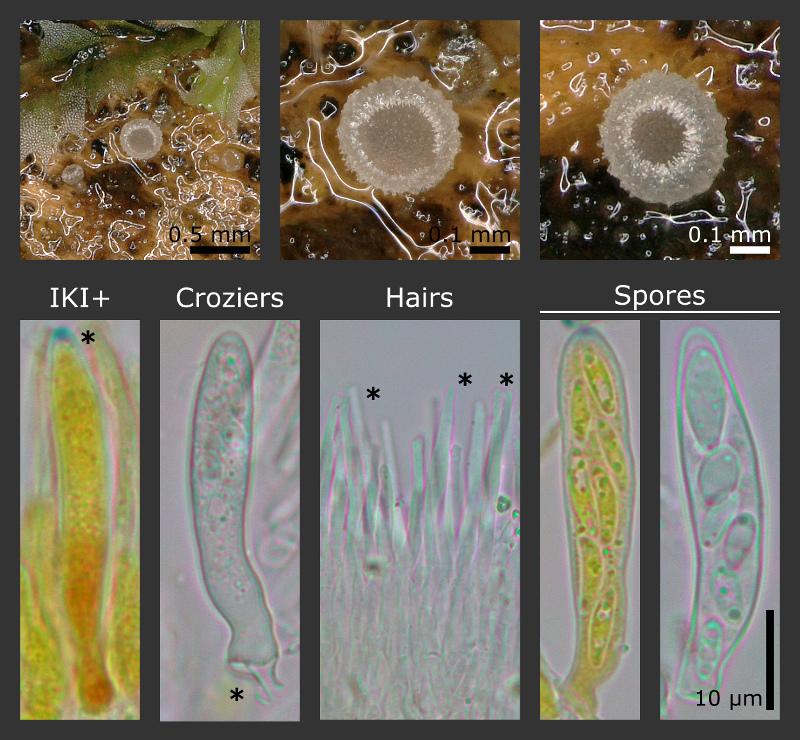
Would you agree this is likely a Hyaloscypha?

Unfortunately I cannot provide good enough data to solve the species since these were found by chance on a wood sample (I still need to check whether it was coniferous) harvested for other purposes (a Mucronella species).

Briefly, apothecia were tiny (< 1 mm), whitish-translucent, with dense hairs on the excipulum. I could check that the asci were IKI+ and developed from croziers. Paraphyses are cylindrical. Hairs were smooth, hyaline, cylindrical, slightly tapering at the top, not reacting to iodine. I could not get mature spores, but a few of them within asci were 8-9 x 1.5-2 µm, hyaline, smooth, fusiforms and often arcuate.

Many thanks for your help.

With my best wishes,

Edouard
  • message #56275
Kosonen Timo, 12-02-2019 06:19
Kosonen Timo
Re : Hyaloscypha sp. ?
Hello,

IF substratum happens to be coniferous, H. aureliella is a good alternative. A slide with excipular cells in MLZ reagent would be helpfull (amyloid nodules?). There's no resin visible in the photos provided, but there are always exceptions. Pick the most mature fruitbody and make a careful mount with water.

If hardwood and absolutely no MLZ reactions (hairs, excipula), it could be a Hyaloscypha look-a-like, just "outside" Hyaloscypha :-).

cheers,

Timo
Hans-Otto Baral, 12-02-2019 07:55
Hans-Otto Baral
Re : Hyaloscypha sp. ?
Did you measure the hairs? Do they have the same scale as the asci? If yes, then the hairs are pretty small. Which region of ?France does it come from?
Was the substate exposed, a still-attached branch? Or on the moist gorund?
The MLZ reaction of hairs and exciple is used in Huhtinen's key as a character but one must know that it is not at all shown in Lugol.
Edouard Evangelisti, 12-02-2019 21:40
Edouard Evangelisti
Re : Hyaloscypha sp. ?
Dear Timo and Zotto,

Thanks a lot for your messages!


I should have mentioned that, actually these are collections from the Suffolk (Brandon, UK). I am in Cambridge for work at the moment, that is why I do not have access to my usual microscope and reagents.


I will try my best to save some samples for further observations on rehydrated samples (still better than nothing I guess) when I am back to France.


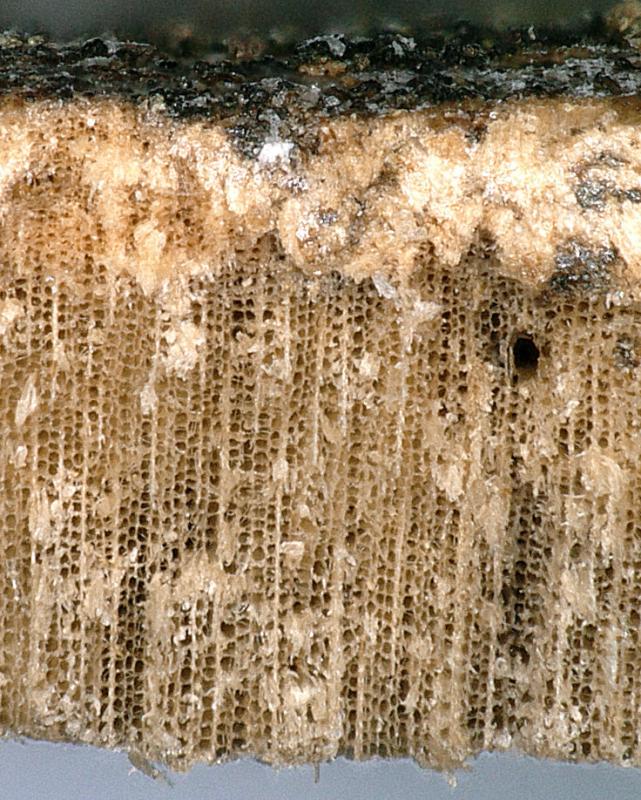
I can confirm this was coniferous wood (picture enclosed). It was on the ground, and quite rotten already. Thanks for the tip regarding the use of Melzer vs Lugol for reaction with hairs, I was not aware of that.


I will go back there and see if I can collect older specimens to do more observations, including a more careful look at the resin and to measure hairs.


Cheers,
Edouard
  • message #56291
Hans-Otto Baral, 12-02-2019 22:13
Hans-Otto Baral
Re : Hyaloscypha sp. ?
Yes, it is coniferous, so Timo's suggestion (aureliella) is not ruled out.