
02-06-2026 14:33
 Nicolas VAN VOOREN
Hello.I'm searching for a PDF copy of the followin
02-06-2026 17:58
Louis DENYBonjour forum, Sur feuille de Populus tremula, en

28-07-2011 18:31
 Alex Akulov
Dear FriendsToday I made the pdf file of Velenovsk
11-09-2025 16:57
 Jason Karakehian
Our revision of Marthamycetales (Leotiomycetes) is
12-11-2019 10:32
 Miguel Ángel Ribes
Hi againExactly at the same place than my previous
25-12-2019 17:54
Valencia Lopez Francisco JavierHola a todos/asEstas supuestas pezizas estaban en
12-07-2015 00:05
 Nedim Jukic
This one from the same locality as the previous on

30-05-2026 21:12
Philippe PELLICIERSur branche de mélèze (Larix) près de la neige,
A Xylaria globosa (Spreng. ex Fr.) Mont. is a only Xylaria species with red-orange colorations in the ascostroma. This specimen found in the Cordillera Central, 500 mts. altitude, has these characteristics. The orange-red coloration develops only in thin sterile cilindrical stromata arising between fertile globose black stromata , they have few peritecias. The ascospores are 18-24 x 6-8 microns.
In http://mushroaming.com/Amazing_Amazon is referred as X. glabrosa, but i cant found any references to this specie.


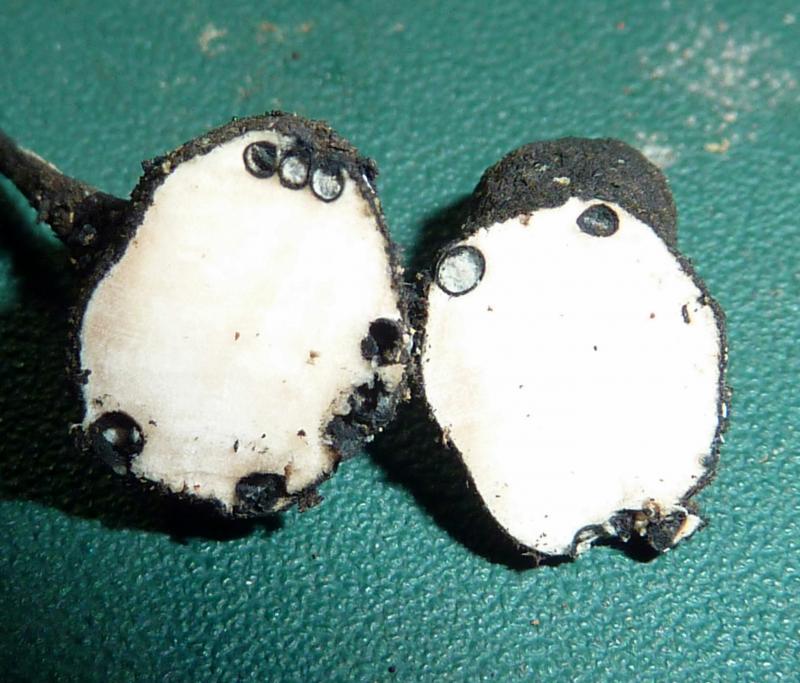


Saludo.
In my experience X. polymorpha s.st. and X. obovata (syn schweinitzii) never produce red droplets when emerging but my concept of X. globosa does (= anisopleura). But this complex still needs a lot of attention using other methods :-)
The red drop producing taxon is extremely common in Ecuador and presumably over most of the Neotropics
cheers
Thomas