
03-05-2026 10:57
 Castillo Joseba
Me mandan el material seco de Galicia (España) re
02-05-2026 12:42
Alain BRISSARDBonjour à tousJeuidi 30 avril dernier on m'a remi
02-05-2026 13:06
Pauline. PennaBonjour Please can someone help me with this id
01-05-2026 22:45
 Thierry Blondelle
Bonjour à tous, Une récolte sur bouse séchée d
28-04-2026 20:07
 Lothar Krieglsteiner
... on twig in the air at standing Ceratonia siliq
14-04-2026 05:32
Ethan CrensonHi all, A few weeks back a friend pointed out som
28-04-2026 20:33
Vitus SchäfftleinHello, I found Trochila ilicina on Ilex aquifoliu
30-04-2026 10:28
Rot BojanHello, by appearance I would say that I am dealing
Patellaria or Lecanidion
Peter Thompson,
19-12-2013 15:26
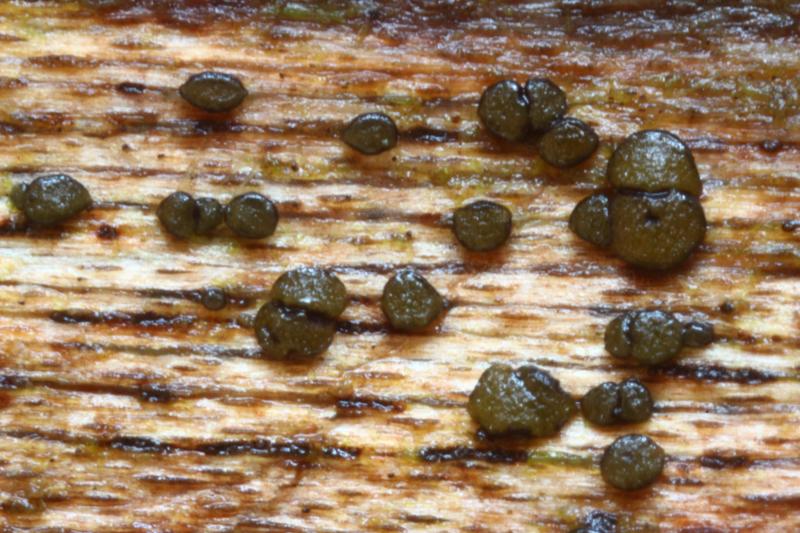
I have been considering an ascomycete which seems to be growing in association with a lichen or alga. There is a slimy, green film on the wood, which is decorticated Betula pendula.
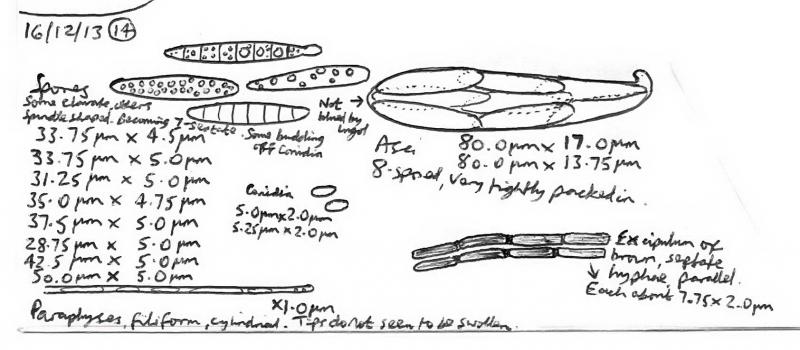
In many ways, it seems to fit best with the genus Patellaria (long, multiply septate spores, asci which rupture at the tip, no reaction to lugol and parallel, regularly septate hyphae in the excipulum).
There seem to be inconsistencies as well (olive green hymenium and paraphyses neither branched nor swollen at the tips).
I have attached a photograph of the fruit bodies and a sketch of the microscopy and wonder if anyone has an idea as to what it is.
Thank you,
Peter.
Gernot Friebes,
19-12-2013 15:33
Re : Patellaria or Lecanidion
Hi Peter,
how about Durella connivens?
Best wishes,
Gernot
how about Durella connivens?
Best wishes,
Gernot
Peter Thompson,
19-12-2013 18:06
Re : Patellaria or Lecanidion
Hello Gernot,
Thank you for your reply.
I overlooked Durella. It seems that D. connivens can have olive green hymenium as well as grey hymenium.
The green algal sliminess on the host and the 7-septate spores also fit. I was surprised to see that all of the spores with septa had exactly seven.
I think that you are right.
With Best Wishes,
Peter.
Thank you for your reply.
I overlooked Durella. It seems that D. connivens can have olive green hymenium as well as grey hymenium.
The green algal sliminess on the host and the 7-septate spores also fit. I was surprised to see that all of the spores with septa had exactly seven.
I think that you are right.
With Best Wishes,
Peter.