

05-05-2026 22:40
Gernot FriebesHi,I believe this is a Plagiostoma growing on a Sa
06-05-2026 11:25
 Castillo Joseba
Me mandan el material seco de Galicia (España) re
06-05-2026 17:23
Thomas Læssøehttps://svampe.databasen.org/observations/10594257
28-04-2026 20:07
 Lothar Krieglsteiner
... on twig in the air at standing Ceratonia siliq
04-05-2026 18:13
 Stephen Martin Mifsud
ID request for what seems to be a true aquatic fun
04-05-2026 16:39
Stephen Martin Mifsud
ID request: This specimen was collected in Malta o
28-07-2011 18:31
 Alex Akulov
Dear FriendsToday I made the pdf file of Velenovsk
04-05-2026 09:50
Castillo Joseba
Me mandan el material seco de Galicia,(España) re

Hi to all
I need your help with these pinkish orange erumpent ascomata up to 0.5 mm by a longitudinal rupture of the peridermis of the host. There are not lips or valves around them.
The lateral ectal excipulum seems to be a prismatical/subangularis texture but it is very difficult to cut well. Asci with croziers, 8-spored, IKI red or dirty red blue in IKI (at high concentration), IKI b after KOH pret.
The end cells of the paraphyses have a peculiar snake head-like morfology and they have big roundish but incolore Vb's.
I think it belongs to the genus Laetinaevia but I don't see it in Hein's paper on this genus.
The fungus wwas found growing on indeterminate grasses at 1500 m of altitude
Have you any idea?
 Laetinaevia-sp-0001.pdf
is there more of this dark red-brown exudate on the excipulum?
I think a section of the margin and flanks would help to get an idea of the excipulum.
Also, are these globose drops VBs or SCBs? Did you test them with CRB?
Zotto
Hi Zotto
Sorry but it's impossible because the material is not well preserved and it is dried. No. I didn't test them with Crb, but they disappear in KOH. Do you think they are SCBs?
You must only rehydrate the apothecia, though probably the cells are not alive anymore. But a view on the exterior, do you have a photo that shows the brown exudate? It is just cut on your crop photo on the plate.
I see a certain similarity with the genus Pseudonaevia. I have a specimen that I placed with hesitation there. In my folder (dir. Hysteropezizella-complex) you find also the protologue.
Hi Zotto
Now I think you are right: They are not VBs but SCBs. But I cannot to cut well the apothecia.

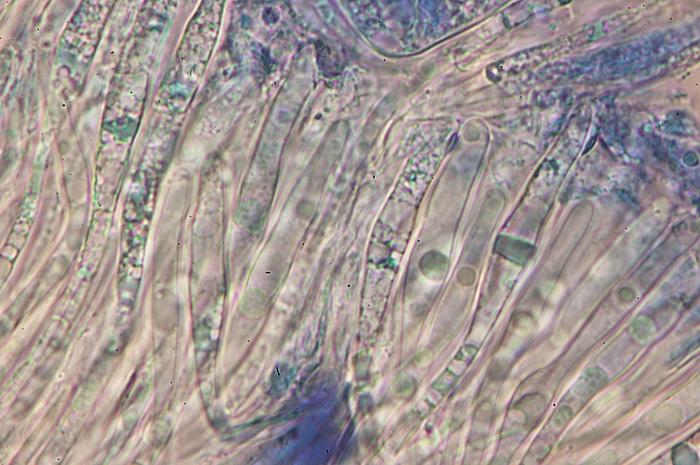
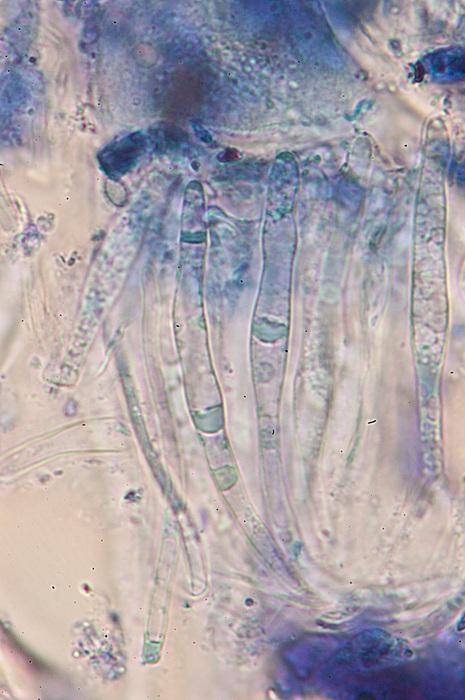
Did you compare this Pseudonaevia genus? And are the spores already septate within the living asci?
But, are the ascospores of your fungus septate inside the asci too?
When I saw 'my' fungus in the field my first impresion it was a member of Naevoideae because the erumpent pinkish orange ascomata, very different to yours.
Pseudonaevia caricina seems also to eject aseptate spores, but is described as pale yellow.
I think we need not different genera for different colours :-)
How this genus could be defined and whether it is related to Hysteropezizella remains open. But a section of your fungus would have been useful to understand the excipulum.
Yes. Off course! A better section in needed for to unerstand the excipulum! I hope Jesús can found it again!
Thanks, Zotto