
10-06-2026 10:45
 François Freléchoux
Bonjour à nouveau, Encore une détermination qui
08-06-2026 10:16
 Spooren Marco
I don`t have a clou about this fungus,it is not in
10-06-2026 09:24
François Freléchoux
Bonjour, J'imagine que cette détermination ne do
09-06-2026 18:32
Camille MertensSur morceau de roseau immergé 0,5 - 0,7 mm de dia
08-06-2026 17:00
François BartholomeeusenGood day everyone, On June 5 2026, I collected de
07-06-2026 15:10
 William Slosse
Hello everyone,On 05-06-26, I found following asco
05-06-2026 11:02
Thomas Læssøehttps://svampe.databasen.org/observations/10596691
07-06-2026 12:09
François Freléchoux
Bonjour, Voici une brève description de ce qui m
07-06-2026 12:43
Steve ClementsBojour. This was a strange find on a stick on my
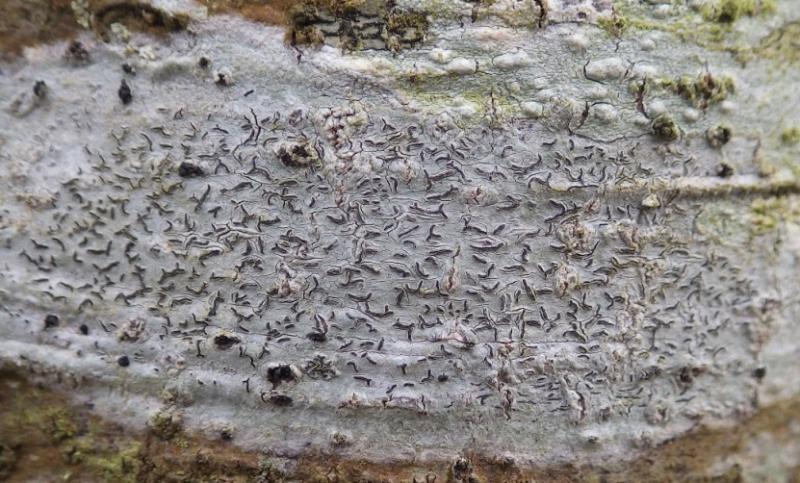
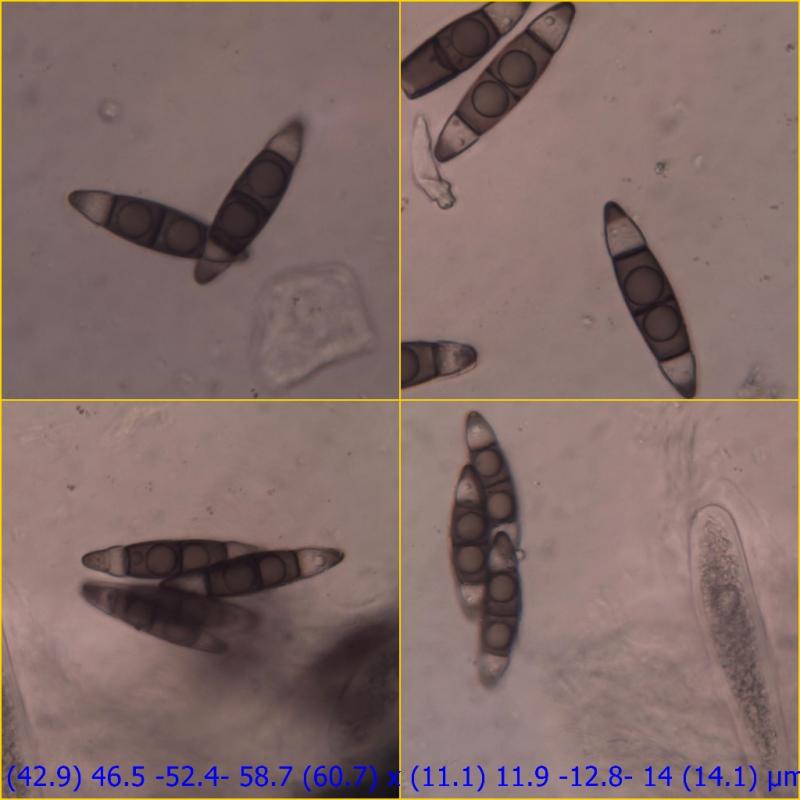
I would like to have more opinions about this asco, that was growing on the thallus of a lichen (of the genus Graphis), as can be observed from the first photo attached. In addition there was another parasite with similar appearance over the lichen. I was doing the microscopy of the lichen and noticed some stranges spores. Then I selected a emerging volcano and made some sections of it. From the shape of the ascospores I immediatly thought that could be a Hysterium sp.. When I measured the spores I got a surprise, the size was about the double than expected (in average 52.4 x 12.8 µm). I went to the key of Eric Boehm, available at
http://www.eboehm.com/hysterium.html
and arrived to Hysterium macrosporum. Since till now I found only two Hysterium species: H. angustatum and H. pulicarea and, according to the description given in the above website, H. macrosporum it is a very rare species, I became doubtful. Is there any other suggestion?
Thank you in advance,
zaca



Hi Zaca,
H. macrosporum is not possible because ascospores are 2-coloured.
It's close to H. pulicare but different, to my mind. But there are a big variations in H. pulicare (for example, H. pulicare Pers. and H. truncatulum, one of its synonyme) and study would be necessary.
My opinion is that your fungus is probably an ined. fungus.
Alain
PS just a question : ascopores are in water in fourth picture ?
Ragarding your question the answer is: YES. All the observation was done with water.
Regards,
zaca