06-05-2026 11:25
 Castillo Joseba
Me mandan el material seco de Galicia (España) re
28-04-2026 20:07
 Lothar Krieglsteiner
... on twig in the air at standing Ceratonia siliq
05-05-2026 22:40
Gernot FriebesHi,I believe this is a Plagiostoma growing on a Sa
04-05-2026 18:13
 Stephen Martin Mifsud
ID request for what seems to be a true aquatic fun
04-05-2026 16:39
Stephen Martin Mifsud
ID request: This specimen was collected in Malta o
28-07-2011 18:31
 Alex Akulov
Dear FriendsToday I made the pdf file of Velenovsk
04-05-2026 09:50
Castillo Joseba
Me mandan el material seco de Galicia,(España) re
02-05-2026 12:42
Alain BRISSARDBonjour à tousJeuidi 30 avril dernier on m'a remi
02-05-2026 13:06
Pauline. PennaBonjour Please can someone help me with this id
Discomycetes
Claude Kaufholtz-Couture,
26-10-2014 16:45
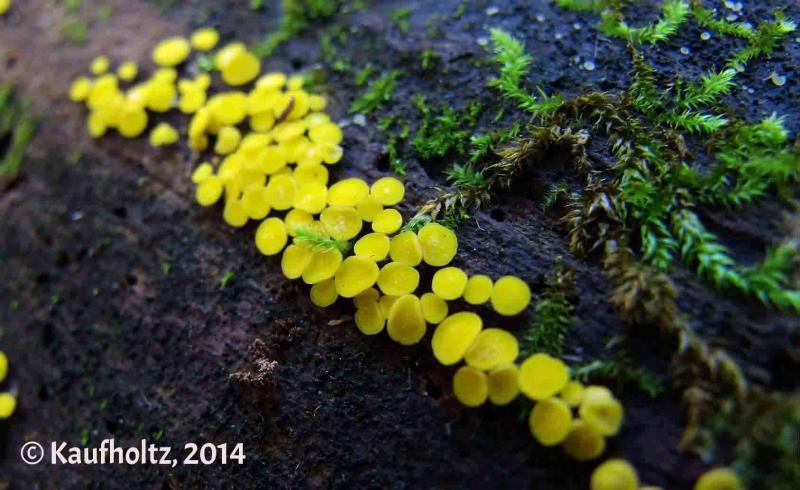
 Bonjour,
Mon étude préliminaire m'indique qu'il ne s'agit pas de Bisporella citrina.
Que dois-je rechercher exactement pour m'aider à trouver le nom de cette espèce ?
Sporée blanchâtre
Spores cylindriques, fusiformes à subbacilliformes, lisses, à paroi mince, n'ayant aucun septum, l'appendice hilaire non visible, à contenu guttulées à biguttulées, verdâtres dans le NaCl isotonique 0,9 %, inactives dans le Melzer, cyanophiles
7,4 [8,8; 9,4] 10,7 x 2,7 [3,1; 3,2] 3,5 µm
Q = 2,3 [2,8; 3] 3,5; N = 30; C = 95%
Me = 9,1 x 3,1 µm; Qe = 2,9
Je vous remercie !
Claude
Hans-Otto Baral,
26-10-2014 18:01

Re : Discomycetes
Bonjour Claude
Maybe you expected to see septate spores? The septum is formed in Bisporella citrina only on overmature spores, so don't worry. If the excipulum is gelatinized I am quite sure it is this species. You can also look at the ascus apex in IKI, but you need dead asci for that. The apical ring is a bit like a T, while for instance in Bisporella subpallida it is only reactive in the lower part of the wall thickeningl like two short thin lines, Also the contents of the paraphyses are worth to look at.
The difference in apicla ring and genetic data led me to say Calycina citrina for the present fungus, so I restrict Bisporella to B. subpallida and B. pallescens.
Zotto
Maybe you expected to see septate spores? The septum is formed in Bisporella citrina only on overmature spores, so don't worry. If the excipulum is gelatinized I am quite sure it is this species. You can also look at the ascus apex in IKI, but you need dead asci for that. The apical ring is a bit like a T, while for instance in Bisporella subpallida it is only reactive in the lower part of the wall thickeningl like two short thin lines, Also the contents of the paraphyses are worth to look at.
The difference in apicla ring and genetic data led me to say Calycina citrina for the present fungus, so I restrict Bisporella to B. subpallida and B. pallescens.
Zotto
Claude Kaufholtz-Couture,
26-10-2014 19:44
Re : Discomycetes
Thank you Hans-Otto,
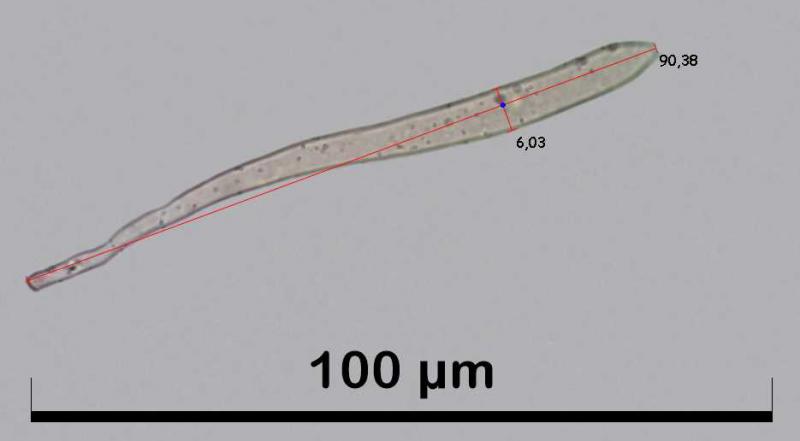
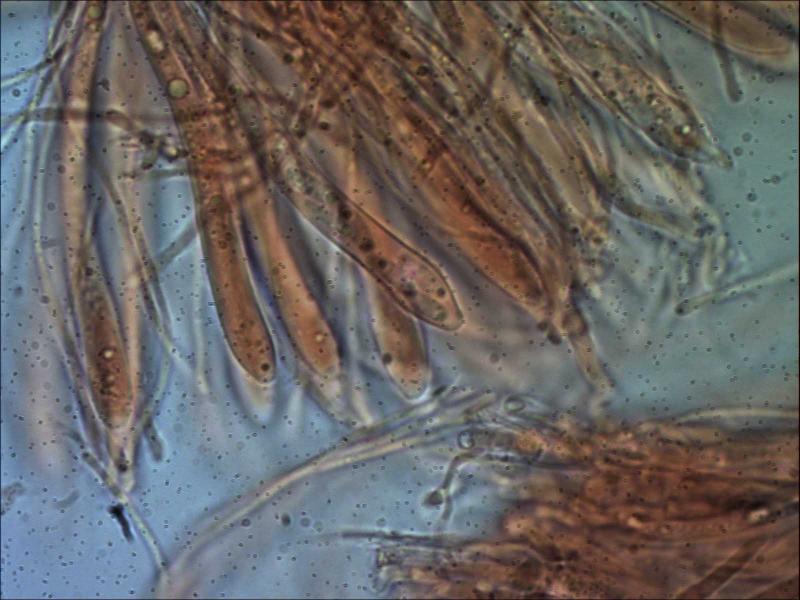
I am to look closer at what you asked me. In the meantime, here are microscopic elements of the collection in question.
I hope that it can help.
Claude