
02-05-2026 12:42
Alain BRISSARDBonjour à tousJeuidi 30 avril dernier on m'a remi
02-05-2026 13:06
Pauline. PennaBonjour Please can someone help me with this id
01-05-2026 22:45
 Thierry Blondelle
Bonjour à tous, Une récolte sur bouse séchée d
28-04-2026 20:07
 Lothar Krieglsteiner
... on twig in the air at standing Ceratonia siliq
14-04-2026 05:32
Ethan CrensonHi all, A few weeks back a friend pointed out som
28-04-2026 20:33
Vitus SchäfftleinHello, I found Trochila ilicina on Ilex aquifoliu

30-04-2026 10:28
Rot BojanHello, by appearance I would say that I am dealing
27-04-2026 18:48
Tony MoverleyCollected 23rd April 2026, Norfolk, EnglandSwarms
27-04-2026 20:52
Lothar Krieglsteiner
Found on hanging tiwg of Olea europaea in dried-ou
 Dear friends
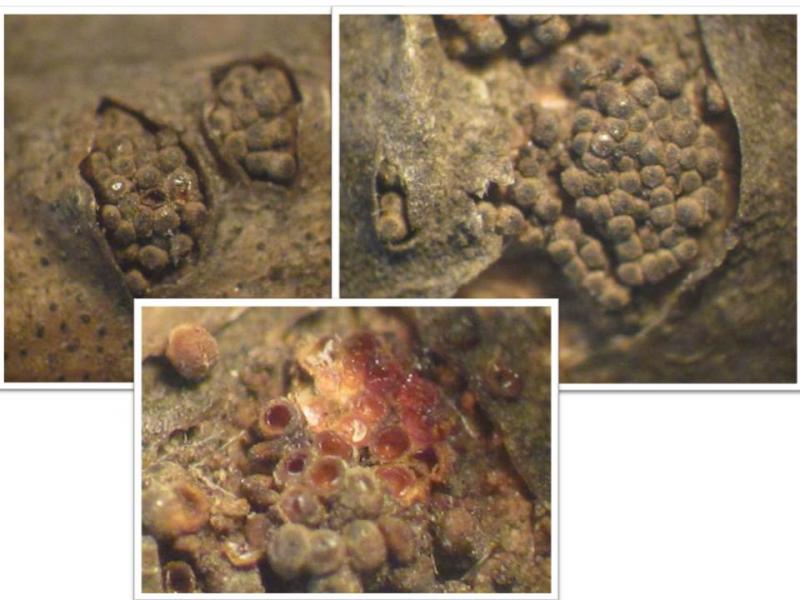
Among the old samples, which are stored in our mycological collection, I found one that was signed as Nectria decora. It is not N. decora a 100% and even non Nectriaceae representative, because presence of many threadlike, branched, septate paraphyses (pseudoparaphyses) in hamathecium.
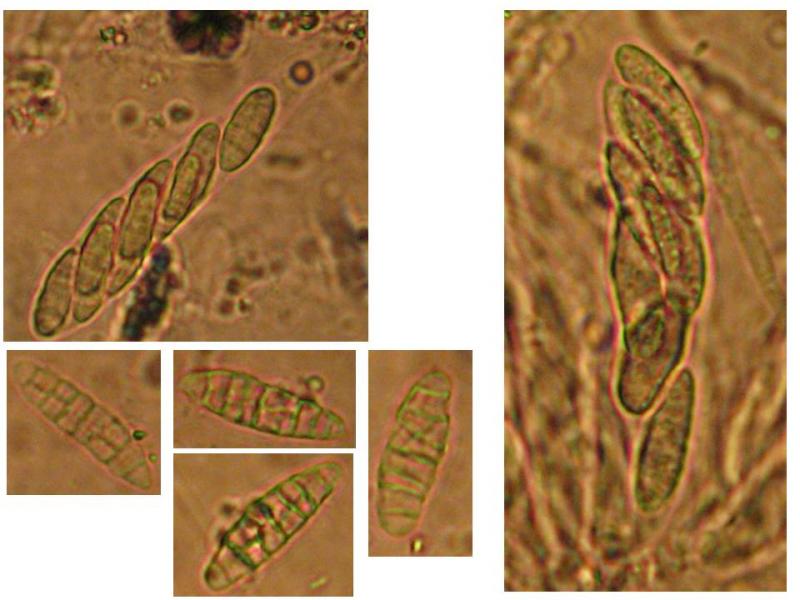
Perithecia (pseudothecia) erupt in dense groups from the bark of thin dry twigs of Caranana arorescens. Externally perithecia looks olive-brown, but in a cross section the wall is clearly red-brown. The walls of fruiting are very thick. Asci are 67,3-83,6 x 14,2-15,8. Ascospores are arranged in two rows or obliquely, in some cases biseriate in the upper part and uniseriate below. Ascospores hyaline, muriform (with 7-8 transverse and multiple longitudinal and oblique septae), slightly constricted near the central septum, 16,3-21,5 x 4,7-7,6.
Alone I can not reidentify this sample.
If you have some ideas about it, I would greatly appreciate for your help.
Alex
Hello Alex,
this sample has transversely septate spores. So - I first would look in the genus Thyronectria. Maybe there ist a species on Caragana?
Regards from Lothar
This is really Thyronectria representative with presence of paraphyses in hamathecium.
New article about this genus is in the attached file.
Alex
 s10-0001.pdf
thank you for the paper! - very interesting, I did not have it yet.
Maybe you can find a species there - or not?
Regards from Lothar
thank you for the paper! - very interesting, I did not have it yet.
Maybe you can find a species there - or not?
Regards from Lothar