
10-05-2026 23:17
 Andreas Gminder
Hello,today we found in a moist steep decidous for
29-04-2026 10:44
 Lothar Krieglsteiner
growing at moist, drying-out soil at the side of a
10-05-2026 16:18
brigitte vignotbonjour trouvée en Ariège sur bois une petite
27-04-2026 17:16
Lothar Krieglsteiner
.. Algarve, moist lying.The conidiomata look like
10-05-2026 09:02
Buckwheat PeteHello everybody, ould this be Lachnum subvirgineu
08-05-2026 11:55
Gernot FriebesHi,found on a decorticated Picea abies branch stil
11-05-2016 20:37
 Zuzana Sochorová (Egertová)
Hi,this very little ascomycete grew on soil in a m
09-05-2026 07:37
Zuzana Sochorová (Egertová)
Hello,please, could anyone share this paper?Ferná

05-05-2026 22:40
Gernot FriebesHi,I believe this is a Plagiostoma growing on a Sa
 Hi to everybody and specially to J. Fournier, a very good specialist on this genus.
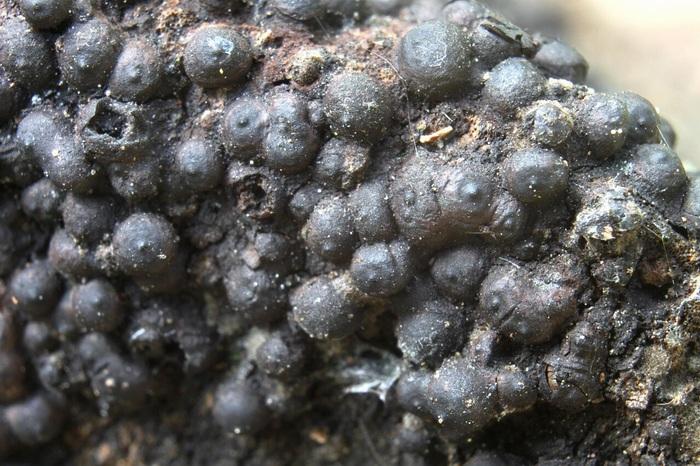
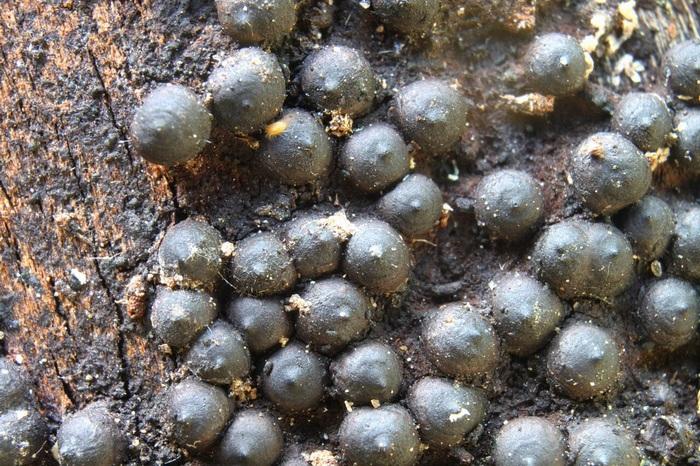
Our common friend P. Zapico has found at his home these gregarious, blackish, roundish, papillate and ostiolate, carbonaceous, perithecia 0.9-1.4 mm in diam. growing over on more or less persistent subiculum on very rotten wood of a cut Salix babylonica.
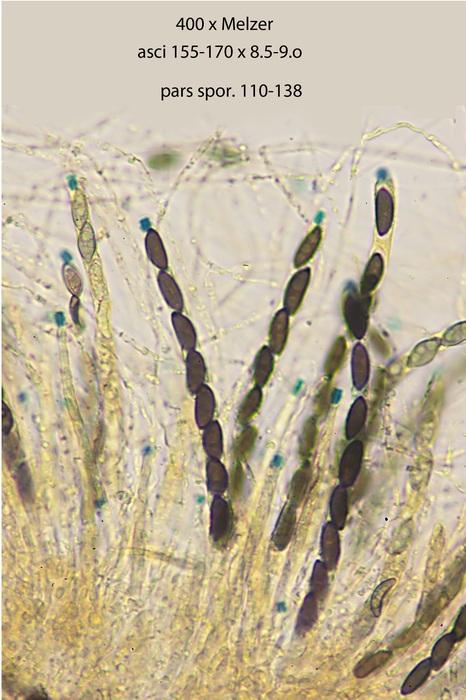
The asci are cylindrical, 8-spored, 155-170 x 8.5-9 microns, pars sporifera 110-138 with a conspicuous apical apparatus Melzer deep blue 5-6 x 4 micr.
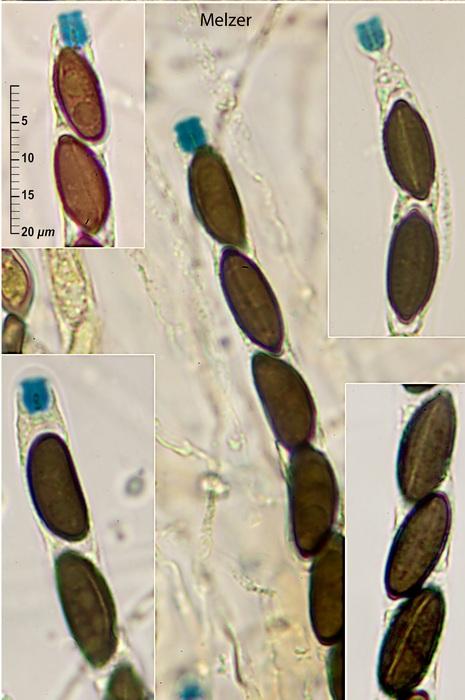
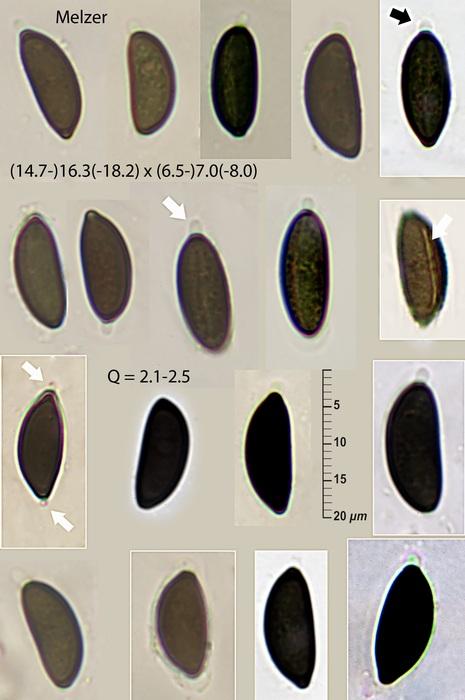
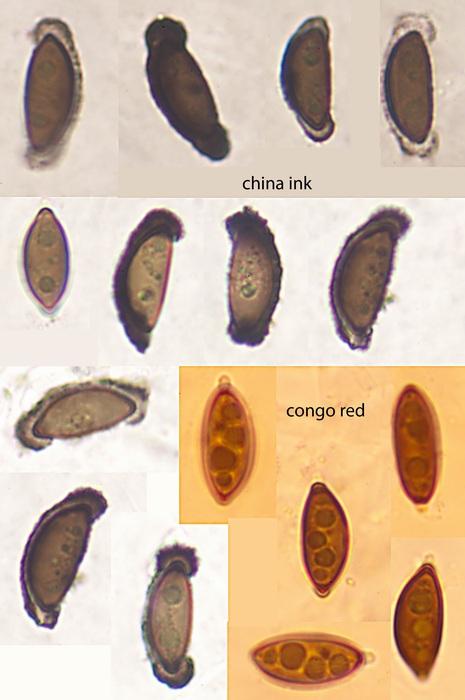
The ascospores are ellipsoid, equilateral, brownish at maturity, with straight germ slit nearly as long as spore, situated on the more convex side, and 1(-2) semiglobose cellular appendage (-s) surrounded by a partial, narrow slimy sheath. (14.7-)16.3(-18.2) x (6.5-)7.0(-8.0); Q = 2.1-2.5
I feel this fungus could be near to Rosellinia akulovii L.E. Petrini but I'd like to know your opinion.
Many thanks in advance for your help

it's good to hear from you and Pedro!
The overall morphology and the ascospores with cellular appendages and germ slit on the convex side clearly set this Rosellinia in the aquila-corticium group. Based on ascospores and apical apparatus dimensions and sheath morphology I would call it R. aquila, even though the ascospores are a bit small. I have seen a wide range of variations in this species, from small-spored collections like yours to large-spored ones grading into R. corticium. They might represent different species but they are difficult to separate based on morphology only.
I do not know R. akulovii for comparison.
Sorry Enrique, I guess you are not going to like my answer!
Cheers,
Jacques
Hi Jacques
No. I like very much your expert opinion on this very difficult genus, at least for me.
Many thanks, Jacques!