
05-05-2026 22:40
Gernot FriebesHi,I believe this is a Plagiostoma growing on a Sa
04-05-2026 18:13
 Stephen Martin Mifsud
ID request for what seems to be a true aquatic fun
04-05-2026 16:39
Stephen Martin Mifsud
ID request: This specimen was collected in Malta o
28-07-2011 18:31
 Alex Akulov
Dear FriendsToday I made the pdf file of Velenovsk
28-04-2026 20:07
 Lothar Krieglsteiner
... on twig in the air at standing Ceratonia siliq
04-05-2026 09:50
 Castillo Joseba
Me mandan el material seco de Galicia,(España) re
02-05-2026 12:42
Alain BRISSARDBonjour à tousJeuidi 30 avril dernier on m'a remi
02-05-2026 13:06
Pauline. PennaBonjour Please can someone help me with this id
01-05-2026 22:45
 Thierry Blondelle
Bonjour à tous, Une récolte sur bouse séchée d
Hopefully there is someone here that can help me with this inconspicuous species I collected on the underside of Platanus x hispanica leaves on 24/4/2016:
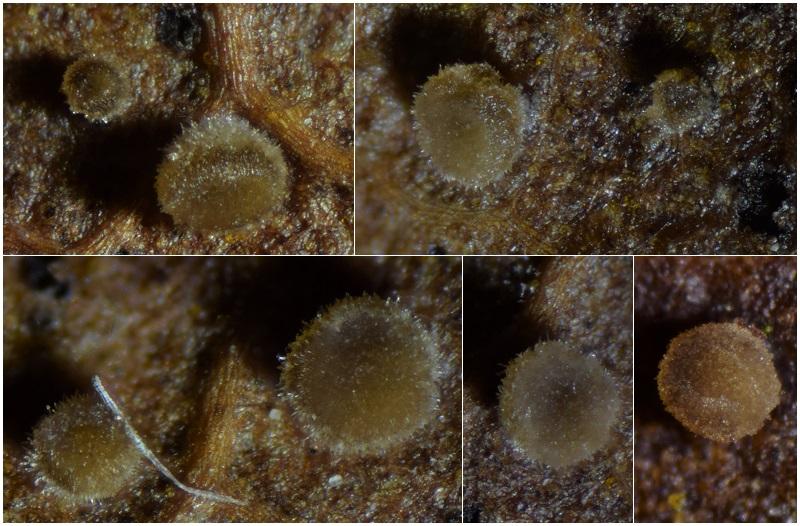
Apothecia up to 0.4mm, smooth to densely hairy
51.128851°N, -0.152131°W 70 metres above sea level
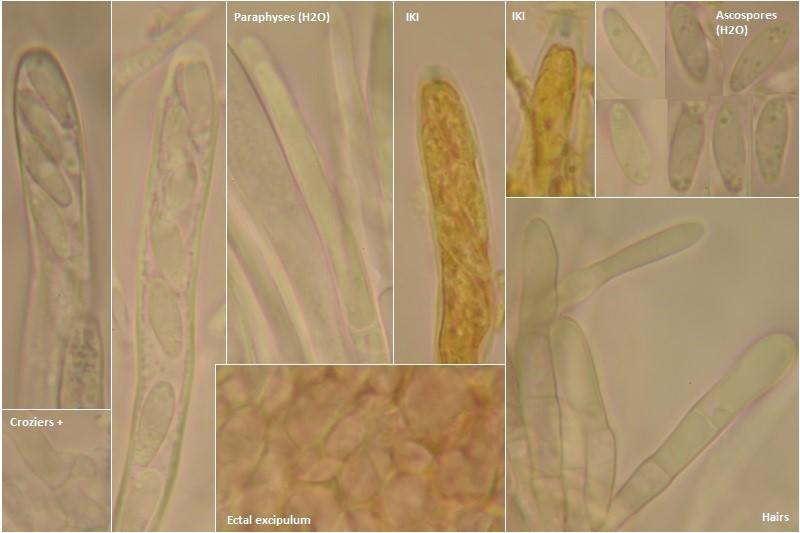
Ascospores 8.1-10.5 x 2.9-4 µm, smooth, hyaline, aseptate, with few small droplets
Asci with croziers, IKI light blue, possibly with Hymenoscypus type ring (?)
Paraphyses with single elongated, +/- refractive vacuole
Hairs when present clavate, smooth, up to 3-septate, end cell with single vacoule.
I have no idea where this species belongs, so any hints whatsoever would be much appreciated!
Amitiés,
Nick

the apical ring looks more Sclerotinaceous to me but about the genus I have currently no idea.
cheers,
Stip

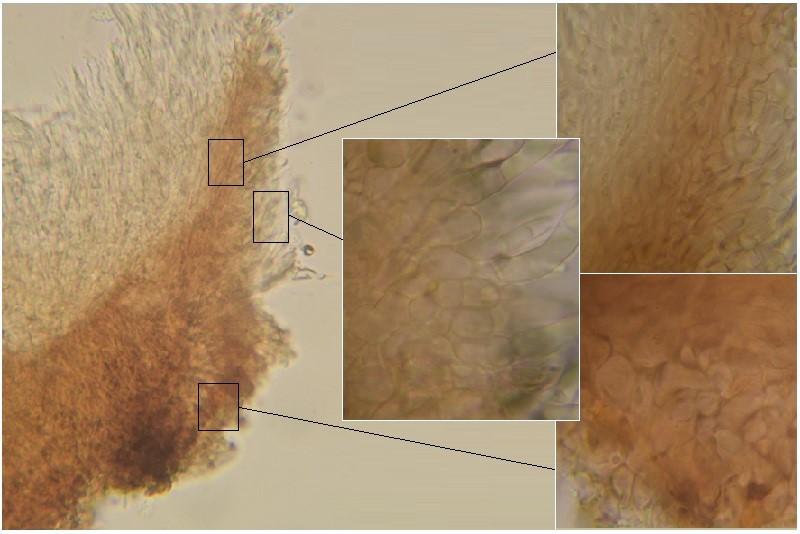
this looks indeed a bit sclerotiniaceous, mainly the basal amyloid protrusion. Could you please characterise the excipulum? Possibly the fungus is related to Moellerodiscus, though being very small and apparently sessile.
Zotto
Thanks for the advice. I had briefly considered Sclerotiniaceae but ended up getting nowhere.
I must admit I haven't grasped the terminology to describe the excipulum, so I'm hoping the picture helps....If not, I can try some more sectioning but I fear I'll end up with less than ten fingers :)
You can see the outside of the apothecium is a rosy-brown colour and which darkens lower down. The point of attachment is black.
Cheers,
Nick
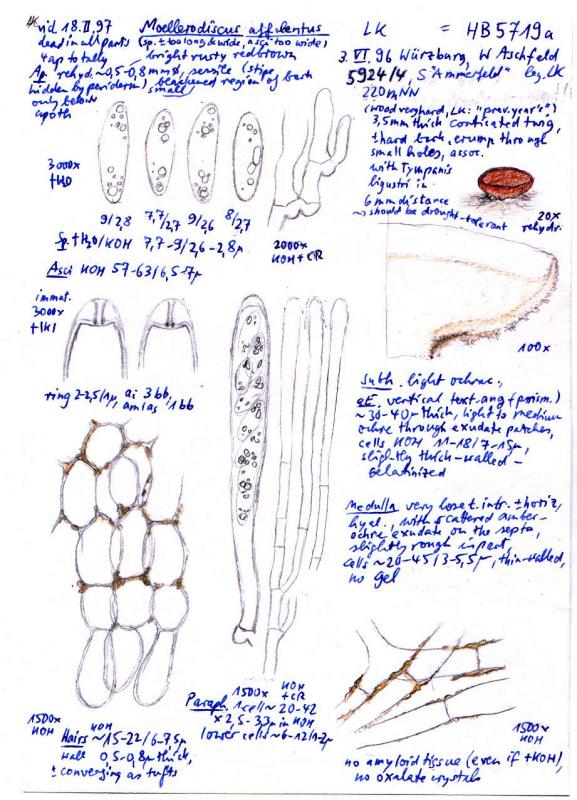
I see there was a similar case of sessile ?Moellerodiscus growing on a twig of Ligustrum which I could study only in the dead state.
Hi Zotto,
ah - I remember this. I think it grew together with Tympanis ligustri there.
Regards from Lothar