

06-04-2026 21:36
 Viktorie Halasu
Hello, could anyone please send me the article wi
06-04-2026 19:40
 David Gibbs
Help with this one much appreciated, on rotting Fa
06-04-2026 11:07
Louis DENYBonjour forum, Trouvé sur bois de feuillu très d
06-04-2026 16:24
Juuso ÄikäsLast Tuesday I found some tiny white Helotiales gr
05-04-2026 20:40
 Robin Isaksson
Hi!Found i Japan on bark of Abies sp. Spores 35-4
06-04-2026 08:15
 Lothar Krieglsteiner
some days ago, on the lower surface of leaf of Que
 Bonjour à tous,
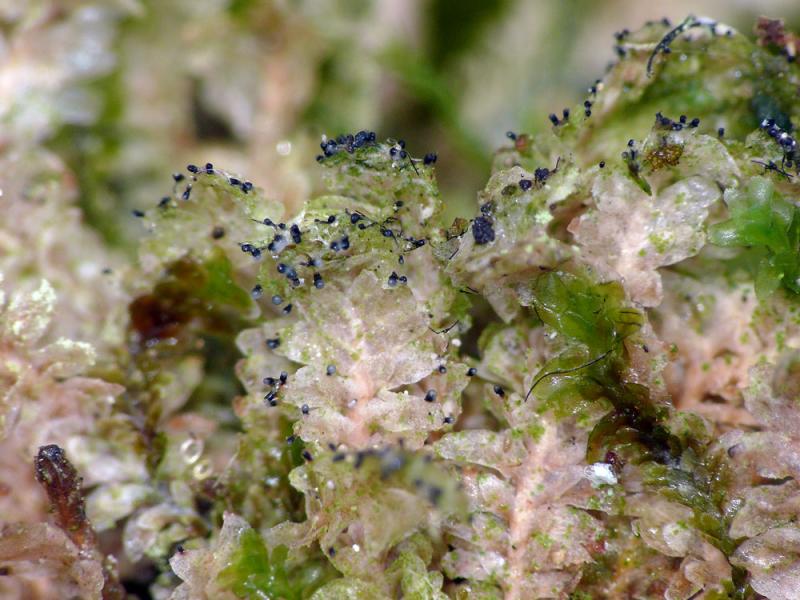
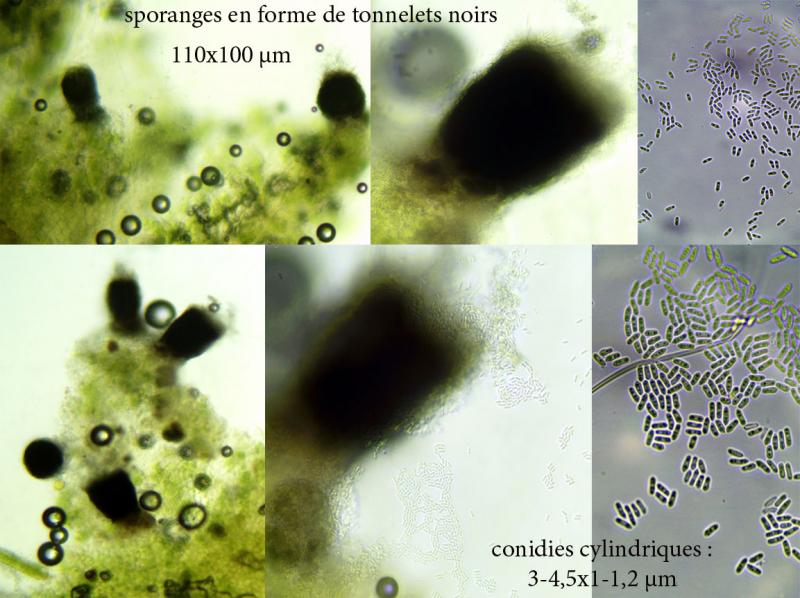
 Quelqu'un aurait-il une idée sur ce champignon imparfait sur feuilles d'hépatique à feuilles (Diplophyllum albicans) ?
Bernard

Best regards,
Bernard
I actually saw this quote from Sclerotium on Diplophyllum albicans. A. Racovitza did an extraordinary work, what a job !
Bernard

Hallo,
I would say the pycnidia belong to the lichenized fungus Micarea botryoides (Nyl.) Hedl. (eventually to a closely related taxon - there may exist undescribed taxa within this group of Micarea)
it is not a rare species on shaded sites, it shows quite a broad ecology, growing on rocks and bryophytes/detritus on them, switching also to shaded bark, it prefers sites protected from rain, dark convex, often tuberculate apothecia are formed not so often
Zdenek
Bernard
I guess, the fungus from the link to a blog is something else, synnematose, indeed.
In this case I expect pycnidia of Micarea.
Micarea botryoides is quite a common lichen and superficially may resemble a synnematous non-lichenized fungus. Most species of Micarea contain a small-celled 'micareoid' alga (with cell 4-7 um) so you may check this. Pycnidia of M. botryoides also should contain 'cinereorufa-green' pigments that are reddish-purplish with adding of nitric acid, and intensifying green with KOH
See also the exceptional monograph on Micarea by Coppins (1983) for pycnidia and other details on ecology , morphology , taxonomy: https://ia801406.us.archive.org/17/items/bulletinofbritis11britlond/bulletinofbritis11britlond.pdf
