
09-04-2026 15:25
Jac GelderblomOn bare soil between mosses Ifound an asco I deter
09-04-2026 13:55
Thomas Læssøehttps://svampe.databasen.org/observations/10589176
09-04-2026 10:12
Thomas Læssøehttps://svampe.databasen.org/observations/10587061
08-04-2026 20:33
 Vasileios Kaounas
Found 07-04-26, in Abies cephalonica. Diameter 1,
08-04-2026 10:39
FRANCIS FOUCHIERBonjour , je recherche en pdf cet article: KORF R

06-04-2026 21:36
 Viktorie Halasu
Hello, could anyone please send me the article wi
06-04-2026 19:40
 David Gibbs
Help with this one much appreciated, on rotting Fa
 Hello
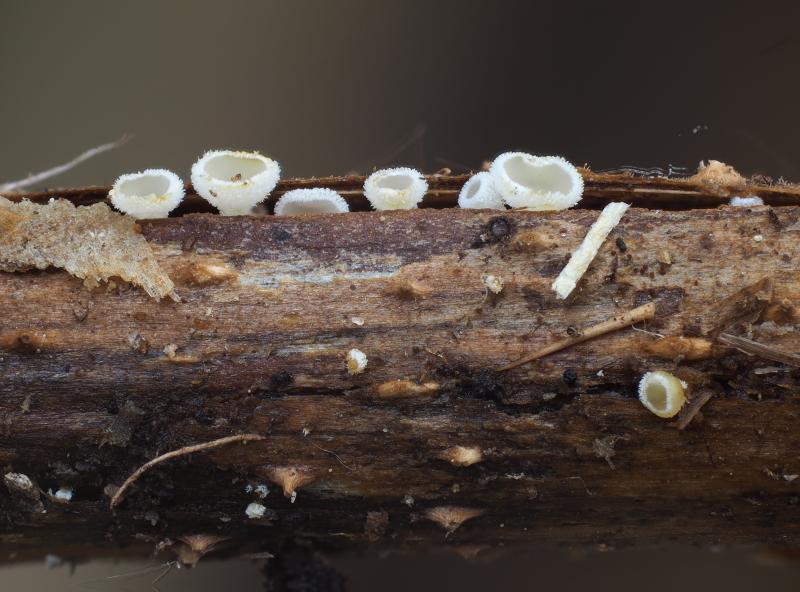
HelloI have found this nice Lachnum on last years stem of Rubus idaeus. I firstly thought it was L. clavigerum, but it has a colour change - first yellow as seen on the photo later red-brownish. Also the spores are to big.
Sp. elipsoid-flattened elipsoid, 9-12 x 2-2,5. Asci approx. 55 x 4 µm without croziers, J+ (blue). Hairs cylindrical with warts/spines, some with crystals on the top. Paraphyses fusiform 3,5 µm broad
Cheers
Rasmus

Hello Rasmus,
in Lachnum you should first note 3 things:
- croziers (you did and say no)
- contents of living paraphyses (and hairs) - with or without a large amount of vacuolar guttules. I suggest: no
- crystals on the hairs. You do not mention then, so I think no.
L. clavigerum (as far as I have it in my mind correctly) has crystals on the hairs. I never found it on Rubus, but (as far as I remember) on Epilobium angustifolium.
The most common species on Rubus is L. virgineum - what do you think?
Best regards, Lothar
Thanks for the comments!
A lot of the hairs does in fact have crystals on the top. Also the colour change when bruised is quite distinct and not present in L. virginum as far as i know.
Best regards
Rasmus

I have a clavigerum folder for Rubus idaeus, with several samples (including HB 8585).
The spectrum of the species includes also Aruncus etc. I am not sure if there are any clear differences between the substrates, except for spore size:
9-11 x 2-2.5 on Rubus
6-9 x 1.7-2 on Epilobium/Aruncus
So perhaps two species?
Rasmus' description includes crystals. The colour change would point to VBs in the paraphyses and hairs, but for a species with crystals this is impossible. Actually, a yellowish-cream disc is not unusual in L. clavigerum.
Zotto