
09-04-2026 15:25
Jac GelderblomOn bare soil between mosses Ifound an asco I deter
09-04-2026 13:55
Thomas Læssøehttps://svampe.databasen.org/observations/10589176
09-04-2026 10:12
Thomas Læssøehttps://svampe.databasen.org/observations/10587061
08-04-2026 20:33
 Vasileios Kaounas
Found 07-04-26, in Abies cephalonica. Diameter 1,
08-04-2026 10:39
FRANCIS FOUCHIERBonjour , je recherche en pdf cet article: KORF R

06-04-2026 21:36
 Viktorie Halasu
Hello, could anyone please send me the article wi
06-04-2026 19:40
 David Gibbs
Help with this one much appreciated, on rotting Fa
asco on Angelica sylvestris
Franz Berger,
27-05-2020 20:00
 Dear ascofreaks!
 I cant even find a correct genus:
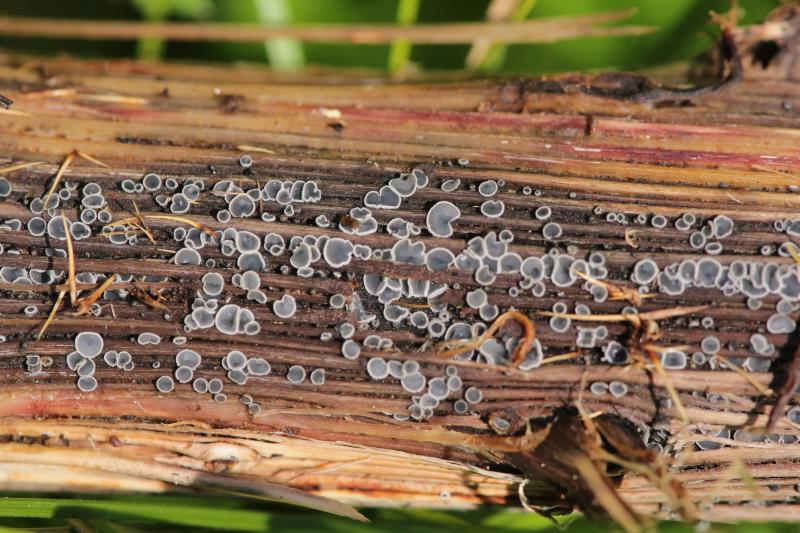
Apo 0,7 mm, On base of old dead stem of Angelica sylvestris in a bog. Foto in moist state, dry the hairy white rim distinctly more prominent and the black disc (when dry!) sunken and due of the retraction more of the hairy dark grey exciple visible.
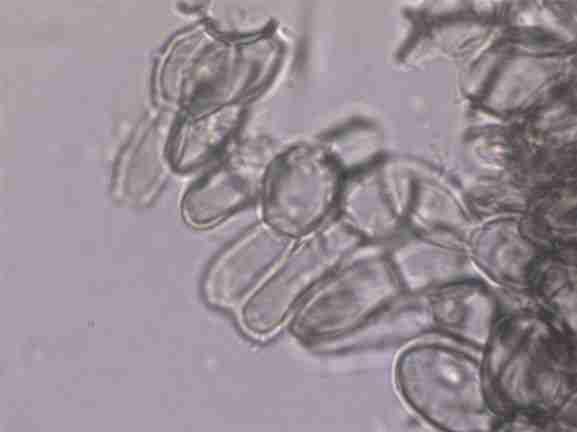
epihymenium grainy black, grains soluble in KOH, hymenium 60 µm, hyalin insperse, exciple paraplect., outside covered with short club shaped "hairs".
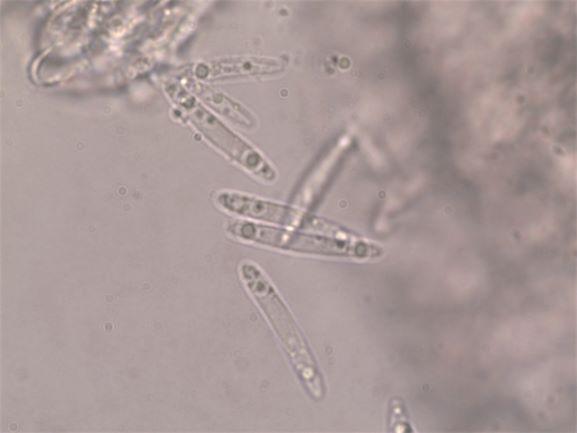
asci cylindrical, 60x 5-6 µm, unitunicate, 8 spores biseriate, tip J neg., spores hyaline, aseptate, straight to slightly bent, 17-19x3 µm, obtuse, with small oil droplets only in both tips.

Hans-Otto Baral,
27-05-2020 20:07

Re : asco on Angelica sylvestris
Dear Franz
this is not easy without microphotos. Did you see the paraphyses? Do they contain refractive contents? From this it depends whether it is a Mollisia or Pyrenopeziza.
When already dried, this will not be as easy as in the fresh state.
The spores are rather large, so it is not the common P. atrata.
Zotto
Franz Berger,
27-05-2020 20:27
Re : asco on Angelica sylvestris
AHA, not the paraphyses are inspers, but the overlaying asci in not perfect hand-cut section with their ascospores are containing the refractive droplets.
Hans-Otto Baral,
27-05-2020 21:06
Re : asco on Angelica sylvestris
Hmm, I cannot imagine what you saw :-( You do not have the possibility for microphotos?
Franz Berger,
28-05-2020 09:22
Re : asco on Angelica sylvestris
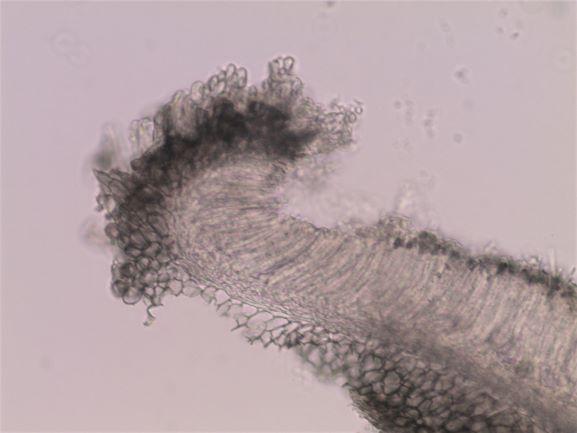
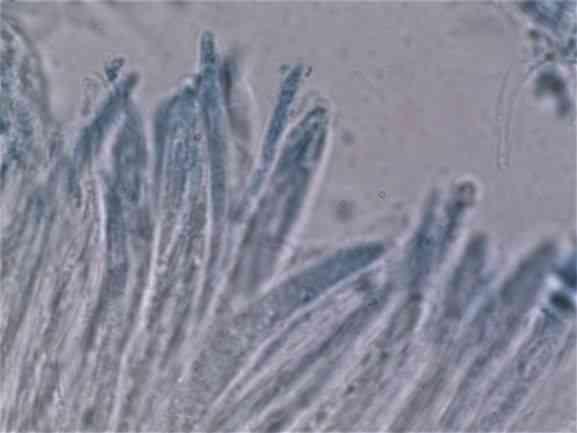
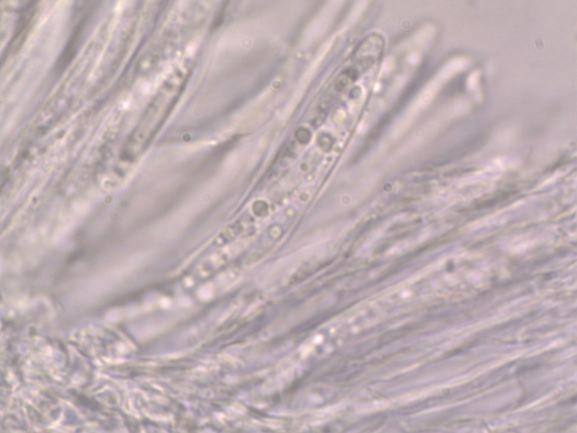
no real paraphyses visible , only empty asci?
the insperse hymenium is caused by dense asci and the oildropletes of ascospores and not by paraphyses
the insperse hymenium is caused by dense asci and the oildropletes of ascospores and not by paraphyses
Hans-Otto Baral,
28-05-2020 10:01
Re : asco on Angelica sylvestris
This is now very helpful. The greybrown excipulum of angular cells clearly points to a Pyrenopeziza, also the long-conical ascus apices. Paraphyses are well visible on your 2nd pic but they are dead - impossible anymore to see the relevant contents.
Interesting species, not easy to ideintify. Species on dicot stems exist a lot, many are host specific, others not. You can look in my subfolder "Pyrenopeziza on herbaceous dicots" in folder Ploettnerulaceae of Helotiales. I should insert more spore sizes to the folder names to a more rapid search. P. carduorum is a species with similar spores but perhaps only on Asteraceae.
Franz Berger,
28-05-2020 10:10
Re : asco on Angelica sylvestris
Thank You very much for Your help!