Accès membres

Mot de passe perdu? S'inscrire

09-04-2026 15:25

Jac Gelderblom

On bare soil between mosses Ifound an asco I deter

09-04-2026 13:55

Thomas Læssøe

https://svampe.databasen.org/observations/10589176

09-04-2026 10:12

Thomas Læssøe

https://svampe.databasen.org/observations/10587061

08-04-2026 20:33

Vasileios Kaounas Vasileios Kaounas

Found 07-04-26, in Abies cephalonica. Diameter 1,

08-04-2026 10:39

FRANCIS FOUCHIER

Bonjour , je recherche en pdf cet article: KORF R

06-04-2026 15:04

David Chapados David Chapados

Hi! Could someone help me identifying this specim

29-06-2016 15:18

Per Vetlesen

HiIt was found on the bark of a dead branch of Jun

07-01-2018 22:47

Per Vetlesen

Grown in moist chamber on bark/resin of fallen Pin

06-04-2026 21:36

Viktorie Halasu Viktorie Halasu

Hello, could anyone please send me the article wi

06-04-2026 19:40

David Gibbs David Gibbs

Help with this one much appreciated, on rotting Fa

« < 1 2 3 4 5 > »
Lachnum pudibundum on Filipendula
Stefan Jakobsson, 18-06-2020 22:01
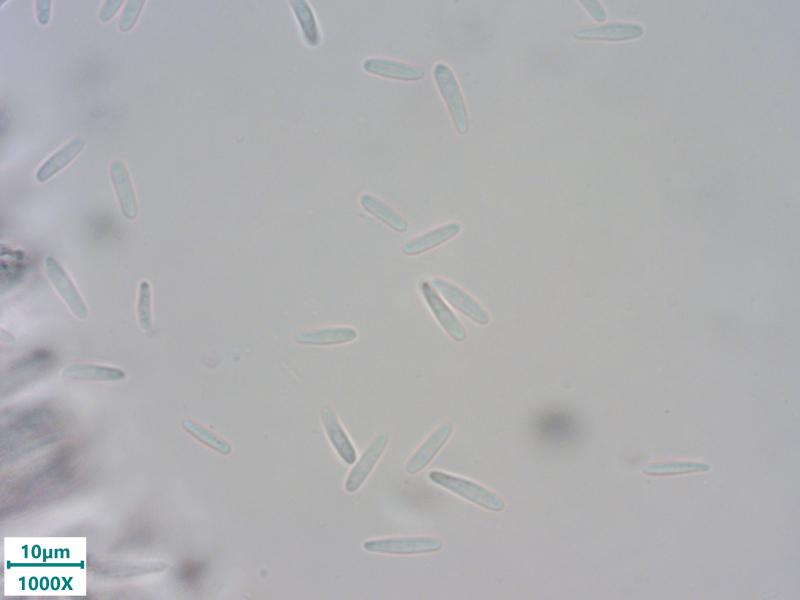
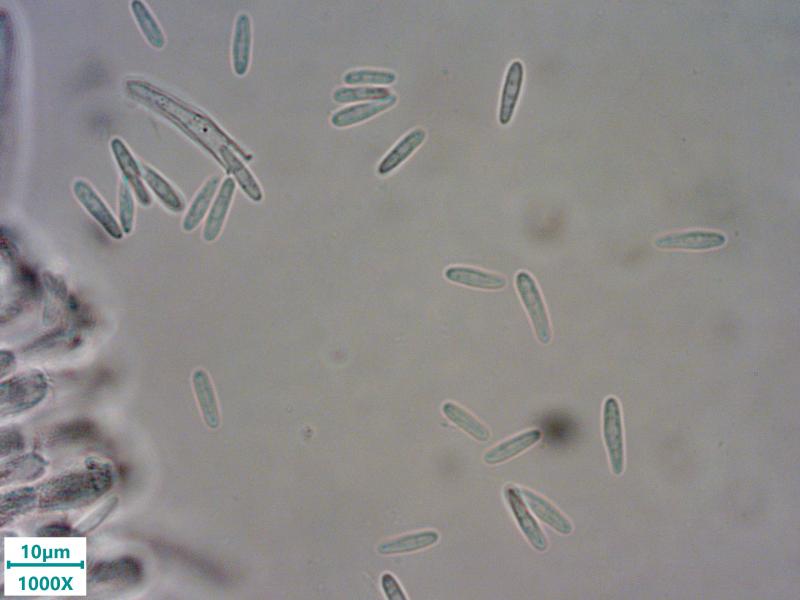
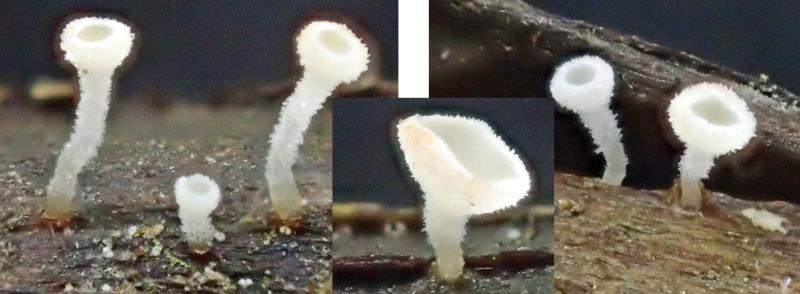
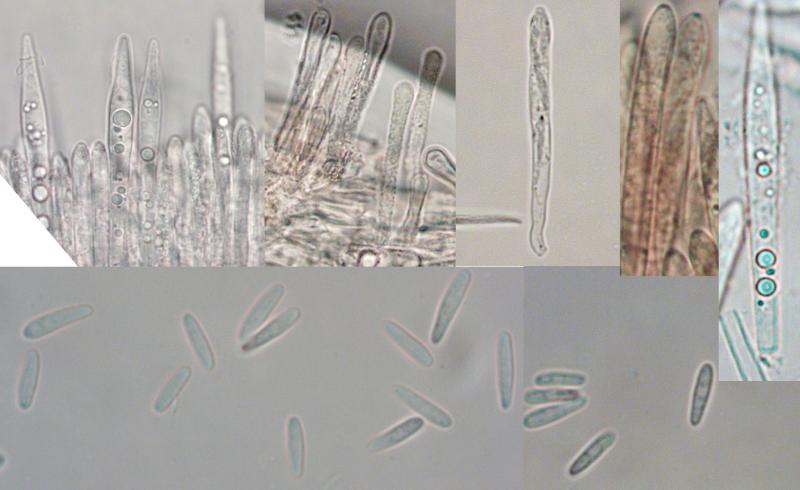
Here a Lachnum I am not quite sure about. It is white, to 0,6 mm diameter and stipe up to 0,9 mm. The surface blushes slightly on damage. The hairs are cylindrical or slightly clavate, fairly short, 20-50x3-4 µm, no chrystals. Eight spored, no croziers. The spores have no droplets:

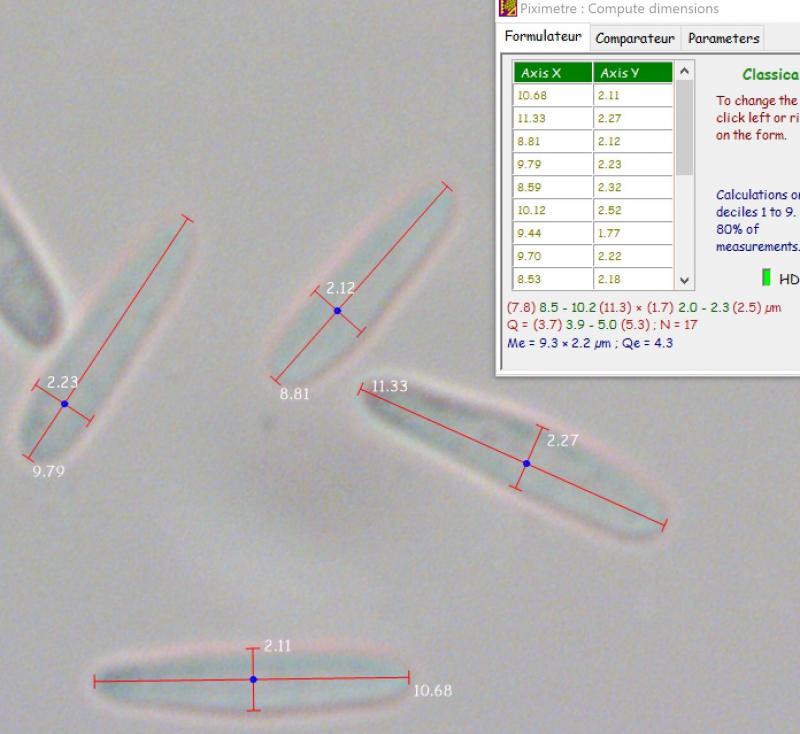
(6.7) 8.2 - 10.4 (11.4) × (2.0) 2.05 - 2.6 (2.8) µm
Q = (3.2) 3.6 - 4.5 (4.7) ; N = 37
Me = 9.2 × 2.3 µm ; Qe = 4.0


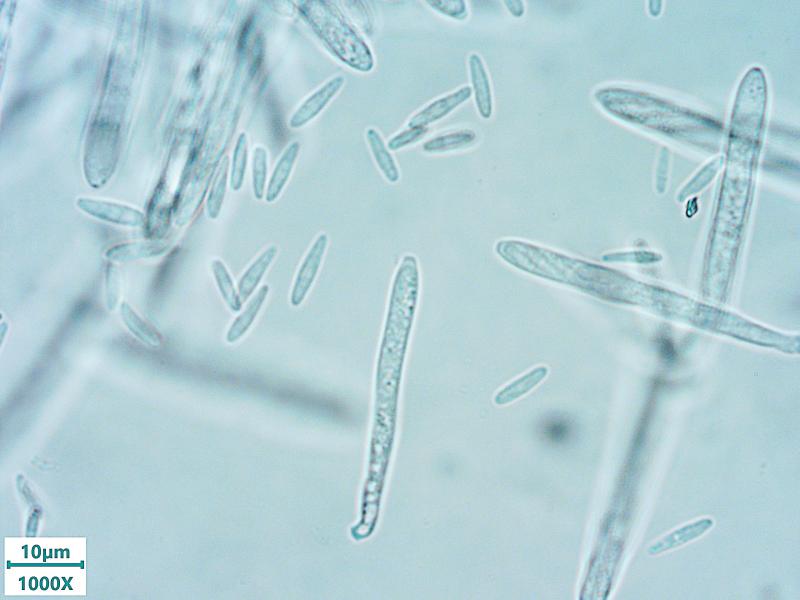
The paraphyses are 50-65 x 4.7-6, with one or two bigger and some smaller droplets, protruding some 15-25 µm.


With these features I end up in subkey 4 of Zotto's key and there step 3 with three lignicolous species and an "unclear collection from Filipendula". This one was most probably growing on Filipendula ulmaria on a wet and swampy lake shore.


I compared to an L. pudibundum i found some weeks ago (on Prunus padus) and the main difference seems to be that the hairs are not capitate (with the exception of one hair) and the paraphyses are marginally more protruding. Is a host switch to Filipendula possible for L. pudibundum?
  • message #63740
  • message #63740
Hans-Otto Baral, 18-06-2020 22:33
Hans-Otto Baral
Re : Lachnum pudibundum on Filipendula
Hmm, I agree with the similarity with L. pudibundum.

In my key I cannot find Filipendula mentioned.

Filipendula stems are quite easily recognized from its smooth surface, not sure if this one is something else.

Zotto
Stefan Jakobsson, 18-06-2020 22:51
Re : Lachnum pudibundum on Filipendula
I peeled off the smooth top layer as the apos where in a crack under it.

This is what my key says.
  • message #63743
Hans-Otto Baral, 19-06-2020 09:27
Hans-Otto Baral
Re : Lachnum pudibundum on Filipendula
You are right, I looked in the wrong (old) version.

The collection from Marais Poitevin is unpreserved and I only made a few notes: Apoth. faintly changing red-brown, stipe up to 0.5 x 0.07 mm, spores *7-10 x 1.6-1.8, lipid 0-1, hairs 40-60, apex not or mostly slightly inflated (clavate), no crystals. Paraphyses broadly lanceolate, strongly protruding (no contents stated).

So yours has broader spores. But do you have a scale? I would like to remeasure the width.
Stefan Jakobsson, 19-06-2020 10:35
Re : Lachnum pudibundum on Filipendula
Here three photos with a scale. The scale is a bit strange though - you should pick e.g. the lefthand side margin of the two vertical end bars to get 10 µm.
  • message #63748
  • message #63748
  • message #63748
Hans-Otto Baral, 19-06-2020 12:29
Hans-Otto Baral
Re : Lachnum pudibundum on Filipendula
Thanks! With this I get 7.5-10.5 x 1.8-2(-2.2) which is closer to my measurements.
Stefan Jakobsson, 19-06-2020 13:10
Re : Lachnum pudibundum on Filipendula
Well, that is interesting, thank you! It seems I am doing some kind of systematical error then.
  • message #63751
Hans-Otto Baral, 19-06-2020 16:46
Hans-Otto Baral
Re : Lachnum pudibundum on Filipendula
These values I can confirm when taking the length as valid.
Stefan Jakobsson, 19-06-2020 19:28
Re : Lachnum pudibundum on Filipendula
Thank you for your help! Your notes match my fungus so well that I take it that they are the same. I'll will preserve it as Lachnum sp. (aff. pudibundum).