
12-06-2026 14:50
 François Freléchoux
Bonjour, Voici la brève description d'une Mollis
10-06-2026 21:16
François Freléchoux
Bonsoir,Le dernier du jour, en attendant votre avi
11-06-2026 19:01
 William Slosse
Hello all,In an attempt to make a culture of a sus
11-06-2026 19:03
 Nicolas VAN VOOREN
Chers membres d'Ascofrance,Le site sera placé en

09-06-2026 18:32
Camille MertensSur morceau de roseau immergé 0,5 - 0,7 mm de dia
10-06-2026 12:54
Steve ClementsBonjour encore, Pouvez-vous m'aider, s'il vous pl
10-06-2026 21:07
François Freléchoux
Toutes les tiges de gentianes jaunes de l'an passÃ
10-06-2026 13:41
François Freléchoux
Bonjour à nouveau, Voici une trouvaille d'hier.
Arachnopeziza aurata ?
Roland Labbé,
25-02-2009 00:42
Voici une planche d'un disco que je crosi être Arachnopeziza aurata.
Il est possible que ce soit aussi A. delicatula.
Qu'en pensez-vous ? Merci.
Détails :
Date de récolte: 2009 / 02 / 16
Culture intérieure sur bûche en décomposition d'érable à sucre
Sporée non disponible
Ascome 0,2-0,7 mm de diam.
Spores cylindriques, arrondies à une extrémité et effilées à l'autre, à 5-7 septa, lisses, contenant de petites guttules, 10-20% environ du volume total, hyalines en NaCl iso., 45-68 x 2,5-3 µm, 59,2 x 2,8 µm (10 spores), Q = 21,14, possiblement incomplètement matures
Asques à 8 spores unisériées, avec un crochet à la base, à appareil apical amyloïde, 80-100 x 10-12 µm
Paraphyses cylindriques, parfois fourchues vers la base, septées, contenant environ 10-20% de guttules, hyalines, 1-1,5 µm de diam.
Poils fusoïdes, à paroi plutôt épaisse, incrustés, formés de cellules ellipsoïdes caténulées à la base (?), 150-250 x 4-5 µm
Excipulum en textura globulosa- angularis, formé de cellules à paroi épaisse
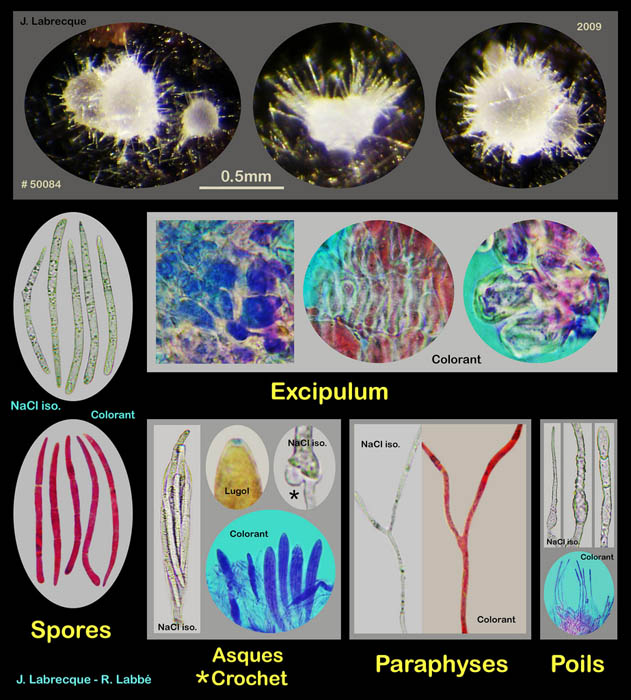
Richard Korf,
25-02-2009 06:34
Re:Arachnopeziza aurata ?
I think there is no doubt that this is A. aurata rather than A.delicatula.
Dick Korf
Dick Korf
Roland Labbé,
26-02-2009 16:27
Re:Arachnopeziza aurata ?
Thank you Dick.
What's about var. alba of this species ?
Roland
What's about var. alba of this species ?
Roland
Richard Korf,
26-02-2009 21:48
Re:Arachnopeziza aurata ?
I am currently in California, and cannot consult my notes. I'm not even sure I ever examined Grelet's type. In my experience there is a great deal of variation in pigmentation of the apothecia, "aurata" being more the exception as a color description than the rule. Certainly many collections show no or little coloration at all, and would qualify as "alba" when described. I'd surely want to examine Grele's description and the type(now in PC I believe) before deciding on what he described being what you have.
Dick
Dick
Roland Labbé,
26-02-2009 23:07
Re:Arachnopeziza aurata ?
Thank you Dick.
Roland
Roland