
12-11-2019 10:32
 Miguel Ángel Ribes
Hi againExactly at the same place than my previous
25-12-2019 17:54
Valencia Lopez Francisco JavierHola a todos/asEstas supuestas pezizas estaban en
28-07-2011 18:31
 Alex Akulov
Dear FriendsToday I made the pdf file of Velenovsk
12-07-2015 00:05
 Nedim Jukic
This one from the same locality as the previous on


30-05-2026 21:12
Philippe PELLICIERSur branche de mélèze (Larix) près de la neige,
31-05-2026 10:35
Hulda Caroline HolteHello,I collected this species growing on a rather
25-05-2026 16:35
 Bernard CLESSE
Bonjour à toutes et tous,J'ai trouvé récemment,
29-05-2026 15:35
daniel FERREBonjour à tous,Je voudrais votre aide pour cette
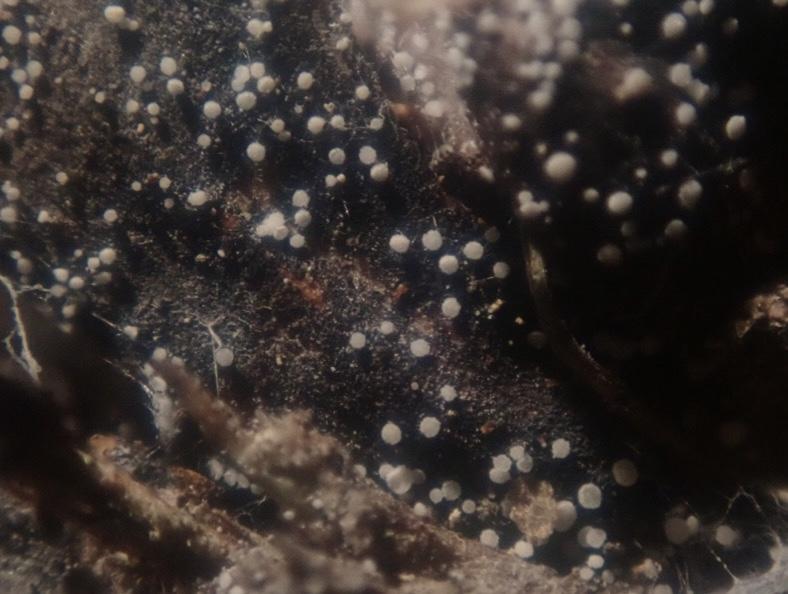
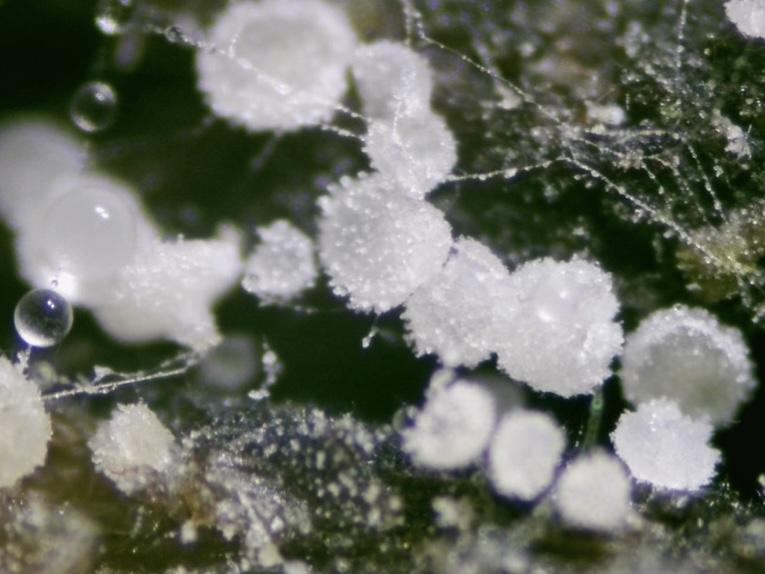
I found and collected this species growing on Pinus sylvestris cones on the 8th of February, in Buskerud county, Norway. The temperature was around -10° C when I collected the specimen, but the apothecia quickly revitalised when put in a moist plastic bag in the fridge.
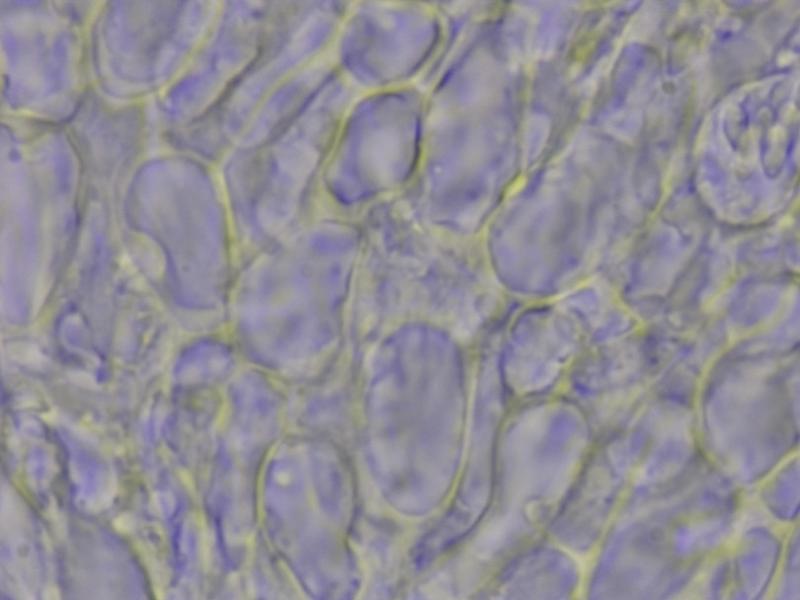
The largest apothecia measure 400 µm diameter and have an approximately 100 µm long stalk.
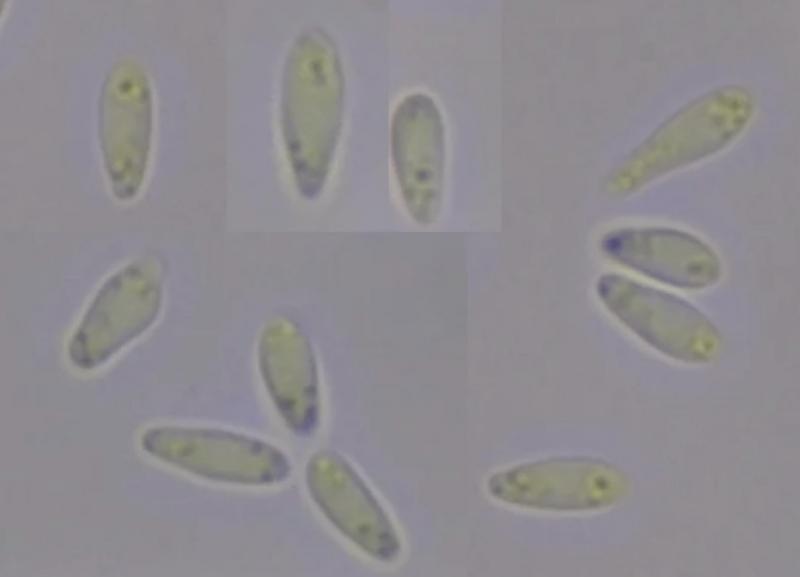
The ascospores have many small LBs. OCI about 2 (3)
(5,8) 6,7-7,7 (8,6) x 1,9-2,4µm
Mean= 6,81 x 2,2µm
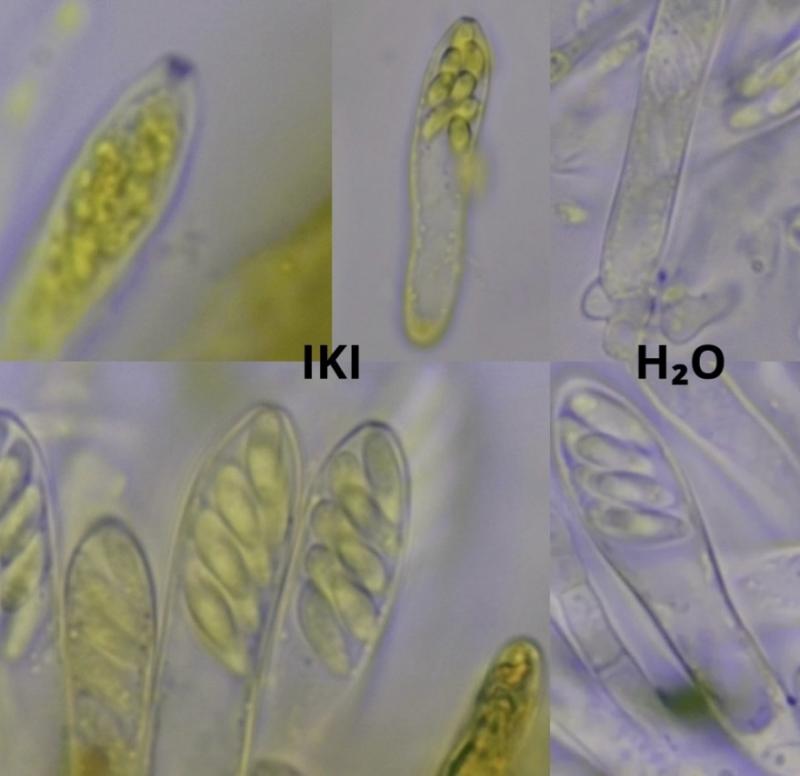
Asci with croziers IKI+ Most asci react blue, but some turn reddish (even where I would assume that the concentration of iodine would be the same, see photo)
(34,6) 36,5-43,2 x (5,3) 5,8-7,7 µm
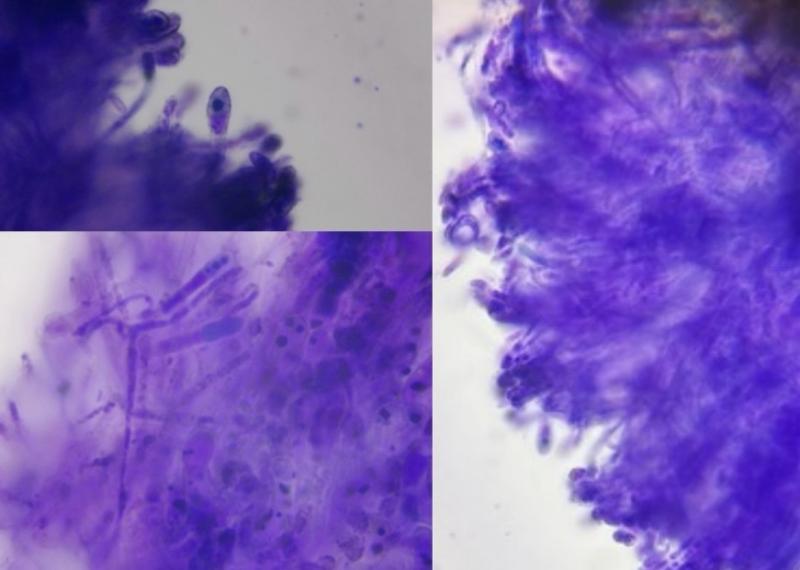
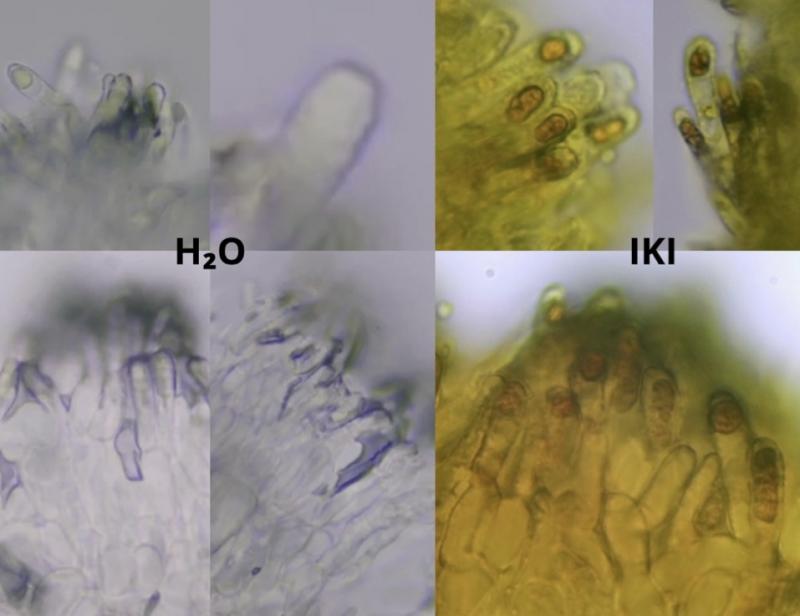
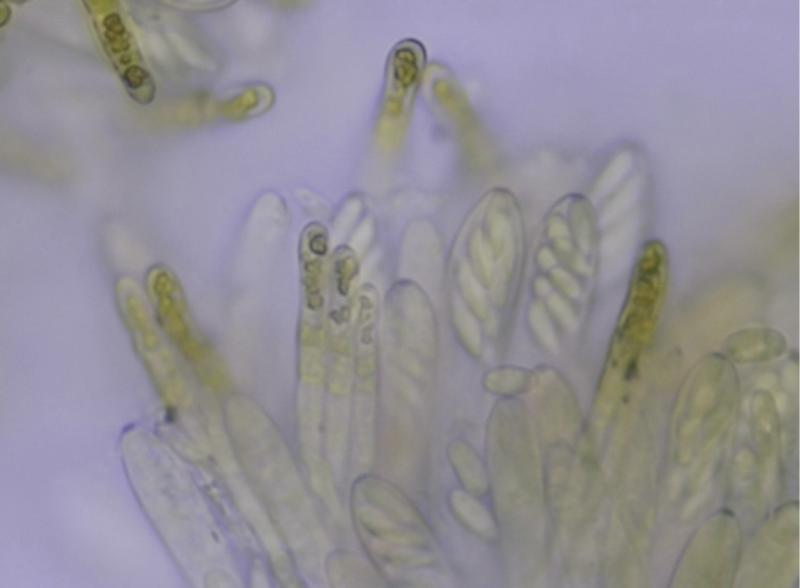
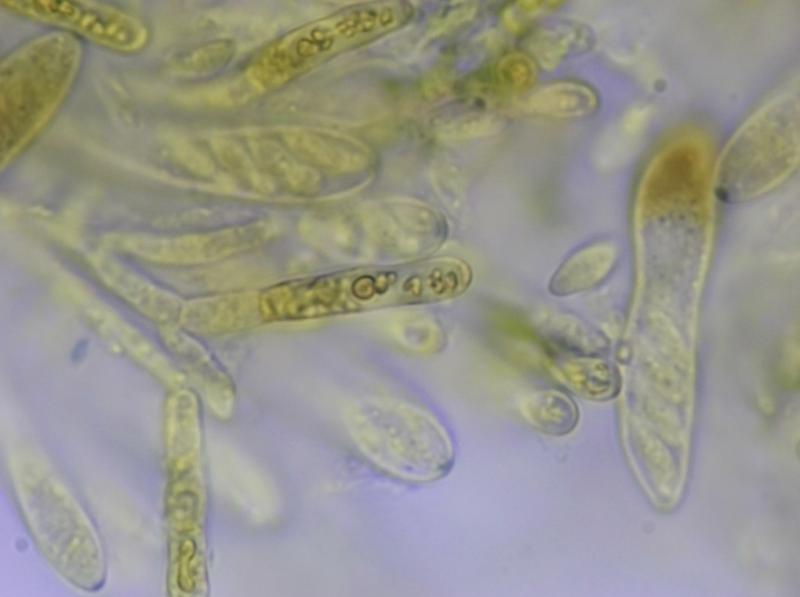
The paraphyses are cyllindric-clavate, septate and have a large refractive vacuole (?). The vacuole (?) partially dissolves and turns golden in IKI. It does not stain readily in CRB (even after multiple minutes), but I have seen some dark blue spots (metachromatic bodies?) especially after adding KOH to the other side of the slide. The paraphyses measure up to 3,3 µm at the tips.
The hairs are slightly rough and measure 3,2-4 µm at the apex. Most of the hairs contain a more or less globular body which turn amber in IKI.
The spore measurements were taken from newly discharged spores in a water mount. All measurements were taken from living cells.
Does anyone have an idea as to which species, or even genus this might be?
Thank you in advance and best regards,
Hulda
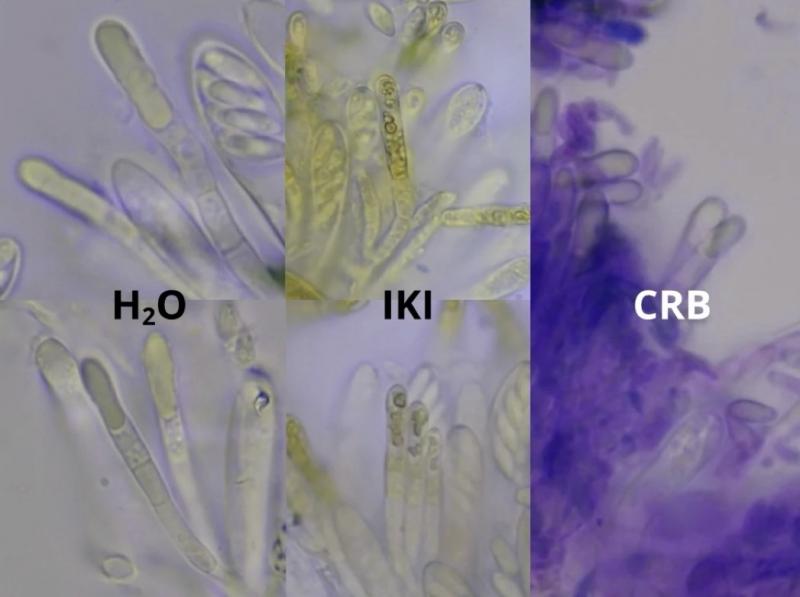

Ciliolarina seems like a good suggestion. Is there anything that I can check to narrow it down further?
I read in your "Vital versus herbarium taxonomy" that "CRB never induces the formation of MCs but rather stains the bodies in a homogeneous turquoise-blue" (pg 364). In the CRB mount that I added KOH to (closer to the KOH than the photos shown here) I observed a turquoise color (not shown in the photos) a few seconds before the cells died and the color disappeared. I did not observe the strong turquoise color elsewhere. Can VBs sometimes get dark blue spots in CRB instead of staining turquoise?
Kind regards, Hulda
Kind regards, Hulda

Nice description!
"The ascospores have many small LBs. OCI about 2 (3)
(5,8) 6,7-7,7 (8,6) x 1,9-2,4µm
Mean= 6,81 x 2,2µm"
Are the spores really that narrow?
Could you show the brown IKI reaction of the vacuoles in the paraphyses again in a larger area?
Thank you and greetings
Ingo
The asci in the previous water mount kept ejecting new spores and created shifting in the water that moved the spores and made them difficult to measure. Hence, I could not be 100% sure that the measurements were correct so I have now I measured the spores again. This time from a fresh spore print.
These are the new measurements:
(5,3) 5,8-7,2 (7,7) x (2,1) 2,2-2,9µm
Mean= 6,45 x 2,51µm
I have added photos of the paraphyses in a larger area as requested. Let me know if these are insufficient. I have also added a photo of the spores from the spore print in CRB.
Kind regards, Hulda

Thanks for the new fotos and measurment.
"The asci in the previous water mount kept ejecting new spores and created shifting in the water that moved the spores and made them difficult to measure."
Spore measurements using a spore image are simpler and more accurate.
"Let me know if these are insufficient."
The micro-images would be perfect if a scale were integrated.
With your new measurments and photos fits your find with a Ciliolarina-species with the provisional name Ciliolarina "IKI bb H+ VB IKI-"
https://drive.google.com/drive/u/0/folders/0B5SeyOEkxxZhdVRlWGVQNE9qYkk?tid=0B5SeyOEkxxZhYVZub0N1aGY5YTg&resourcekey=0-mAZI-5ORfpJ7IfGOYR2caA
The vacuoles of this species do not stain reddish-brown or bluish with IKI.
Discolorations with IKI, as shown in the following link, must not be present.
https://asco-sonneberg.de/pages/gallery/ciliolarina-violette-vakuolen-260208jj43130.php
Of course, it's also possible that it's a different species of Ciliolarina. Sequences will have to show that.
Greetings
Ingo
I currently only have a simple camera setup that ensures that the spore photos are of the same size relative to each other, but I hope to obtain equipment for measuring photos and adding scales soon.
I have looked at the images in the linked folder and found one collection (HB62246E) that has a note: “IKI deep redbrown” about the paraphyses and “IKI 2bb/(r)b” about the asci. This would also fit my collection.
Unfortunately, I do not have access to sequencing so it will have to stay a Ciliolarina sp.
Kind regards, Hulda