Accès membres

Mot de passe perdu? S'inscrire

11-09-2025 16:57

Jason Karakehian Jason Karakehian

Our revision of Marthamycetales (Leotiomycetes) is

12-11-2019 10:32

Miguel Ãngel Ribes Miguel Ángel Ribes

Hi againExactly at the same place than my previous

25-12-2019 17:54

Valencia Lopez Francisco Javier

Hola a todos/asEstas supuestas pezizas estaban en

28-07-2011 18:31

Alex Akulov Alex Akulov

Dear FriendsToday I made the pdf file of Velenovsk

12-07-2015 00:05

Nedim Jukic Nedim Jukic

This one from the same locality as the previous on

28-08-2014 18:36

Rubén Martínez-Gil Rubén Martínez-Gil

Hola a todos. Subo unas fotos de un asco que enco

31-05-2026 22:53

éric ROMERO éric ROMERO

Bonjour tous, Je n'ai pas d'idée pour cette esp

30-05-2026 21:12

Philippe PELLICIER

Sur branche de mélèze (Larix) près de la neige,

31-05-2026 10:35

Hulda Caroline Holte

Hello,I collected this species growing on a rather

25-05-2026 16:35

Bernard CLESSE Bernard CLESSE

Bonjour à toutes et tous,J'ai trouvé récemment,

« < 1 2 3 4 5 > »
Pseudaegerita spec.
Marian Jagers, 22-04-2026 20:17
Marian Jagers
Is anyone familiar with the Hyphomycetes genus Pseudaegerita and possibly willing to studie my find?

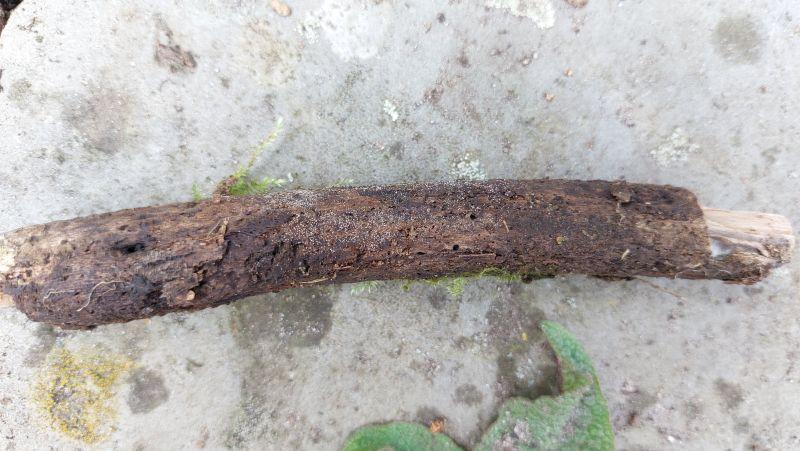
Found in a strip along a stream on on moist wood of strongly decating trunk of Cytisus scoparius; trunk ± 2 cm diam.

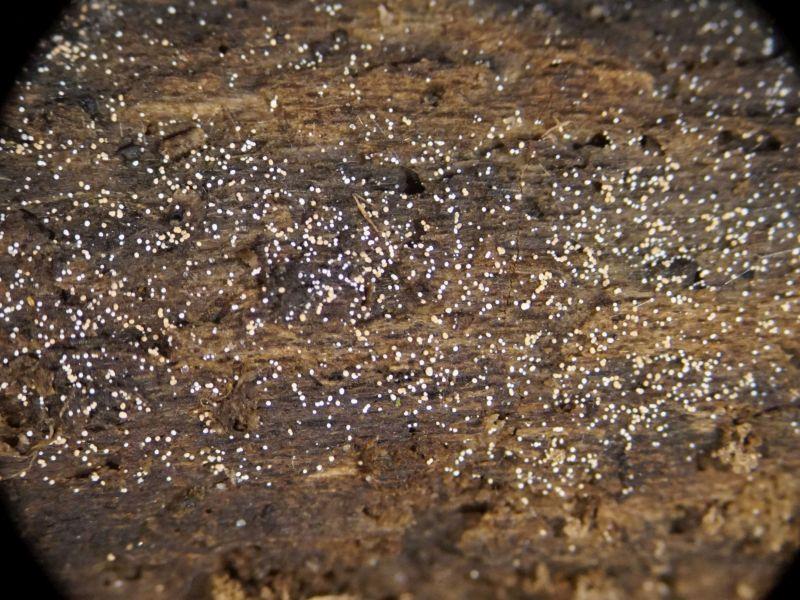
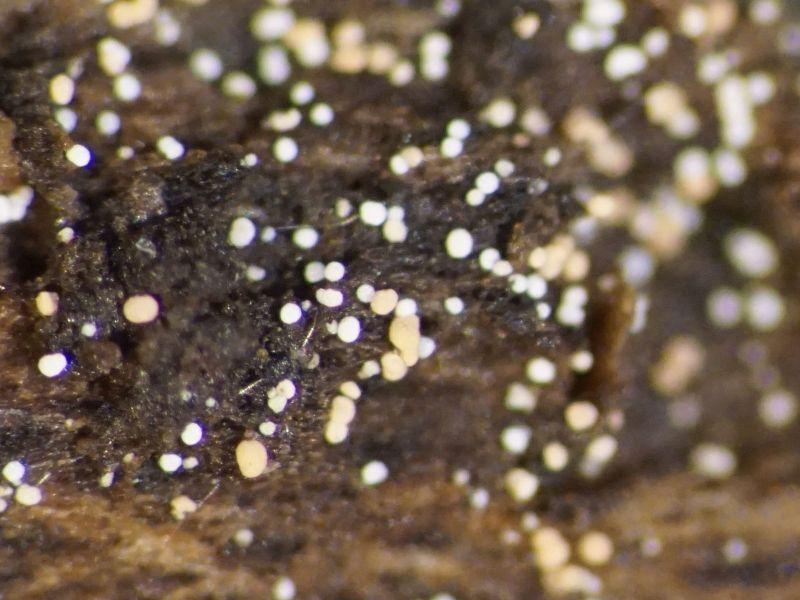
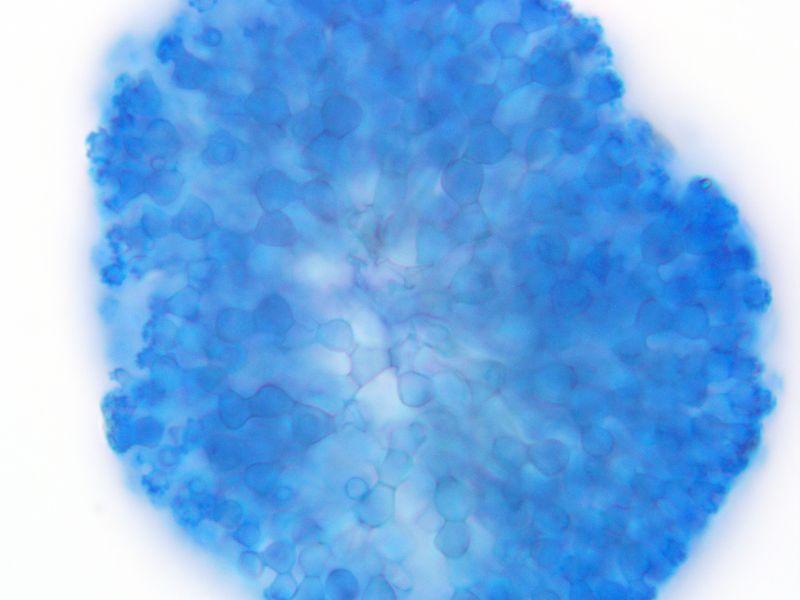
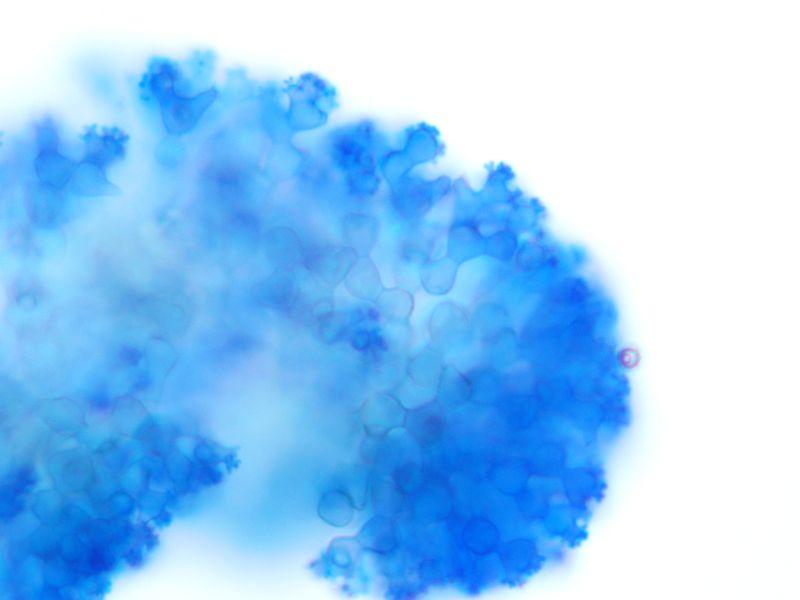
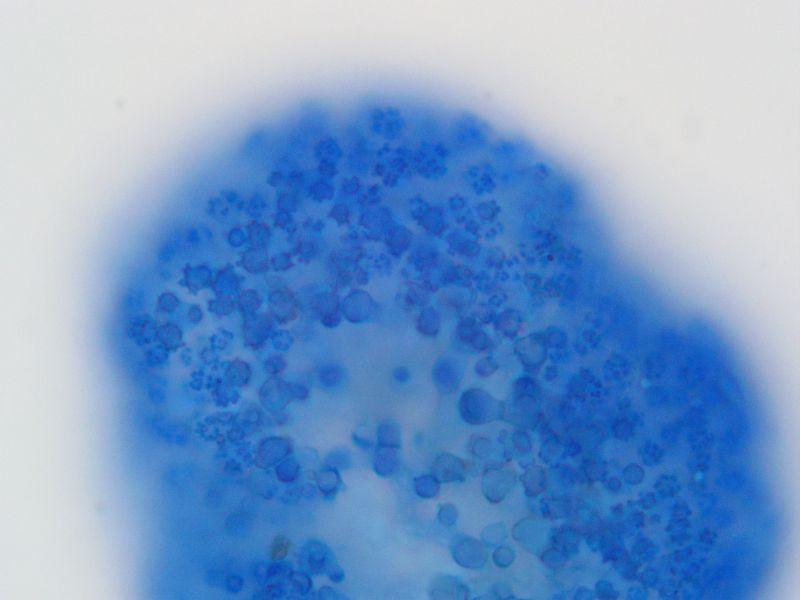
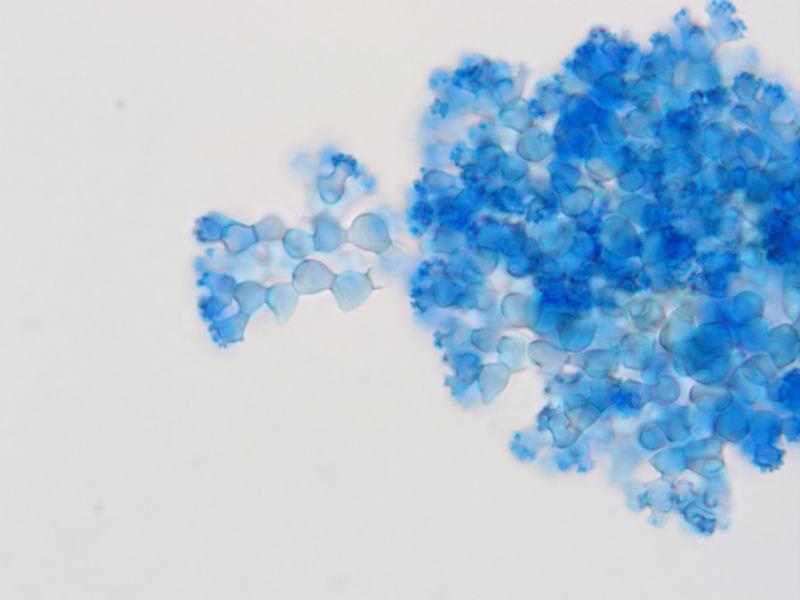
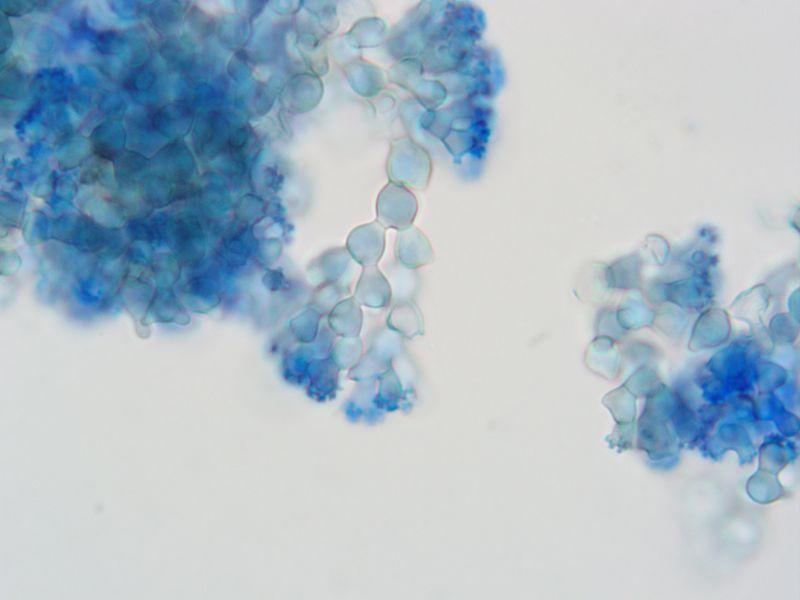
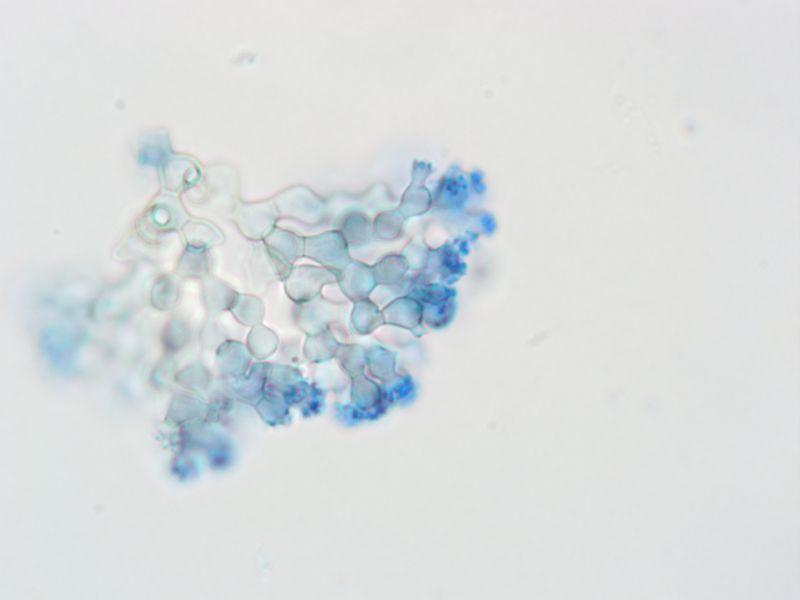
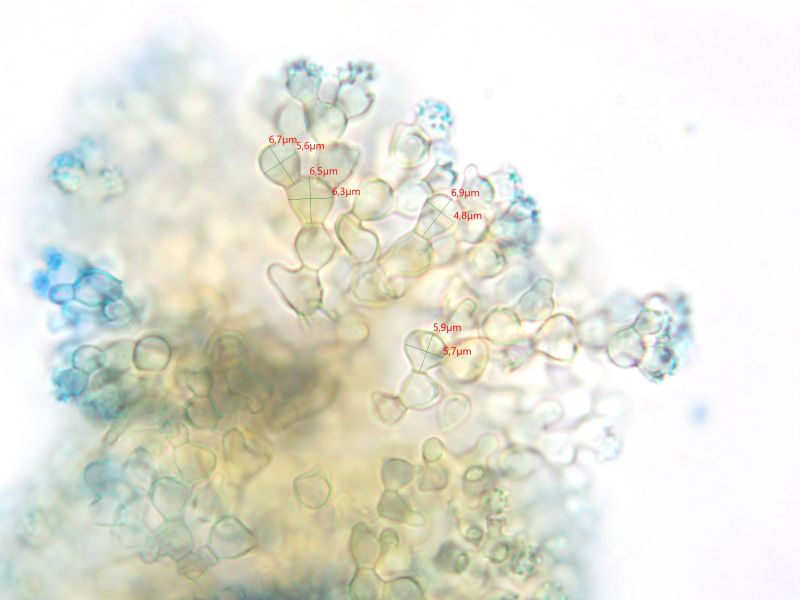
Conidiophores macroscopically barely visible, in large groups scattered or close together, superfical, whitish ore pale ocher, slightly rough, roundish but flattened at the top, sometimes fused together and then longer than high. Not fused bulbils upto 150 µm diam. Conidiophores very easy to remove from the substrate and in particular the smaller bulbils in the colony stuck together during collection with a needle for microscopic examination.

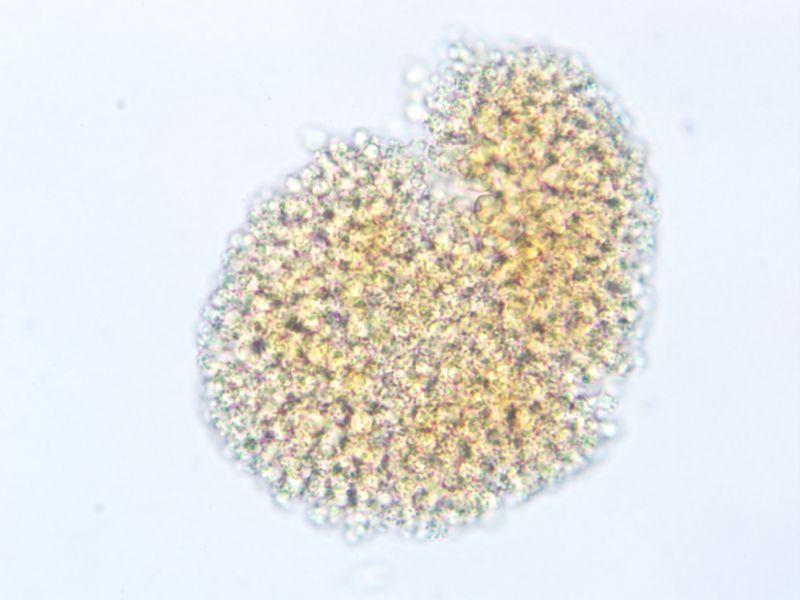
The entire exterior is covered with coral-like outgrowths. Smaller conidiophores have a rather loose structure, showing that the interior consists of smooth, thin-walled, variably shaped (somewhat rounded-angular) cells; cells variabel in length and width, ± 4,7-7 x 4.5-6,5 µm. New cells are formed at two places on the top side of a cell. In this way, chains of cells are formed. The terminal cell is more often branched three times, and these branches are covered with spines of ± 1 µm lenght. Cells of small conidiophores are easy to push apart. In contrasts to this the cells of larger ones are difficult to push apart. Clamps are absent.

Thanks in advance.

Marian
  • message #85129
  • message #85129
  • message #85129
  • message #85129
  • message #85129
  • message #85129
  • message #85129
  • message #85129
  • message #85129
  • message #85129
Francois Guay, 22-04-2026 20:28
Francois Guay
Re : Pseudaegerita spec.
It looks like Brocchiosphaera brocchiata to me :)

Exemple: https://www.inaturalist.ca/observations/349873463
Marian Jagers, 22-04-2026 21:01
Marian Jagers
Re : Pseudaegerita spec.
Hello Francois,

Thank you very much for your response. This is a completely unknown group to me, but step by step I am making progress. How wonderfully shaped is this small species.

I found a Japanese article by Kaoru Yamaguchi et al. from 2020 containing a table with the differences between the various species. 

Kind regards,

Marian
Stip Helleman, 22-04-2026 22:11
Stip Helleman
Re : Pseudaegerita spec.
Hoi Marian,

it looks like Pseudaegerita and Candelabrum are the same, both are synonimized with Hyaloscypha (Index Fungorum). in K. Yamaguchi et al. / Mycoscience 61 (2020) 265-281 the genus Brocchiosphaera is separated here from Candelabrum and put in Sordariomycetes.

The morphological differences are not very clear to me.

cheers,

Stip
Marian Jagers, 23-04-2026 17:30
Marian Jagers
Re : Pseudaegerita spec.
Stip, Thank you too for your information. I checked Index Fungorum. According to Fungorum Pseudaegerita and Candelabrum are the same, both are synonimized with Hyaloscypha. I also checked Brocchiosphaera and this genus has been accepted; classified as Incertae sedis in Pisorisoriales.

I also have read the article by Yamaguchi (2020) and a part of the literature cited in the references (including that of Voglmayr (1998). The key in Voglmayr contains six species of the genus Candelabrum s.l. The key guided me to C. brocchiata. The seventh species (B. bulbiformis.) could be excluded with the tabel in Yamaguchi.


So, based on colour, size and absence of a basal plate (I checked this again for more certainty) my find is indeed C. brocchiata.


Thank you both. I wouldn't have figured this out without your help and Stip, I will email you personally (again) regarding the next steps for this Dutch find.