
04-06-2026 10:50
 François Freléchoux
Bonjour, J'ai trouvé hier un petit asco observé
04-06-2026 07:02
François Freléchoux
Bonjour, Voici la description d'une espèce qui p
04-06-2026 13:34
Gernot FriebesHi,I am interested to hear your opinion on this Le
04-06-2026 11:36
Gernot FriebesHi,found on Vaccinium myrtillus.Asci: IKI –, 8-s
22-05-2026 13:29
Gernot FriebesHi,I am curious to hear your opinion on this mater
18-10-2022 00:12
Valencia Lopez Francisco JavierHola amigos/asRecientemente encontré esta colecci
03-06-2026 19:45
 Miguel Ángel Ribes
Good afternoonI'm completely baffled by this suppo
03-06-2026 14:39
Thomas FlammerApothecia yellow, glassy-transparent, 80 - 120 ymS
Hypoxylon rubiginosum?
Enrique Rubio,
18-07-2011 18:55
 Hi to all:
These resupinate stromata grow on wood of Fagus sylvatica. KOH 10% extractable pigments are orange red but peripherically purplish. Asci have an apical apparatus Mlz. negative but bluish in IKI.
Could be H. rubiginosum?
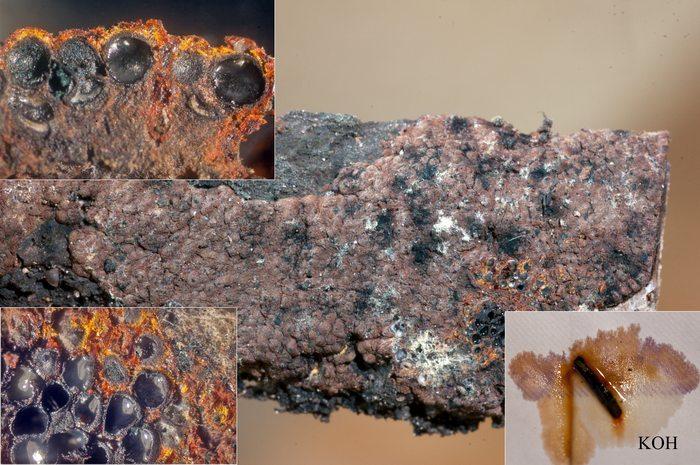


Enrique Rubio,
18-07-2011 19:43
Re : Hypoxylon rubiginosum?
Dear René:
No smell I have noted, perithecia are 375-575 microns high and stromata are small (only 3-4 cm)
Enrique
No smell I have noted, perithecia are 375-575 microns high and stromata are small (only 3-4 cm)
Enrique
Jacques Fournier,
18-07-2011 20:59

Re : Hypoxylon rubiginosum?
Hi Enrique,
I guess you studied it in detail because it seemed a bit strange to you. The results of your chromatography are indeed surprising.
I would be glad to see it and I will forward it to Marc to study its HPLC profile.
Thanks in advance,
Jacques
I guess you studied it in detail because it seemed a bit strange to you. The results of your chromatography are indeed surprising.
I would be glad to see it and I will forward it to Marc to study its HPLC profile.
Thanks in advance,
Jacques
Enrique Rubio,
19-07-2011 12:13
Re : Hypoxylon rubiginosum?
OK., Jacques. I will send you my material
Best wishes
Enrique
Best wishes
Enrique
Jacques Fournier,
28-09-2011 10:44
Re : Hypoxylon rubiginosum?
Dear Enrique,
I eventually received your specimen, thanks!
I wonder if two different Hypoxylons were not mixed up in your collection because I failed to see any purplish tinge around the orange pigments obtained on a paper with KOH, following your method.
Ascal rings also differ from what you observed in that they turn blue in Melzer and IKI as well.
I first though your fungus might be H. canariense, so far known only from Canary Islands where it is very common, in which I sometimes observed dubious reactions of ascal rings to iodine, but I do think the one you sent me is a depauperate form of H. rubiginosum.
Many undescribed species of Hypoxylon likely are still to be discovered, most of them resembling H. rubiginosum in gross morphology. Keep on screening them!
With best wishes,
Jacques
I eventually received your specimen, thanks!
I wonder if two different Hypoxylons were not mixed up in your collection because I failed to see any purplish tinge around the orange pigments obtained on a paper with KOH, following your method.
Ascal rings also differ from what you observed in that they turn blue in Melzer and IKI as well.
I first though your fungus might be H. canariense, so far known only from Canary Islands where it is very common, in which I sometimes observed dubious reactions of ascal rings to iodine, but I do think the one you sent me is a depauperate form of H. rubiginosum.
Many undescribed species of Hypoxylon likely are still to be discovered, most of them resembling H. rubiginosum in gross morphology. Keep on screening them!
With best wishes,
Jacques
Enrique Rubio,
28-09-2011 12:31
Re : Hypoxylon rubiginosum?
Many thanks for your study, Jacques
Enrique
Enrique