
29-05-2026 15:35
daniel FERREBonjour à tous,Je voudrais votre aide pour cette
28-05-2026 16:15
James MitchellHello,Does anyone have the original publication of
28-05-2026 11:06
Thomas Læssøehttps://svampe.databasen.org/observations/10596750
23-05-2026 11:44
 Charles Grapinet
Hello, I am having trouble identifying this copro
25-05-2026 16:44
François BartholomeeusenHi forum members,During an excursion organised by
26-05-2026 21:25
Dirk GerstnerHello everyone, I'm completely stumped by this li
26-05-2026 22:44
Ethan CrensonHi all, I think I have Incrucipulum capitatum her
22-05-2026 14:44
 Lothar Krieglsteiner
in unripe condition citrine yellow, then soon fadi
25-05-2026 16:35
 Bernard CLESSE
Bonjour à toutes et tous,J'ai trouvé récemment,
22-05-2026 13:29
Gernot FriebesHi,I am curious to hear your opinion on this mater
I am looking for the part of the following article that deals with Nectriopsis lecanodes:
Sérusiaux, E.; Diederich, P.; Brand, A.M.; Boom, P. 1999 - New or interesting lichens and lichenicolous fungi from Belgium and Luxembourg. VIII. Lejeunia 162: 1-95.
It'd be great if somebody could send me these pages.
Best wishes,
Gernot


y

I haven't those pages but I know this species quite well (Christian too). If you want confirmation, please give your observations.
Alain
Yannick
Alain
thanks but I'm not actually looking for confirmation but for a recent description with synonyms and maybe further literatur given for this species. Also I'm not sure if the correct basionym is Sphaeria lecanodes Ces. 1857 or Nectria lecanodes Ces. 1863...
Best wishes,
Gernot

here is the basionyme of N. lecanodes:
Nectriopsis lecanodes (Ces.) Diederich & Schroers
Basionym: Nectria lecanodes Ces., in Rabenhorst, Herb. mycol. ed. 2: 525, 1863.
However, ?I think that it is not the genus Nectriopsis but the genus Lasionectria, I'm working to a new combination. In section, ascomatal wall >40 µm thick composed of two regions fits better to the genus Lasionectria
Best wishes
Christian


Hi Gernot.
I can get these pages, but only on the next Monday.
@Christian: Thanks for this information! I thought there already was a combination to the genus Lasionectria? (http://www.cybertruffle.org.uk/cyberliber/59351/0021/003/0267.htm)
@Nicolas: That would be great, thank you!
Best wishes,
Gernot
 p56-0001.pdf
Best wishes,
Gernot
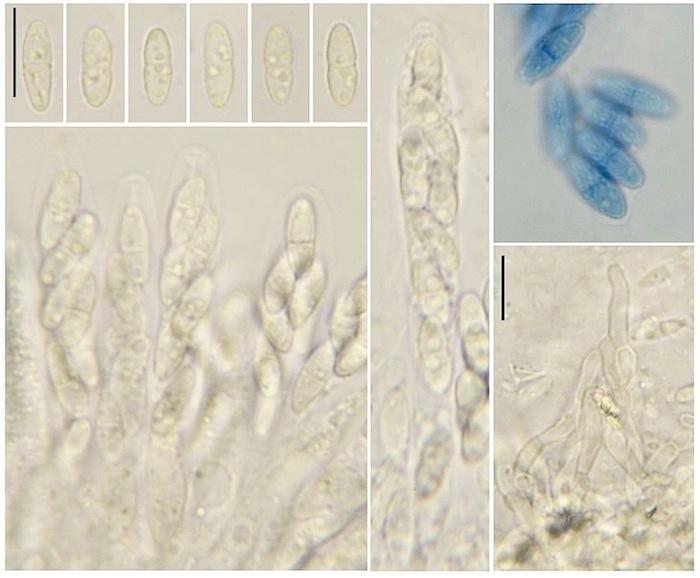
But, it's obviously 'Nectriopsis' lecanodes.
Alain
thanks for sharing your experience! Maybe the different descriptions result from different maturities of the material examined in literature.
Best wishes,
Gernot