
12-07-2015 00:05
 Nedim Jukic
This one from the same locality as the previous on
06-06-2026 17:44
Steve ClementsBonjour, This disco was on planed wood 3 x 1.5 cm
14-08-2016 23:15
 Alex Akulov
Dear friendsCan you help me to find the descriptio

05-06-2026 11:02
Thomas Læssøehttps://svampe.databasen.org/observations/10596691
04-06-2026 11:36
Gernot FriebesHi,found on Vaccinium myrtillus.Asci: IKI –, 8-s
05-06-2026 12:10
 François Freléchoux
Capitotricha sp. sur Lonicea caerulea Caractères
19-05-2026 10:27
Patrice TANCHAUDBonjour, récolte récente sur terre retournée i
04-06-2026 18:39
Gernot FriebesHi,I collected this species in two different locat
Echinosphaeria canescens/strigosa
Chris Yeates,
11-03-2012 12:48
 I have collected good material of an Echinosphaeria and would like to place images on the database. I am aware that there is no clear line between the two species - indeed some authorities suspect they are one and the same. What are the chief 'differences' please? I suspect this is a question for Alain and his special knowledge!
J'ai rassemblé bon matériel et que vous souhaitez placer des images sur la base de données. Je suis conscient qu'il n'ya pas de ligne claire entre les deux espèces. Quelles sont les 'différences' s'il vous plaît? Je soupçonne que c'est une question pour Alain et sa connaissance particulière!
merci et amitiés
Chris
Andrew N. Miller,
11-03-2012 15:37

Re : Echinosphaeria canescens/strigosa
E. canescens is believed to have smaller ascospores (17–24 x 3–4 µm) than E. strigosa (34–40 x 6–7 µm), but I have not seen good material of E. strigosa. If anyone has good material of E. strigosa, I would love to sequence it and let DNA solve this mystery once and for all...;o) I believe E. strigosa was described from England.
Andy
Andy
Chris Yeates,
11-03-2012 15:56
Re : Echinosphaeria canescens/strigosa
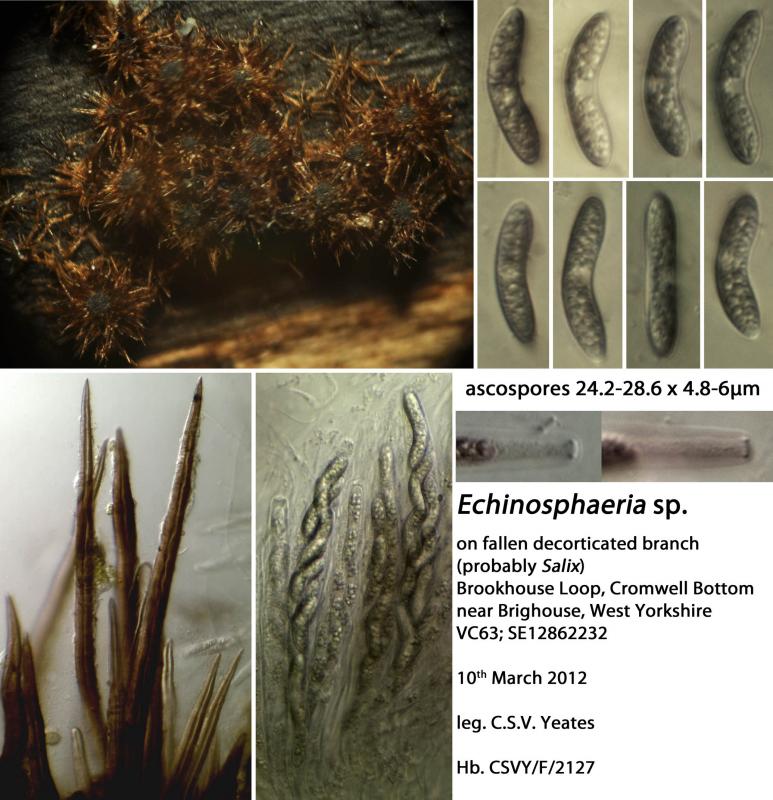
thanks for that Andy - of course the ascospores from my collection measure 24.2-28.6 x 4.8-6µm . . . . . typical! These spores are still hyaline and mostly non-septate, but were ejected in a water mount so presumably they're 'natural' size - I'll post some images later today.
there are few mycologists collecting these kind of fungi in the UK, but those who do and are using Ellis & Ellis I as their source are going to be producing a confusing situation - that work does not include Lasiosphaeria strigosa, but does have L. canescens with spore measurements of 30-40 x 4-5µm.
Chris
there are few mycologists collecting these kind of fungi in the UK, but those who do and are using Ellis & Ellis I as their source are going to be producing a confusing situation - that work does not include Lasiosphaeria strigosa, but does have L. canescens with spore measurements of 30-40 x 4-5µm.
Chris
Chris Yeates,
11-03-2012 16:04
Re : Echinosphaeria canescens/strigosa
images:
Alain GARDIENNET,
11-03-2012 17:14

Re : Echinosphaeria canescens/strigosa
Hi Andy,
I have strigosa dated the 23rd december 2011. Is it too old ?
Chris, I've already got Echinosphaeria like yours...disturbing.
Alain
Andrew N. Miller,
11-03-2012 19:05
Re : Echinosphaeria canescens/strigosa
Dear Alain,
That would be perfect if the collection contains 20-30 ascomata. I can try sequencing it and see where it comes in relation to E. canescens. I already have several sequences of E. canescens from Europe and North America.
Andy
That would be perfect if the collection contains 20-30 ascomata. I can try sequencing it and see where it comes in relation to E. canescens. I already have several sequences of E. canescens from Europe and North America.
Andy
Hans-Otto Baral,
11-03-2012 21:50

Re : Echinosphaeria canescens/strigosa
Hi all
I suppose the spores get distinctly narrower when placed in lethal media. Chris's spores are alive, according to the regular multiguttulate interior.
Zotto
I suppose the spores get distinctly narrower when placed in lethal media. Chris's spores are alive, according to the regular multiguttulate interior.
Zotto
Chris Yeates,
11-03-2012 22:40
Re : Echinosphaeria canescens/strigosa
yes they were alive; I shall dry the material and revive and look at it later in various reagents, to see if there are any significant differences
Chris
Chris
Bernard Declercq,
12-03-2012 13:23

Re : Echinosphaeria canescens/strigosa
Hi all,
E. canescens and E. strigosa not only have spores with different dimensions, but they have a different shape too. See paper in annex.
Best regards,
Bernard
E. canescens and E. strigosa not only have spores with different dimensions, but they have a different shape too. See paper in annex.
Best regards,
Bernard
 Declercq 2008_Lasiosphaeria s.l.
Andrew N. Miller,
13-03-2012 15:58
Re : Echinosphaeria canescens/strigosa
Bernard's beautiful photos just reminded me that what I have in my collections are lots of specimens of E. strigosa (the longer-spored species). What I really need are collections of E. canescens (the shorter-spored species; 17–24 x 3–4 µm) for molecular study. My apologies for my confusion...
Andy
Andy
Chris Yeates,
13-03-2012 21:09
Re : Echinosphaeria canescens/strigosa
So in view of that - and looking at Bernard's illustrations - should I label my collection "E. cf. strigosa" then?
Chris
Chris
Andrew N. Miller,
13-03-2012 21:50
Re : Echinosphaeria canescens/strigosa
Yes, if being nomenclaturally correct is important to you...;o)
Andy
Andy