
08-06-2026 17:00
François BartholomeeusenGood day everyone, On June 5 2026, I collected de
08-06-2026 10:16
 Spooren Marco
I don`t have a clou about this fungus,it is not in
07-06-2026 15:10
 William Slosse
Hello everyone,On 05-06-26, I found following asco
05-06-2026 11:02
Thomas Læssøehttps://svampe.databasen.org/observations/10596691
07-06-2026 12:09
 François Freléchoux
Bonjour, Voici une brève description de ce qui m
07-06-2026 12:43
Steve ClementsBojour. This was a strange find on a stick on my
12-07-2015 00:05
 Nedim Jukic
This one from the same locality as the previous on
06-06-2026 17:44
Steve ClementsBonjour, This disco was on planed wood 3 x 1.5 cm
14-08-2016 23:15
 Alex Akulov
Dear friendsCan you help me to find the descriptio
blue mould from Portugal
Lothar Krieglsteiner,
05-04-2026 22:46
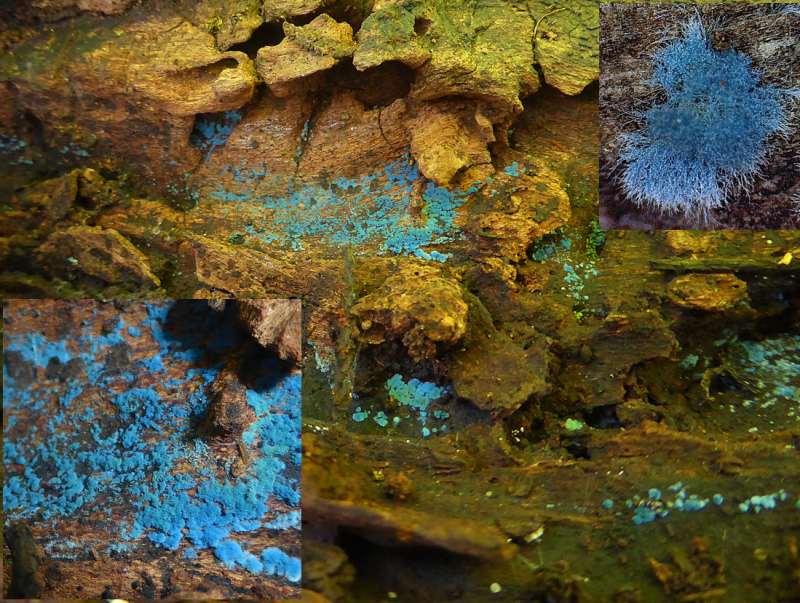
 on wood of Ceratonia, Algarve, 3.4.2026.
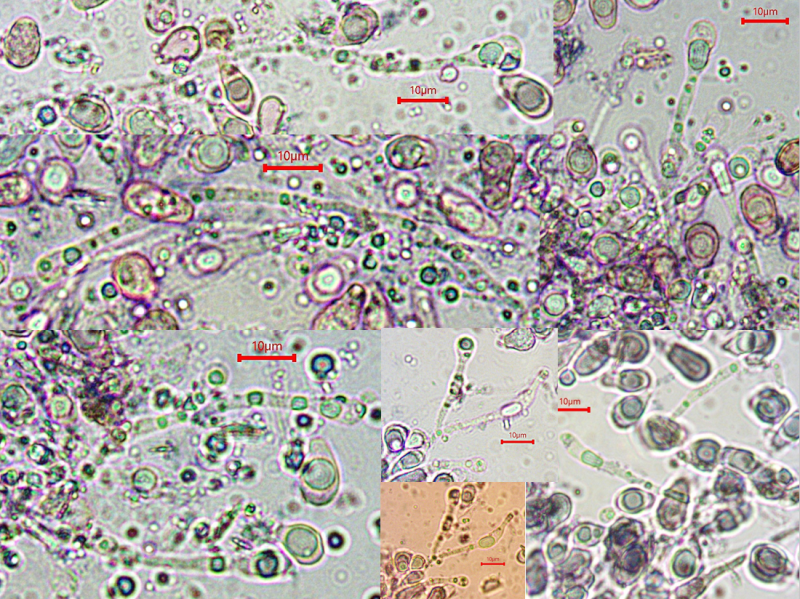
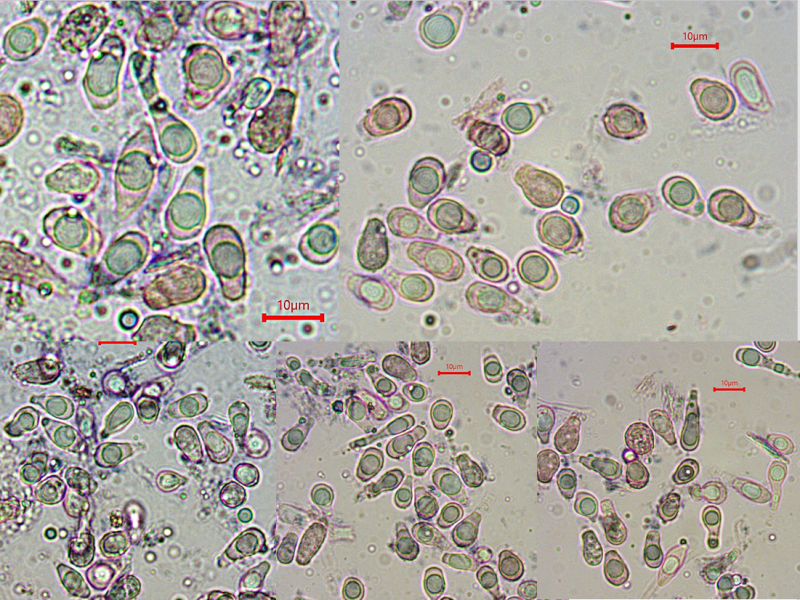
The color reminded of Chlorociboria or similar, the macroscopical aspect a bit of Trichoderma. The bluish mould color would lead to Penicillium or Aspergillus - but ... - see yourself.
Who can provide me with a hint?
Best regards, Lothar
Gernot Friebes,
05-04-2026 23:08
Re : blue mould from Portugal
Hi, Lothar!
Caeruleomyces verae, maybe? Did you observe clamps?
Best wishes,
Gernot
Caeruleomyces verae, maybe? Did you observe clamps?
Best wishes,
Gernot
Lothar Krieglsteiner,
06-04-2026 08:07
Re : blue mould from Portugal
Hi Gernot,
thank you very much - this looks very good.
No, I did not observe clamps but will search for those soon.
I did not have the idea of a basidiomycete (sorry to the forum for posting here) - and I did not find a lot of the hyphae at all between all those conidia.
Seems to be a quite nice find anyway ...
Thanks again and best wishes for you, too,
Lothar
thank you very much - this looks very good.
No, I did not observe clamps but will search for those soon.
I did not have the idea of a basidiomycete (sorry to the forum for posting here) - and I did not find a lot of the hyphae at all between all those conidia.
Seems to be a quite nice find anyway ...
Thanks again and best wishes for you, too,
Lothar
Lothar Krieglsteiner,
11-05-2026 10:27
Re : blue mould from Portugal
Hi Gernot,
although it was really labourious, I could detect some clamps (or what I think are clamps). Problem: there is a lot of amorphous matter on the hyphae (and conidia) that make it difficult to observe clamps (in H2O, KOH, Kongo-NH3), furthermore the septa are rupturing easily and longer pieces of hyphal structures are scarce to find.
The picture in Stalpers (Ptychogaster) shows septae with and without clamps. Pity, I was not able to see the structures this way.
But I am seemingly not alone with this problem:
https://www.nahuby.sk/obrazok_detail.php?obrazok_id=878044&poradie=1&form_hash=462b4d6230489060cac396c2a0cb8f4a
As the conidia are fitting very well, and as the macroscopical appearance is quite unique, I do not have doubts about the determination. Thank you very much again!
As far as I find, the fungus is only known from Argentina and from Slowakia, and now from Portugal (?).
Best regards, Lothar
although it was really labourious, I could detect some clamps (or what I think are clamps). Problem: there is a lot of amorphous matter on the hyphae (and conidia) that make it difficult to observe clamps (in H2O, KOH, Kongo-NH3), furthermore the septa are rupturing easily and longer pieces of hyphal structures are scarce to find.
The picture in Stalpers (Ptychogaster) shows septae with and without clamps. Pity, I was not able to see the structures this way.
But I am seemingly not alone with this problem:
https://www.nahuby.sk/obrazok_detail.php?obrazok_id=878044&poradie=1&form_hash=462b4d6230489060cac396c2a0cb8f4a
As the conidia are fitting very well, and as the macroscopical appearance is quite unique, I do not have doubts about the determination. Thank you very much again!
As far as I find, the fungus is only known from Argentina and from Slowakia, and now from Portugal (?).
Best regards, Lothar
Adam Polhorský,
15-05-2026 22:30
Re : blue mould from Portugal
Hi Lothar,
indeed I had similar issues as you. I saw plenty of hyphae, but no clamps, or just very indistinct ones. Here are few more pics: https://www.inaturalist.org/observations/189782658 .It was strange finding this argentinian fungus in Slovakia. Your find connects the dots a little bit:). There is no sequence, but there is a living culture of the type. So it is theoretically possible to compare dna of all 3 collections and find out where it truly belongs.
Adam
Lothar Krieglsteiner,
16-05-2026 07:15
Re : blue mould from Portugal
Hi Adam,
thank you very much for your reply and the link to INaturralist, the fotos there contribute well to the ones from your website - surely we have the same fungus.
Sequencing would surely be intersting. If there is no sequence at all by now one is a bit wondering why the fungus can be classified as belonging to the Hymenochaetales (Index of Fungi).
Best regards, Lothar
thank you very much for your reply and the link to INaturralist, the fotos there contribute well to the ones from your website - surely we have the same fungus.
Sequencing would surely be intersting. If there is no sequence at all by now one is a bit wondering why the fungus can be classified as belonging to the Hymenochaetales (Index of Fungi).
Best regards, Lothar