
14-08-2016 23:15
 Alex Akulov
Dear friendsCan you help me to find the descriptio

05-06-2026 11:02
Thomas Læssøehttps://svampe.databasen.org/observations/10596691
04-06-2026 11:36
Gernot FriebesHi,found on Vaccinium myrtillus.Asci: IKI –, 8-s
05-06-2026 12:10
 François Freléchoux
Capitotricha sp. sur Lonicea caerulea Caractères
19-05-2026 10:27
Patrice TANCHAUDBonjour, récolte récente sur terre retournée i
04-06-2026 18:39
Gernot FriebesHi,I collected this species in two different locat
22-05-2026 13:29
Gernot FriebesHi,I am curious to hear your opinion on this mater
I collected some small caps of Helvella that are similar to H. acetabulum, but all of caps are small (I have some H. acetabulum specimens from there). Collected from south of Caucasia (Iranian part of Caucasus), a broadleaf forest.
Cap up to 1.5 cm broad, 1 cm high, upper surface brown, lower surface pale brown and pubescent, stipe ribbed with cream sharp edge ribs, up to 1.5 cm high and 0.7 cm diam (at base), white to cream.
Spores 16-19 x 11-12.5. what do you think about them?
?
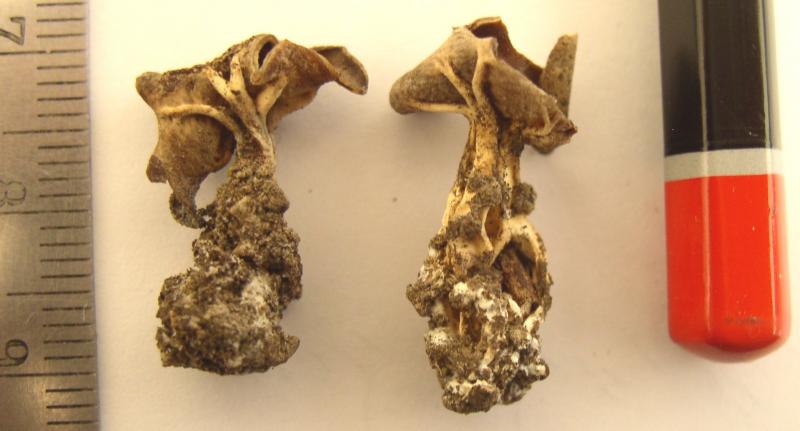
I see in the photo that your specimen has rounded edge ribs, and Helvella acetabulum has sharp edge ribs. I think your specimen is more like Helvella costifera.
Best,
Fidel
the first idea observing the photo is H. costifera, also because the ribs are whitish until their very end.
It's true that, usually, H. costifera has more rounded rigde edges. But it should be said that the sharp ribs in H. acetabulum become evident when the ascomata are rather developed.
In our case, the very small ascomata and the spores at the lowest point of the usual range seem to indicate that the specimens are rather young. In the first stage the ribs are blunt and rounded also in H. acetabulum.
H. costifera, at least in my area of collection, is mostly gray rather than brown.
So I think we will keep some doubt about this collection.
Reza, what did you mean with "sharp edge ribs"? Because in your photo, as Fidel pointed out, the edges are rounded, not sharp. Maybe you mean that the ribs ends abruptly on the surface of the apothecium?
Regards
Mario