
12-06-2026 14:50
 François Freléchoux
Bonjour, Voici la brève description d'une Mollis
10-06-2026 21:16
François Freléchoux
Bonsoir,Le dernier du jour, en attendant votre avi
11-06-2026 19:01
 William Slosse
Hello all,In an attempt to make a culture of a sus
11-06-2026 19:03
 Nicolas VAN VOOREN
Chers membres d'Ascofrance,Le site sera placé en

09-06-2026 18:32
Camille MertensSur morceau de roseau immergé 0,5 - 0,7 mm de dia
10-06-2026 12:54
Steve ClementsBonjour encore, Pouvez-vous m'aider, s'il vous pl
10-06-2026 21:07
François Freléchoux
Toutes les tiges de gentianes jaunes de l'an passÃ
10-06-2026 13:41
François Freléchoux
Bonjour à nouveau, Voici une trouvaille d'hier.
Ascomycete with Dark, Tapering Hairs
Peter Thompson,
13-02-2013 12:26
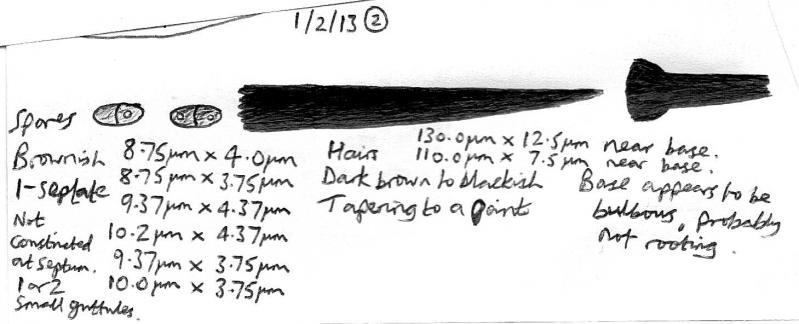
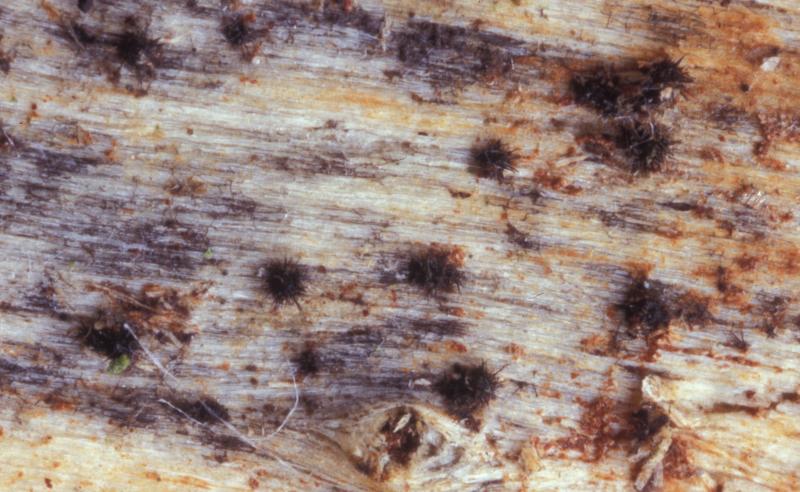
I have fruit bodies of a spherical ascomycete resting on decorticated wood. They have tapering hairs with bulbous bases and macroscopically resemble Lasiosphaeria and related genera. (See attached photograph).
Microscopically, there are about 20 pale brownish 1-septate spores, which have remained inside each of the two perithecia which I have examined. (See attached sketch). I have not seen any asci.
My feeling is that it is a mature ascomycete, but quite old. If so, it has probably also been exposed to freezing temperatures and snow.
I wonder if anyone is aware of a species which possesses a combination of these spore and hair characteristics. My literature search has been unsuccessful.
Thank you,
Best wishes,
Peter.
Alain GARDIENNET,
13-02-2013 12:29

Re : Ascomycete with Dark, Tapering Hairs
It could be closed to Helminthosphaeria genus.
Did you observe asci and hamathecium ?
Sorry, I read the answer in your first mail. So it would be more difficult to have an opinion.
Alain
Did you observe asci and hamathecium ?
Sorry, I read the answer in your first mail. So it would be more difficult to have an opinion.
Alain
Peter Thompson,
13-02-2013 15:16
Re : Ascomycete with Dark, Tapering Hairs
Hello Alain,
Thank you for your reply.
I did not observe any asci - I think that the fruit bodies were probably too old. Only a few loose spores had been retained in the perithecia which I analysed.
I did not mention earlier that each fruit body seems to be seated on a brown, thick walled, septate hyphal subiculum about 2.5 to 3um wide. This subiculum is only located directly under each fruit body, rather than extending across the substrate.
I don't know whether this helps.
Best wishes,
Peter.
Thank you for your reply.
I did not observe any asci - I think that the fruit bodies were probably too old. Only a few loose spores had been retained in the perithecia which I analysed.
I did not mention earlier that each fruit body seems to be seated on a brown, thick walled, septate hyphal subiculum about 2.5 to 3um wide. This subiculum is only located directly under each fruit body, rather than extending across the substrate.
I don't know whether this helps.
Best wishes,
Peter.