
12-06-2026 14:50
 François Freléchoux
Bonjour, Voici la brève description d'une Mollis
10-06-2026 21:16
François Freléchoux
Bonsoir,Le dernier du jour, en attendant votre avi
11-06-2026 19:01
 William Slosse
Hello all,In an attempt to make a culture of a sus
11-06-2026 19:03
 Nicolas VAN VOOREN
Chers membres d'Ascofrance,Le site sera placé en

09-06-2026 18:32
Camille MertensSur morceau de roseau immergé 0,5 - 0,7 mm de dia
10-06-2026 12:54
Steve ClementsBonjour encore, Pouvez-vous m'aider, s'il vous pl
10-06-2026 21:07
François Freléchoux
Toutes les tiges de gentianes jaunes de l'an passÃ
10-06-2026 13:41
François Freléchoux
Bonjour à nouveau, Voici une trouvaille d'hier.
Pyrenomycete
Garcia Susana,
22-04-2013 13:47
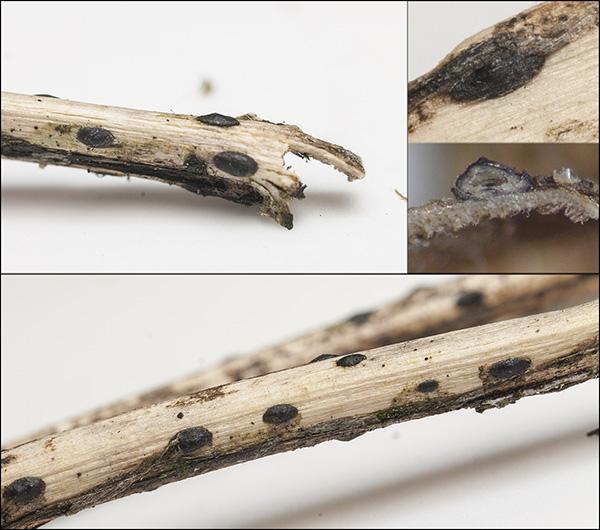
I found this ascomycete growing on dry herbaceous stems.
With 3-5 locules in each is stroma.
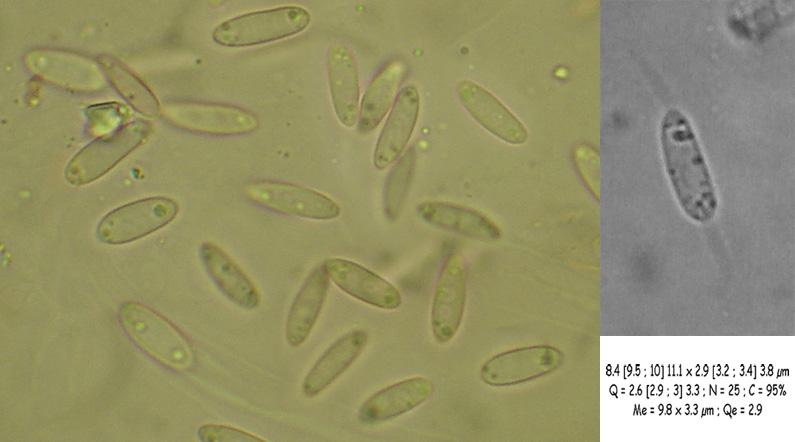
Spores hyaline. Some with appendages at both ends.
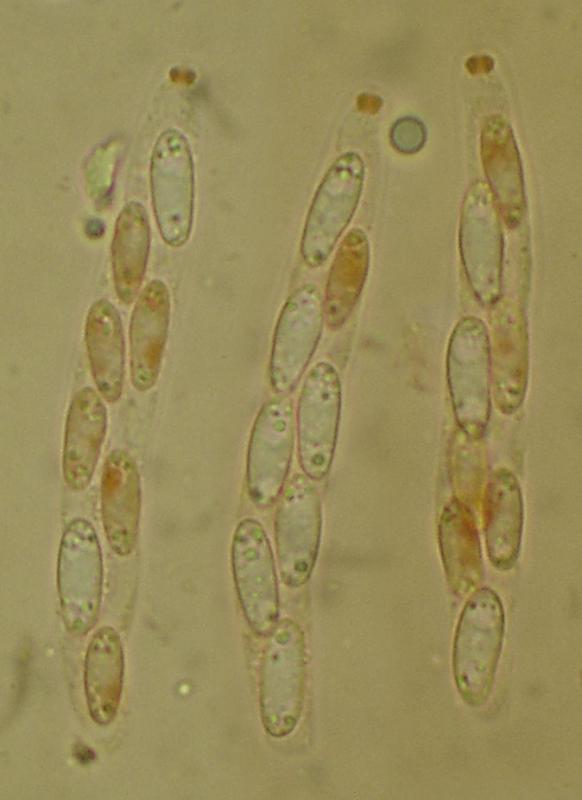
Asci with apical apparatus visible in water, IKI -. 60-65 x 6-8um.
I do not know what species it is, perhaps Phyllachora sp?
I would appreciate any help.
A greeting and thanks.
Susana?
Alain GARDIENNET,
22-04-2013 14:35

Re : Pyrenomycete
Hi Susanna,
It's a Mazzantia species.
Could your herbaceous stem be Solidago ? If yes, it could be M. biennis.
Alain
It's a Mazzantia species.
Could your herbaceous stem be Solidago ? If yes, it could be M. biennis.
Alain
Garcia Susana,
22-04-2013 22:56
Re : Pyrenomycete
Hi Alain,
Thank you for identifying the genre.
I do not know who is the host. I found some dried stems hardly identifiable.
I have no literature of the genre. Is there a key? or the species depends on the host?.
I have seen in the database that is very similar to M.gallii. I know in the area is common Gallium aparine. Could it be?
Thank you very much, greetings
Susana?
Thank you for identifying the genre.
I do not know who is the host. I found some dried stems hardly identifiable.
I have no literature of the genre. Is there a key? or the species depends on the host?.
I have seen in the database that is very similar to M.gallii. I know in the area is common Gallium aparine. Could it be?
Thank you very much, greetings
Susana?
Björn Wergen,
22-04-2013 23:33

Re : Pyrenomycete
Hi Susana,
there are 4 species described in MONOD 1983. I can send you a copy of these descriptions via email.
regards,
björn
there are 4 species described in MONOD 1983. I can send you a copy of these descriptions via email.
regards,
björn
Garcia Susana,
22-04-2013 23:40
Re : Pyrenomycete
That would be nice.
thank you very much björn?
thank you very much björn?
Alain GARDIENNET,
23-04-2013 08:51
Re : Pyrenomycete
Possibilities :
M. galii on Galium / 8-10 x 2,5-3 µm
M. brunaudiana on umbellifers / 9-10 x 4 µm
M. napelii on Aconitum napellus / 11-14 x 3-4 µm
M. biennis on Solidago juncea / 7,5-11 x 3-4,5 µm
M. borealis on Anemone, Tanacetum / 6,5-10 x 3-5 µm
Perhaps some are synonymous (it's my opinion). But know the host is important.
For the yours, M. napellii is the most probable.
Alain
M. galii on Galium / 8-10 x 2,5-3 µm
M. brunaudiana on umbellifers / 9-10 x 4 µm
M. napelii on Aconitum napellus / 11-14 x 3-4 µm
M. biennis on Solidago juncea / 7,5-11 x 3-4,5 µm
M. borealis on Anemone, Tanacetum / 6,5-10 x 3-5 µm
Perhaps some are synonymous (it's my opinion). But know the host is important.
For the yours, M. napellii is the most probable.
Alain
Garcia Susana,
23-04-2013 13:37
Re : Pyrenomycete
Thanks Alain, a greeting
Susana