
20-05-2026 17:47
Margot en Geert VullingsWe found this Mollisia on dead Juncus stems mown l
20-05-2026 21:49
Margot en Geert VullingsWe found this Lachnum on Juncus stems mown last ye
21-05-2026 17:01
Pierre RepellinBonjour à toutes et à tous,Je recherche l'articl
20-05-2026 20:08
 Andreas Millinger
Good evening,another quite distinctive find from M
20-05-2026 12:57
 Ingo Ibelshäuser
Hello everybody, on decayed hardwood e.g. Quercus
22-04-2026 20:54
 Enrique Rubio
Hi to everybody.This Pyrenopeziza grew in moist le

19-05-2026 12:55
 Hardware Tony
After checking Gminder and Otto's library I cannot
Geoglossum confirmation please
Chris Yeates,
01-01-2014 19:04
 Bonsoir tous - and Happy New Year!
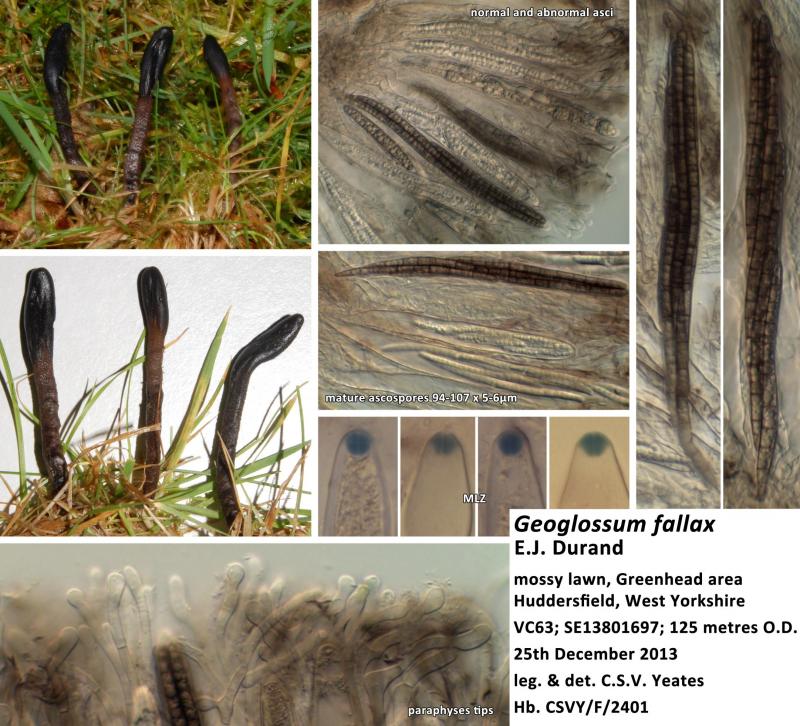
I collected this on a mossy lawn (slightly acidic grassland) on Christmas Day (it has stayed mostly frost-free here - so far!). It seems to key out fine to Geoglossum fallax, especially with regard to characters of the paraphyses tips, which have relatively few septa and are embedded in a brown matrix, and of the spores which are rather slender and tapering at their bases.
But this collection of G. fallax on ASCOFrance http://www.ascofrance.com/search_recolte/1567 looks rather different.
Am I missing something?
Cordialement
Chris
Martin Bemmann,
01-01-2014 19:22

Re : Geoglossum confirmation please
Hi Chris,
stipe is hairy? If so check Trichoglossum (hirsutum). Spore length would fit better. Can you count the septa?
Regards
Martin
stipe is hairy? If so check Trichoglossum (hirsutum). Spore length would fit better. Can you count the septa?
Regards
Martin
Chris Yeates,
01-01-2014 19:33
Re : Geoglossum confirmation please
Hi Martin
the stem has tufts of hyphae, but no setae either on stem or in hymenium;
spores with 7 to 12 septa
best wishes
Chris
the stem has tufts of hyphae, but no setae either on stem or in hymenium;
spores with 7 to 12 septa
best wishes
Chris
Martin Bemmann,
01-01-2014 20:04
Re : Geoglossum confirmation please
Hi Chris,
sorry I ignored the paraphyses. With checking more keys (Maas-Geesteranus, Priou, Olsen etc.) I come to G. fallax too. Though spore size varies.
Regards,
Martin
sorry I ignored the paraphyses. With checking more keys (Maas-Geesteranus, Priou, Olsen etc.) I come to G. fallax too. Though spore size varies.
Regards,
Martin
Michel Hairaud,
01-01-2014 20:58

Re : Geoglossum confirmation please
Hi Chris, Martin and all,
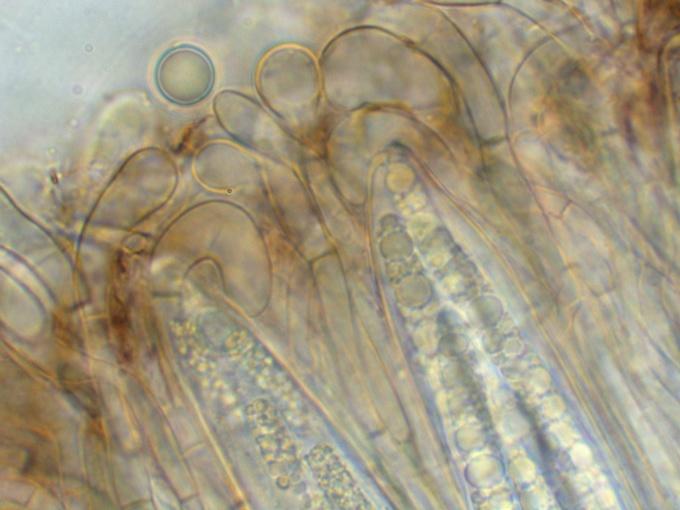
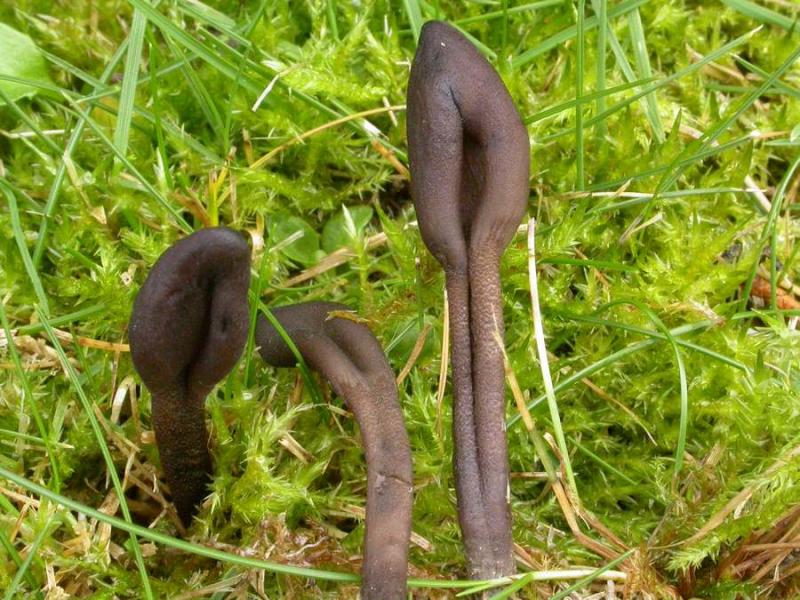
I would also go for G. fallax. Paraphyses tips are often more curved as inthe pic I attach .
Another regular character for fallax is that spores (even freed) are often not mature and then hyalin
Amitiés
Michel
I would also go for G. fallax. Paraphyses tips are often more curved as inthe pic I attach .
Another regular character for fallax is that spores (even freed) are often not mature and then hyalin
Amitiés
Michel
Hans-Otto Baral,
01-01-2014 20:59

Re : Geoglossum confirmation please
Hi
G. fallax is a species that shows the rather rare feature that the spores are ejected when still hyaline. Look at my drawing Geoglossum fallax, HB 6546.JPG with turgescent ascus. In the centre of your collage I see a living ascus with hyaline spores. If you saw these often enough and never brown when turgescent then I have no doubt.
Spores on my drawing are 70-106 x 5-6.5 µm, with 8-12 septa, so fit perfectly.
For the specimen from 2006 (Ascofrance) I am not sure.
Zotto
G. fallax is a species that shows the rather rare feature that the spores are ejected when still hyaline. Look at my drawing Geoglossum fallax, HB 6546.JPG with turgescent ascus. In the centre of your collage I see a living ascus with hyaline spores. If you saw these often enough and never brown when turgescent then I have no doubt.
Spores on my drawing are 70-106 x 5-6.5 µm, with 8-12 septa, so fit perfectly.
For the specimen from 2006 (Ascofrance) I am not sure.
Zotto
Chris Yeates,
01-01-2014 21:40
Re : Geoglossum confirmation please
Martin, Michel and Zotto
thank you for these helpful comments
amitiés
Chris
thank you for these helpful comments
amitiés
Chris