10-06-2026 13:41
 François Freléchoux
Bonjour à nouveau, Voici une trouvaille d'hier.
10-06-2026 11:53
Steve ClementsBonjour, This disco is abundant on dead stems of
10-06-2026 12:54
Steve ClementsBonjour encore, Pouvez-vous m'aider, s'il vous pl
10-06-2026 10:45
François Freléchoux
Bonjour à nouveau, Encore une détermination qui
08-06-2026 10:16
 Spooren Marco
I don`t have a clou about this fungus,it is not in
10-06-2026 09:24
François Freléchoux
Bonjour, J'imagine que cette détermination ne do
09-06-2026 18:32
Camille MertensSur morceau de roseau immergé 0,5 - 0,7 mm de dia
08-06-2026 17:00
François BartholomeeusenGood day everyone, On June 5 2026, I collected de
07-06-2026 15:10
 William Slosse
Hello everyone,On 05-06-26, I found following asco
Petit asco orange
Patrice TANCHAUD,
09-03-2014 16:43
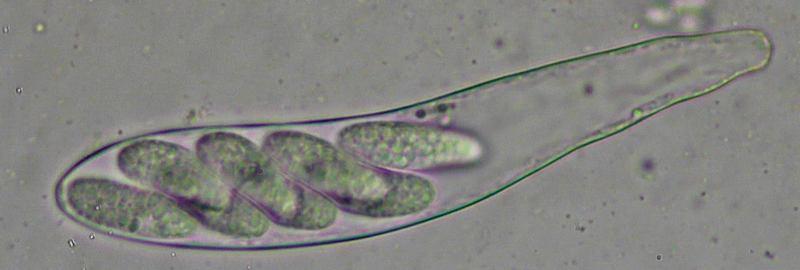
je vous soumets cet asco inférieur à 0,5 mm récolté à l'intérieur d'une écorce d'Eucalyptus. Asques d'une moyenne de 40 µm, spores 17-26 x 7,5-9,5 µm.
Merci d'avance pour vos suggestions.
Patrice
 2014-09-03-0001.pdf
Gernot Friebes,
09-03-2014 16:55
Re : Petit asco orange
Hi Patrice,
reminds me of the genus Pezicula.
Best wishes,
Gernot
reminds me of the genus Pezicula.
Best wishes,
Gernot
Hans-Otto Baral,
09-03-2014 17:00

Re : Petit asco orange
Yes, surely a Pezicula. You should test IKI for the ascus apex and check for the spore number (8?), but to find a name is very difficult. Perhaps P. cinnamomea which is plurvirous.
Zotto
Zotto
Patrice TANCHAUD,
10-03-2014 03:03
Re : Petit asco orange
Asques 8 spores. My IKI is too old, I see no reaction with melzer. You are probably right for genus Pezicula.
Thank you very much Genot and Zotto for your answer.
Amicalement.
Patrice
Thank you very much Genot and Zotto for your answer.
Amicalement.
Patrice
Hans-Otto Baral,
10-03-2014 09:13
Re : Petit asco orange
Boah, great photo!!!
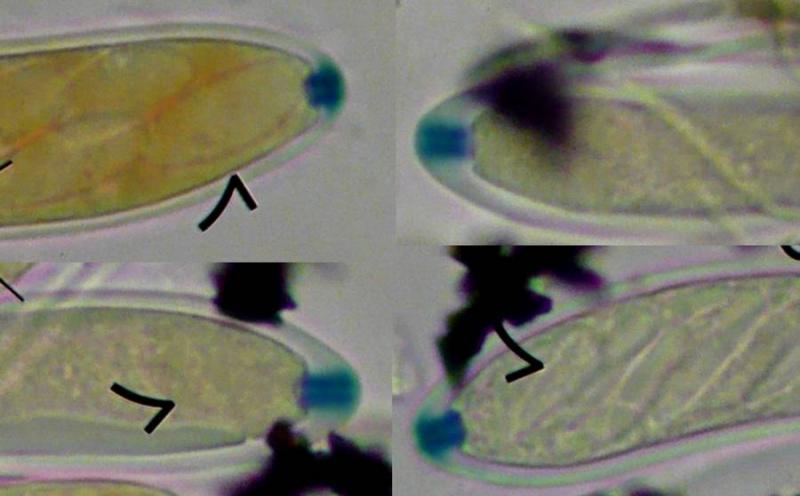
Now, since the reaction is very probably red (RR) in Lugol, you get nothing in Melzer. If you have KOH, put it there for a few seconds, and after a bit washing with water put Melzer and you get a bright blue.
Zotto
Now, since the reaction is very probably red (RR) in Lugol, you get nothing in Melzer. If you have KOH, put it there for a few seconds, and after a bit washing with water put Melzer and you get a bright blue.
Zotto
Patrice TANCHAUD,
11-03-2014 02:08
Re : Petit asco orange
Here is the result, thank you very much Zotto.
Bien amicalement.
Patrice
Bien amicalement.
Patrice