

10-06-2026 12:54
Steve ClementsBonjour encore, Pouvez-vous m'aider, s'il vous pl
09-06-2026 18:32
Camille MertensSur morceau de roseau immergé 0,5 - 0,7 mm de dia
10-06-2026 21:16
 François Freléchoux
Bonsoir,Le dernier du jour, en attendant votre avi
10-06-2026 21:07
François Freléchoux
Toutes les tiges de gentianes jaunes de l'an passÃ
10-06-2026 13:41
François Freléchoux
Bonjour à nouveau, Voici une trouvaille d'hier.
10-06-2026 11:53
Steve ClementsBonjour, This disco is abundant on dead stems of
10-06-2026 10:45
François Freléchoux
Bonjour à nouveau, Encore une détermination qui
08-06-2026 10:16
 Spooren Marco
I don`t have a clou about this fungus,it is not in
10-06-2026 09:24
François Freléchoux
Bonjour, J'imagine que cette détermination ne do
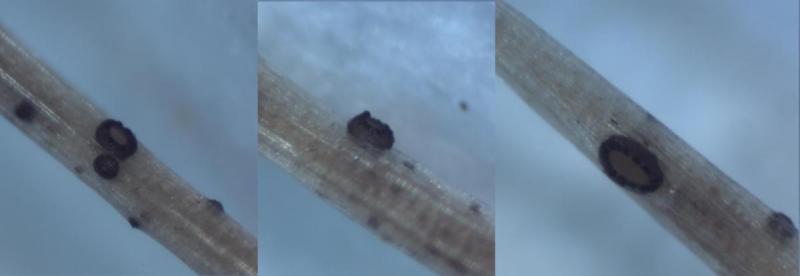
Apothecia are at first immersed in the substrate when they are more or less spherical with a small ostiole. They then becoming erumpent and urceolate, <140 µm diam. The hymenium is pale cream with a light brown exterior and rough dark brown "teeth" on the margin.
The excipulum is a brown textura angularis/globulosa. Marginal cells are dark brown and form irregular "teeth".
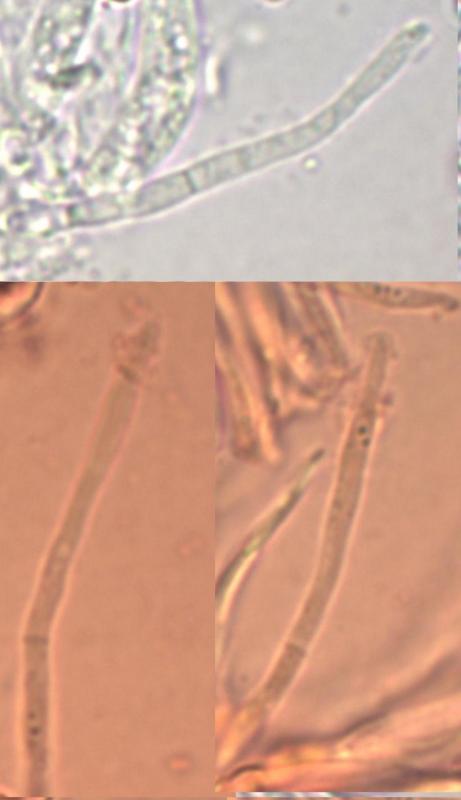
Asci are 26-32 x 4-5 µm, 8-spored, apex blue in IKI. They are mostly immature.
Paraphyses are narrowly cylindrical, ca 1.5 µm wide, about as long as asci.
Spores are hyaline, 0-septate, 7-9 x 1.5-2 µm, fusiform-clavate.
I think it belongs in the Naevioideae but this isn't a group I'm very familiar with and I haven't been able to put a name to it. As ever, I'd be very grateful for any suggestions.
Marcus




Zotto

Maybe the teeth could suggest some sort of Pirottaea (which probably belong to multiple lineages in Pyrenopeziza).
Many members of the Pyrenopeziza lineage are extremely common on grasses (based on anamorphs, grass disease symptoms and DNA sequences), but their DNA and teleomorph morphology haven't been linked up yet.
Cheers,
Brian
Thanks for pointing me in the right direction. This will have to be added to my large collection of unnamed specimens.
I've been trying to get to grips with the commoner species of Mollisia and Pyrenopeziza over the last few months. It's not easy!
Marcus