
12-06-2026 14:50
 François Freléchoux
Bonjour, Voici la brève description d'une Mollis
10-06-2026 21:16
François Freléchoux
Bonsoir,Le dernier du jour, en attendant votre avi
11-06-2026 19:01
 William Slosse
Hello all,In an attempt to make a culture of a sus
11-06-2026 19:03
 Nicolas VAN VOOREN
Chers membres d'Ascofrance,Le site sera placé en

09-06-2026 18:32
Camille MertensSur morceau de roseau immergé 0,5 - 0,7 mm de dia
10-06-2026 12:54
Steve ClementsBonjour encore, Pouvez-vous m'aider, s'il vous pl
10-06-2026 21:07
François Freléchoux
Toutes les tiges de gentianes jaunes de l'an passÃ
10-06-2026 13:41
François Freléchoux
Bonjour à nouveau, Voici une trouvaille d'hier.
Deux récoltes d'Hymenoscyphus du Coignelot (Manhay, Ardenne belge)
Luc Bailly,
12-09-2007 21:05
 Bonjour à tous,
Voici le résultat de l'étude de deux récoltes, pour vérification, et pour voir si ça va pour remplir deux fiches. Récolte, détermination et photos par Luc BAILLY.
---------------------------------------------------
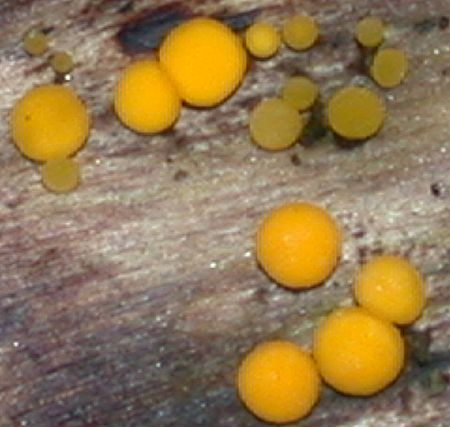
1) Hymenoscyphus conscriptus
Bétulaie pubescente mouilleuse, sur bois humide de Salix cinerea à terre, 080907
Apothécies jaune vif, vite pulvinées, diamètre jusqu'à 2-3 mm. Pied court et épais, de moins d' un mm. En groupe sur bois décortiqué.
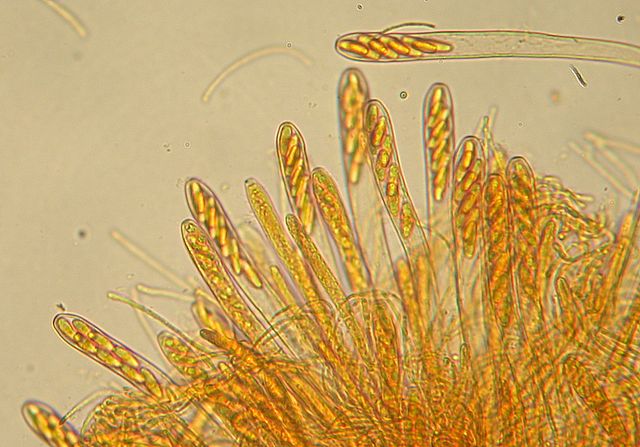
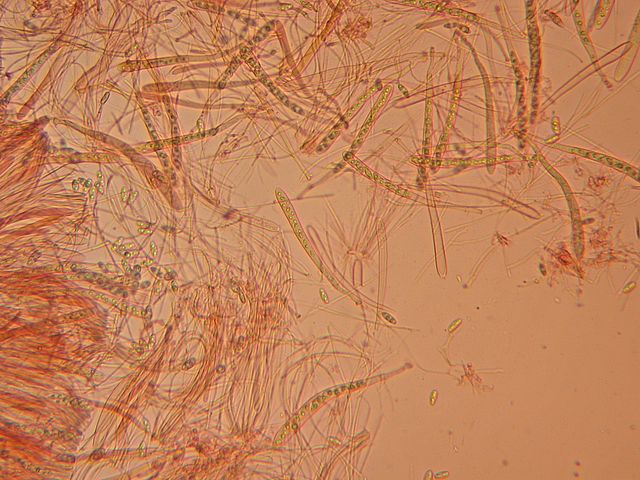
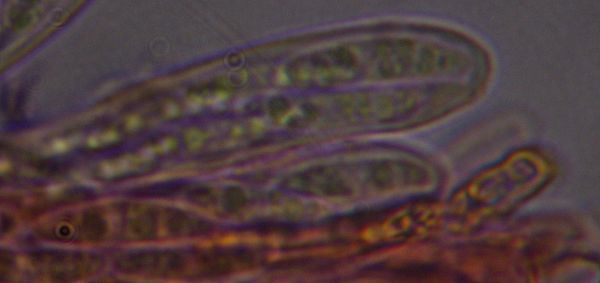
Asques p.ex. 115X7.5 µ, J+, à spores bisériées.
Spores guttulées sauf au milieu à nettement biguttulées, 10.5-16 X 3.5-6 µ, parfois 1-septées.
Paraphyses filiformes, branchues vers la base, rarement cloisonnées, X 1.5 µ vers le sommet.
Photo de la récolte:
Luc Bailly,
12-09-2007 21:08
Re:Deux récoltes d'Hymenoscyphus du Coignelot (Manhay, Ardenne belge)
Photos des asques dans l'iode (liquide de Baral):
Luc Bailly,
12-09-2007 21:09
Re:Deux récoltes d'Hymenoscyphus du Coignelot (Manhay, Ardenne belge)
Photo générale des asques, spores et paraphyses:
Luc Bailly,
12-09-2007 21:20
Re:Deux récoltes d'Hymenoscyphus du Coignelot (Manhay, Ardenne belge)
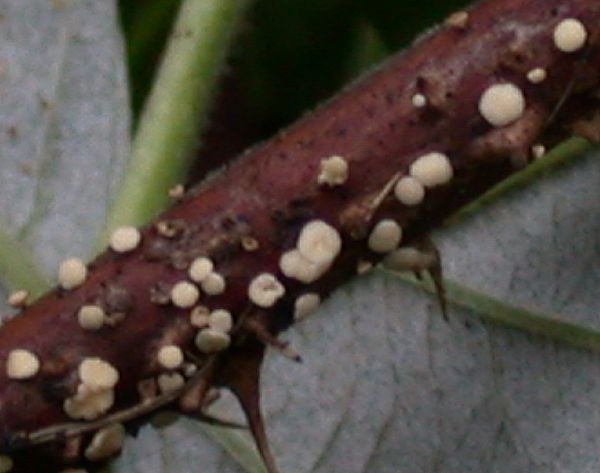
2) Hymenoscyphus separabilis.
Massif de Rubus idaeus en bordure d'une jeune plantation d'épicéas, sur tige morte de Rubus idaeus.
Apothécie de couleur paille pâle à blanchâtre, vite pulvinée, parfois lobée, sessile ou subsessile, lisse, marge un peu débordante; hyménium concolore; diamètre jusqu'à 1 mm.
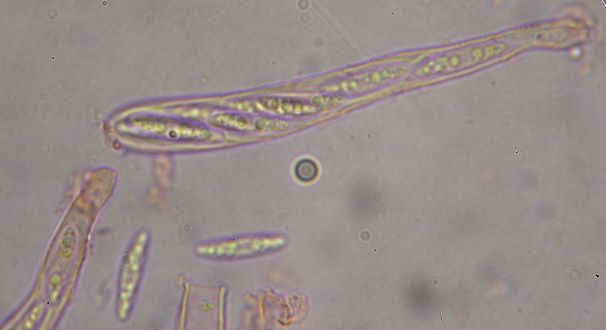
Asques: p.ex. 65X6 µ, J+; spores irrégulièrement bisériées.
Spores 12-13X2.5-3 µ, guttulées aux pôles.
Paraphyses irrégulièrement cylindriques, cloisonnées, + ou - branchues au sommet, certaines contenant au sommet une inclusion jaune (voir photo), X3-4 µ
Photo de la récolte:
Massif de Rubus idaeus en bordure d'une jeune plantation d'épicéas, sur tige morte de Rubus idaeus.
Apothécie de couleur paille pâle à blanchâtre, vite pulvinée, parfois lobée, sessile ou subsessile, lisse, marge un peu débordante; hyménium concolore; diamètre jusqu'à 1 mm.
Asques: p.ex. 65X6 µ, J+; spores irrégulièrement bisériées.
Spores 12-13X2.5-3 µ, guttulées aux pôles.
Paraphyses irrégulièrement cylindriques, cloisonnées, + ou - branchues au sommet, certaines contenant au sommet une inclusion jaune (voir photo), X3-4 µ
Photo de la récolte:
Luc Bailly,
12-09-2007 21:21
Re:Deux récoltes d'Hymenoscyphus du Coignelot (Manhay, Ardenne belge)
Asque et spores:
Luc Bailly,
12-09-2007 21:23
Re:Deux récoltes d'Hymenoscyphus du Coignelot (Manhay, Ardenne belge)
Paraphyse avec inclusion huîleuse jaune:
Merci d'avance pour vos critiques, amitiés mycologiques,
- LUC.
Merci d'avance pour vos critiques, amitiés mycologiques,
- LUC.
Hans-Otto Baral,
12-09-2007 22:34

Re:Deux récoltes d'Hymenoscyphus du Coignelot (Manhay, Ardenne belge)
Bonsoir
I agree with separapilis, a species rather rarely seen by me. I can only add that this is now transferred to Phialina by Huhtinen & Scheuer 1995 (Österr. Z. P. 4: 1-9), an opinion which I accept apart from the fact that I do not see any reason to distinguish between Phialina and Calycellina. Not only because of the apical ring shape this species is not a Hymenoscyphus but belongs in a different family, Hyaloscyphaceae.
As for H. conscriptus your microphotos are too small to be sure. Oil immersion is necessary. I even cannot exclude that this is merely Bisporella citrina (or confluens). Is the ectal excipulum gelatinized? How is the shape of the amyloid apical ring?
Zotto
I agree with separapilis, a species rather rarely seen by me. I can only add that this is now transferred to Phialina by Huhtinen & Scheuer 1995 (Österr. Z. P. 4: 1-9), an opinion which I accept apart from the fact that I do not see any reason to distinguish between Phialina and Calycellina. Not only because of the apical ring shape this species is not a Hymenoscyphus but belongs in a different family, Hyaloscyphaceae.
As for H. conscriptus your microphotos are too small to be sure. Oil immersion is necessary. I even cannot exclude that this is merely Bisporella citrina (or confluens). Is the ectal excipulum gelatinized? How is the shape of the amyloid apical ring?
Zotto
Luc Bailly,
12-09-2007 23:20
Re:Deux récoltes d'Hymenoscyphus du Coignelot (Manhay, Ardenne belge)
Thanks for these informations, Zotto. I'll make a new preparation of the asco on Salix to describe those details.
(Je ferai une nouvelle préparation de l'exemplaire sur saules pour décrire ces détails.)
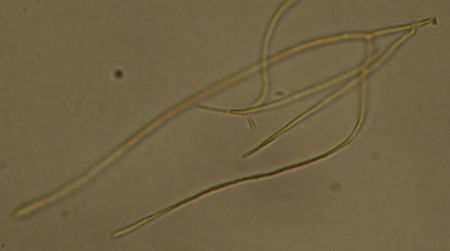
Photo plus précise des paraphyses de la récolte sur saules (yellow asco on Salix, paraphyses):
(ok, trouvé la combinaison complète pour P. separabilis)
(Je ferai une nouvelle préparation de l'exemplaire sur saules pour décrire ces détails.)
Photo plus précise des paraphyses de la récolte sur saules (yellow asco on Salix, paraphyses):
(ok, trouvé la combinaison complète pour P. separabilis)
NC NC,
13-09-2007 15:30
Re:Deux récoltes d'Hymenoscyphus du Coignelot (Manhay, Ardenne belge)
The photo of H. conscriptus looks to me more like a Bisporella than a Hymenoscyphus. Have you made a secion of the apothecium?
Dick Korf
Dick Korf