

19-05-2026 10:27
Patrice TANCHAUDBonjour, récolte récente sur terre retournée i
04-06-2026 18:39
Gernot FriebesHi,I collected this species in two different locat
22-05-2026 13:29
Gernot FriebesHi,I am curious to hear your opinion on this mater
04-06-2026 10:50
 François Freléchoux
Bonjour, J'ai trouvé hier un petit asco observé
04-06-2026 07:02
François Freléchoux
Bonjour, Voici la description d'une espèce qui p
04-06-2026 13:34
Gernot FriebesHi,I am interested to hear your opinion on this Le
04-06-2026 11:36
Gernot FriebesHi,found on Vaccinium myrtillus.Asci: IKI –, 8-s
Associated with Sphaeropsis sapinea?
Jenny Seawright,
10-03-2015 14:50
 Hello all,
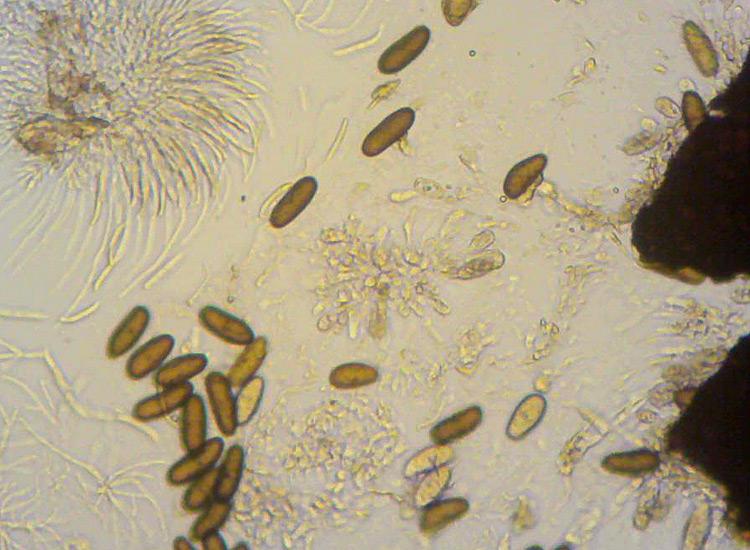
 I noticed a gelatinous substance on cone scales of Pinus sylvestris, in many (but not all) cases associated with black perithecia.
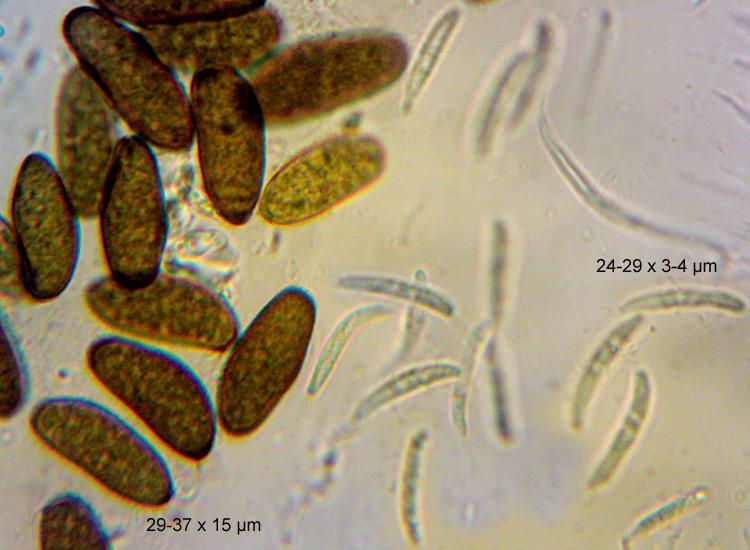
Spores / conidia from the black perithecia were light brown, simple but some faintly 1-septate, 29-37 x 15 µm - smaller than those suggested by Christian Lechat as Sphaeropsis sapinea in different post, but within the size range for that species?
Conidia from the gelatinous substance were hyaline, c. 24-29 x 3-4 µm. Are these from a different fungus?
With regards,
Jenny

Chris Yeates,
10-03-2015 20:58

Re : Associated with Sphaeropsis sapinea?
Hi Jenny
I would still be happy that that is Sphaeropsis sapinea; I have seen it with two and even on occasion three septa. Regarding your second fungus, although your conidial sizes are at the very top end I would wonder about these being beta-condia of Phomopsis conorum now treated as one of the numerous synonyms of the plurivorous Diaporthe eres; I see this is currently in Species Fungorum under an anamorph name - "One Fungus, One Name" at work here? http://www.speciesfungorum.org/Names/SynSpecies.asp?RecordID=123547
best wishes
Chris
I would still be happy that that is Sphaeropsis sapinea; I have seen it with two and even on occasion three septa. Regarding your second fungus, although your conidial sizes are at the very top end I would wonder about these being beta-condia of Phomopsis conorum now treated as one of the numerous synonyms of the plurivorous Diaporthe eres; I see this is currently in Species Fungorum under an anamorph name - "One Fungus, One Name" at work here? http://www.speciesfungorum.org/Names/SynSpecies.asp?RecordID=123547
best wishes
Chris
Jenny Seawright,
11-03-2015 10:34
Re : Associated with Sphaeropsis sapinea?
Thanks for the reply Chris, and for confirming the Sphaeropsis. I'll try and find some spores and perithecia of Diaporthe eres among it.........
With regards
Jenny
With regards
Jenny
Chris Yeates,
11-03-2015 15:43
Re : Associated with Sphaeropsis sapinea?
Hi Jenny
you won't necessarily be able to find the teleomorph. It is quite common to find Phomopsis spp. on dead twigs, stems, leaves etc., without the accompanying Diaporthe.
After a while recognising Phomopsis alpha*- and ß-conidia is generally quite straightforward - do you have access to the two volumes of British Stem & Leaf Fungi by W.B. Grove?
best wishes
Chris
*system is not letting me enter the Greek letter
you won't necessarily be able to find the teleomorph. It is quite common to find Phomopsis spp. on dead twigs, stems, leaves etc., without the accompanying Diaporthe.
After a while recognising Phomopsis alpha*- and ß-conidia is generally quite straightforward - do you have access to the two volumes of British Stem & Leaf Fungi by W.B. Grove?
best wishes
Chris
*system is not letting me enter the Greek letter
Jenny Seawright,
11-03-2015 19:04
Re : Associated with Sphaeropsis sapinea?
Thanks again Chris, but no, I don't have either volume of Grove's "Stem and Leaf Fungi"
John Plischke,
12-03-2015 00:25
John Plischke,
12-03-2015 00:27

Re : Associated with Sphaeropsis sapinea?
This may work better the first did not take you to the book or download page
http://bibdigital.rjb.csic.es/ing/FichaLibro.php?Libro=5228
Jenny Seawright,
12-03-2015 11:21
Re : Associated with Sphaeropsis sapinea?
Thank you both for your help - it is much appreciated!
With regards,
Jenny
With regards,
Jenny