
04-06-2026 11:36
Gernot FriebesHi,found on Vaccinium myrtillus.Asci: IKI –, 8-s
04-06-2026 07:02
 François Freléchoux
Bonjour, Voici la description d'une espèce qui p
04-06-2026 10:50
François Freléchoux
Bonjour, J'ai trouvé hier un petit asco observé
22-05-2026 13:29
Gernot FriebesHi,I am curious to hear your opinion on this mater
18-10-2022 00:12
Valencia Lopez Francisco JavierHola amigos/asRecientemente encontré esta colecci
03-06-2026 19:45
 Miguel Ángel Ribes
Good afternoonI'm completely baffled by this suppo
03-06-2026 14:39
Thomas FlammerApothecia yellow, glassy-transparent, 80 - 120 ymS

Anamorphe
Ueli Graf,
18-03-2015 22:48
 Hallo,
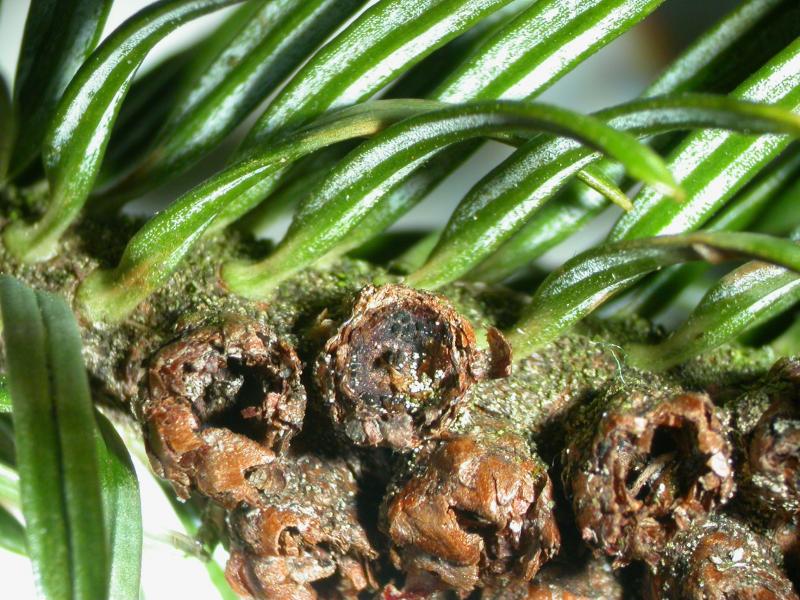
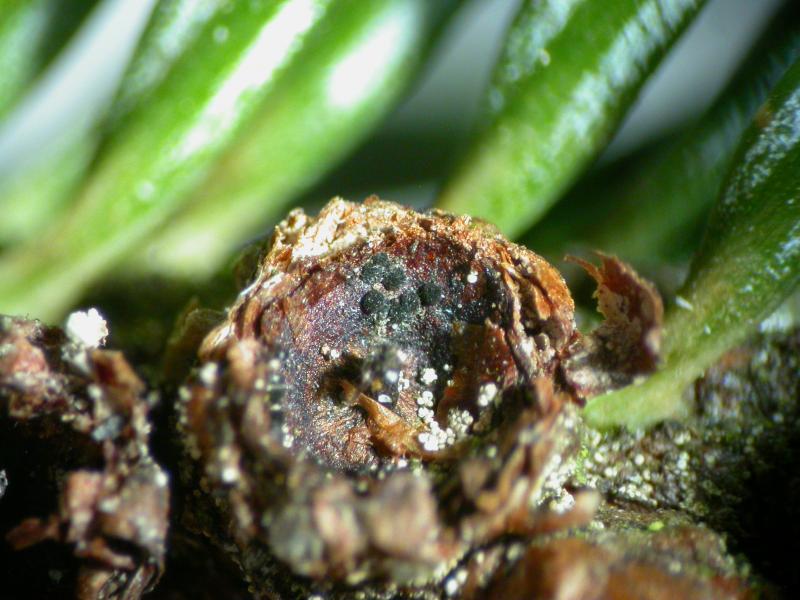
ich habe das heute gefunden auf männlichem Blütenzapfen von Abies alba.
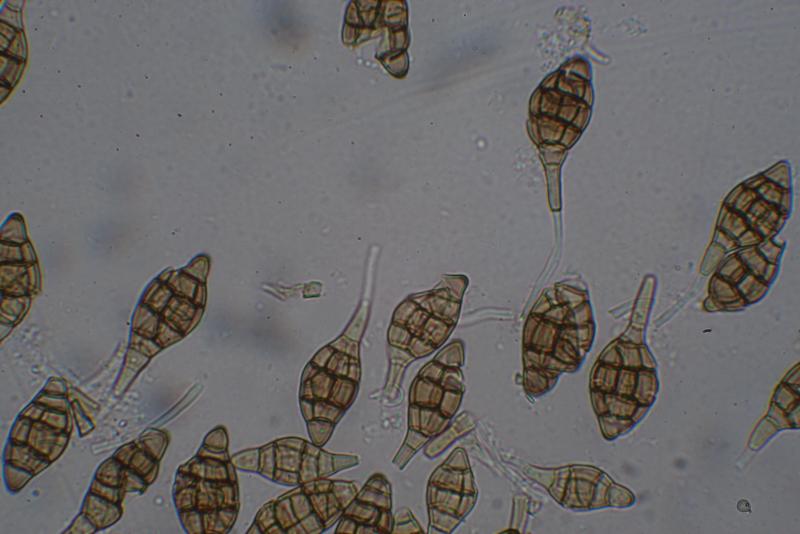
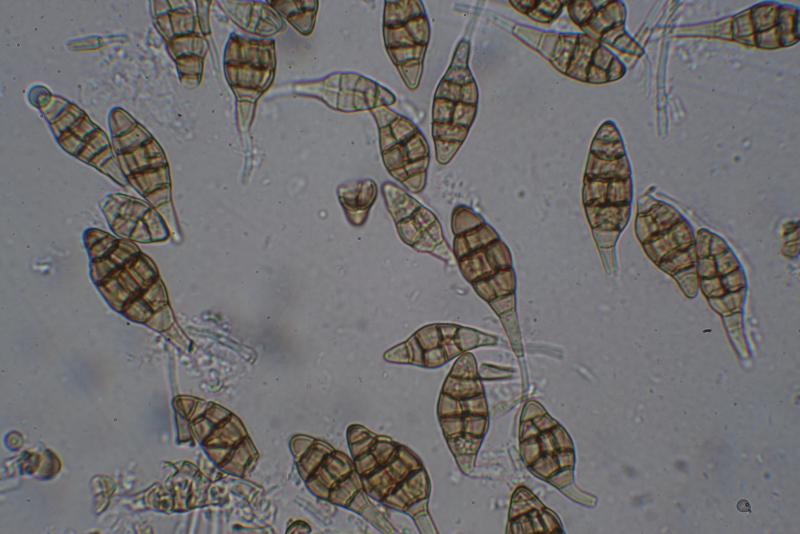
Kann mir jemand sagen was es ist? Sp. 31 - 40 x 11,5 - 13 mü.
Gruss
Ueli
Martin Bemmann,
18-03-2015 23:14

Re : Anamorphe
Hallo Ueli,
vielleicht eine Alternaria? Das hier: http://www.cbs.knaw.nl/index.php/cbs-biodiversity-series/329-cbs-biodiversity-series-6 habe ich leider nicht.
Herzlich
Martin
vielleicht eine Alternaria? Das hier: http://www.cbs.knaw.nl/index.php/cbs-biodiversity-series/329-cbs-biodiversity-series-6 habe ich leider nicht.
Herzlich
Martin
Chris Yeates,
19-03-2015 00:25

Re : Anamorphe
Hallo Ueli
am I correct in thinking that the long, hyaline 'tail' is the end with the point of attachment? If that is the case and, as it appears, the fungus is forming sporodochia, I don't think its an Alternaria; also Alternaria species (I think) rarely occur on wood like this.
I can't think of many dictyosporous sporodochial hyphomycetes (I'm probably missing something - I'll sleep on it ;-) )
LG
Chris
am I correct in thinking that the long, hyaline 'tail' is the end with the point of attachment? If that is the case and, as it appears, the fungus is forming sporodochia, I don't think its an Alternaria; also Alternaria species (I think) rarely occur on wood like this.
I can't think of many dictyosporous sporodochial hyphomycetes (I'm probably missing something - I'll sleep on it ;-) )
LG
Chris
Walter Gams,
19-03-2015 08:02

Re : Anamorphe
I cannot find another suitable genus of hyphomycetes in "Genera of Hyphomycetes" other than Alternaria. But I rather feel this is a coelomycete for which I do not have the literature at hand. It would be crucial to see on which end the conidia were attached.
Dartanha Soares,
19-03-2015 14:12

Re : Anamorphe
My best guess is Alternaria. I belive that the attachment point is the "rounded" end of the conidium, not the "tail" end. You can see, on several conidia, a dark area in the rounded end consistent with the conidium attachment scar of Alternaria.
I don't believe the fungus is forming sporodochia, to me seems that the fungus is growing above something else (a resin drop, an insect body?) and a section of that "fluffy" structure will clarify the doubt. That will also provide the missing "attachment point".
I don't believe the fungus is forming sporodochia, to me seems that the fungus is growing above something else (a resin drop, an insect body?) and a section of that "fluffy" structure will clarify the doubt. That will also provide the missing "attachment point".
Ueli Graf,
19-03-2015 21:55
Re : Anamorphe
Hello, thank you to Martin, Chris, Walter and Dartanha. Has anyone interested in the mushroom? I alone can not determine the and would send the per post.
Thanks Ueli
M Jonathan,
22-03-2015 21:05

Re : Anamorphe
I beleive that the rostrum is how the fungus attach itself to the conidiophore wich seem to be lacking here, i highly doubt that this is alternaria , (that and I think that it is really making those sporodochium?) I am not sure what it is neither, but i do not feel it is a coelomycete neither, curious.
If it is truly an alternia however I would be interested in that collection, it look promising.
If it is truly an alternia however I would be interested in that collection, it look promising.
M Jonathan,
01-04-2015 02:41
Re : Anamorphe
received it today, it is not an Alternia but i am not quite sure what it is yet, perhaps an thyrostroma or stigmina, the fungus indeed produce distinctive black sporodochium
the conidia are also attached to the the sporodochia by the beak and are not chained.
I will try to do a culture of it when I will have time, but right now i am quite busy with my classes, the end of the session is coming soon!
https://farm9.staticflickr.com/8726/16374444243_da8c21fb2f_b.jpg (attachement point with imature conidia)
https://farm8.staticflickr.com/7650/16993154902_931d934b1a_b.jpg (conidia)
https://farm9.staticflickr.com/8736/16372160374_57dc5107c7_b.jpg (more conidia, more mature)
https://farm8.staticflickr.com/7588/16993155032_399ba818ea_b.jpg (a terrible picture i know, but i show a bit the sporodochium).
the conidia are also attached to the the sporodochia by the beak and are not chained.
I will try to do a culture of it when I will have time, but right now i am quite busy with my classes, the end of the session is coming soon!
https://farm9.staticflickr.com/8726/16374444243_da8c21fb2f_b.jpg (attachement point with imature conidia)
https://farm8.staticflickr.com/7650/16993154902_931d934b1a_b.jpg (conidia)
https://farm9.staticflickr.com/8736/16372160374_57dc5107c7_b.jpg (more conidia, more mature)
https://farm8.staticflickr.com/7588/16993155032_399ba818ea_b.jpg (a terrible picture i know, but i show a bit the sporodochium).