
07-06-2026 15:10
 William Slosse
Hello everyone,On 05-06-26, I found following asco
08-06-2026 10:16
 Spooren Marco
I don`t have a clou about this fungus,it is not in
07-06-2026 12:09
 François Freléchoux
Bonjour, Voici une brève description de ce qui m
05-06-2026 11:02
Thomas Læssøehttps://svampe.databasen.org/observations/10596691
07-06-2026 12:43
Steve ClementsBojour. This was a strange find on a stick on my
12-07-2015 00:05
 Nedim Jukic
This one from the same locality as the previous on
06-06-2026 17:44
Steve ClementsBonjour, This disco was on planed wood 3 x 1.5 cm
14-08-2016 23:15
 Alex Akulov
Dear friendsCan you help me to find the descriptio

Dothideomycete on plum stone
Jacques Fournier,
19-04-2015 10:07
 Hi forum,
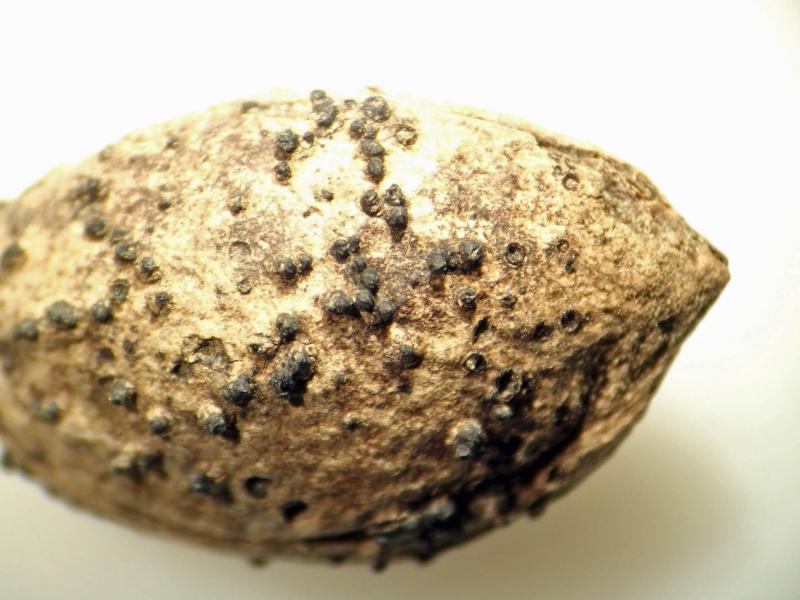
I am posting this Dothideomycete on the behalf of Paul Leroy who recently found it on wild plum stones (Prunus cerasifera) in the vicinity of Tours (France).
Ascomata are subglobose 0.5–0.6 mm diam, half immersed with a stout neck. The neck is broadly rounded or slightly laterally flattened, typically with a slit-like or more rarely Y-shaped ostiole. The wall is black, pseudoparenchymatous, thick and leathery, much thinner and less pigmented in the immersed part.
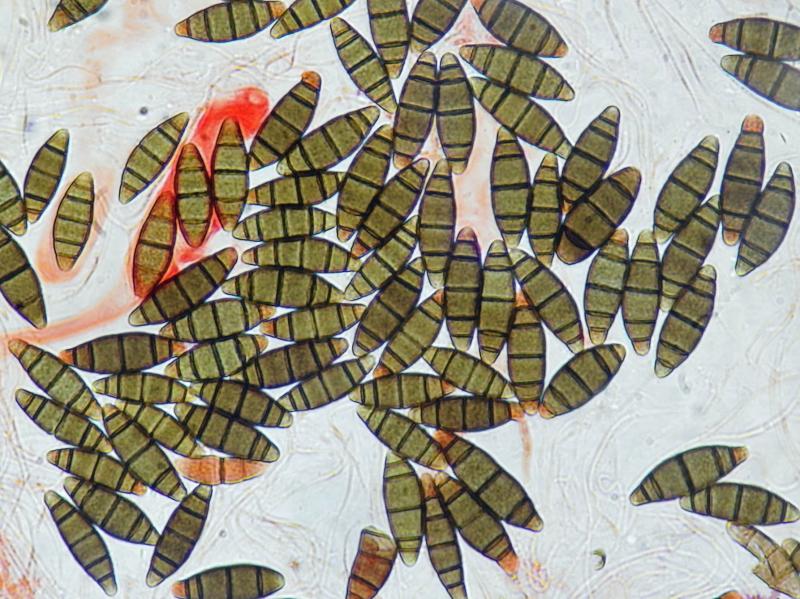
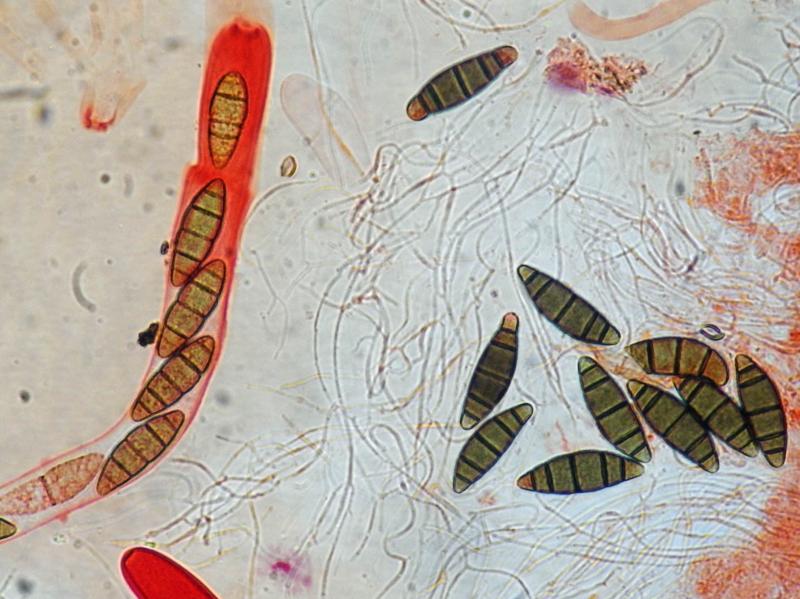
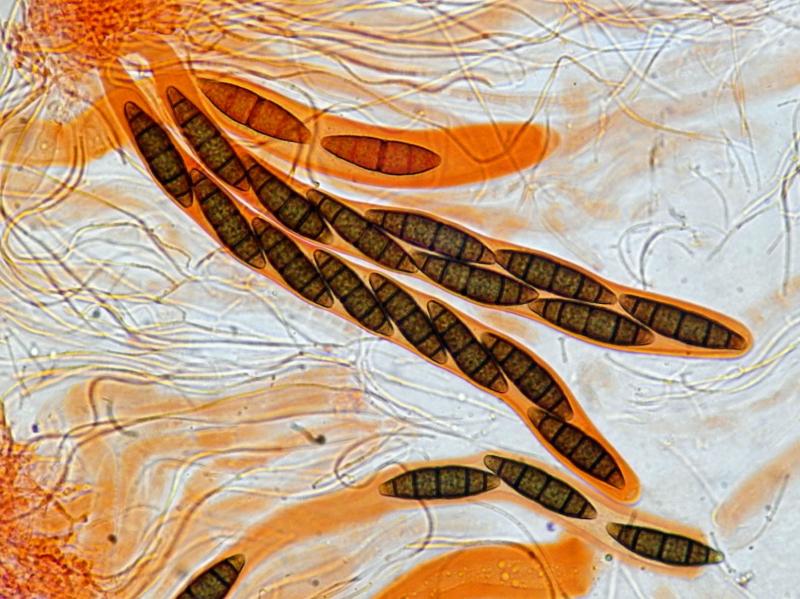
Asci are bitunicate and fissitunicate, short-stipitate, cylindrical to fusiform, with uniseriate overlaping ascospores tending to become biseriate in the mid-part. Apex with a distinct refractive annulus, well seen by contrast in Congo red. Hamathecium of narrow trabeculate pseudoparaphyses. Ascospores 35–38 x 8–9 µm, fusiform slightly inequilateral, 5-euseptate, olivaceous brown at fresh state, end cells smaller and paler, wall verrucose, without sheath.
We considered Trematosphaeria and Lophiostoma in which it might have been placed according to old concepts of these genera but without success. Because of the well-developed ostiolar necks and cylindrical asci with a refractive apical annulus we also considered Navicella but in this genus ascospores are distoseptate and the hamathecium is different.
The unusual substrate and the distinctive morphology of this fungus may remind you something we missed.
Thanks for your suggestions.
Cheers,
Jacques & Paul
Alain GARDIENNET,
19-04-2015 10:51

Re : Dothideomycete on plum stone
Salut Jacques,
Te voilà collé ! Ca rassure.
J'aurais conclu que c'est un asco du complexe Navicella, comme toi.
Je suppose que tu as cherché du côté de Fabre ?
Amuse toi bien !
Alain
Christian Lechat,
19-04-2015 10:54

Re : Dothideomycete on plum stone
Hi Jacques,
There is Lophiostoma oreophilum Speg. in Berlese (Icone Fungorum vol. 1, p. 11, Tab. VII, Fig. 3) which possess such ascospores with 5-euseptate and end cells smaller and paler, 30-35 x 8-10 µm.
Christian
There is Lophiostoma oreophilum Speg. in Berlese (Icone Fungorum vol. 1, p. 11, Tab. VII, Fig. 3) which possess such ascospores with 5-euseptate and end cells smaller and paler, 30-35 x 8-10 µm.
Christian
Jacques Fournier,
19-04-2015 15:12
Re : Dothideomycete on plum stone
merci Christian,
je n'avais pas pensé à consulter Berlese.
L. oreophilum est en effet une une piste mais il est lignicole et dans le protologue (Saccardo) il est dit que le substrat est coloré d'un vert qui rappelle Chorociboria. C'est quand même une piste.
J'ai parcouru Berlese et j'ai trouvé un joli Melanomma sur noyaux, M. nuclearium et sa variété majus, mais ils ne ressemblent pas au champignon de Paul.
Paul, fais un effort, trouve des champignons qui existent dans les livres!
Amitiés,
Jacques
je n'avais pas pensé à consulter Berlese.
L. oreophilum est en effet une une piste mais il est lignicole et dans le protologue (Saccardo) il est dit que le substrat est coloré d'un vert qui rappelle Chorociboria. C'est quand même une piste.
J'ai parcouru Berlese et j'ai trouvé un joli Melanomma sur noyaux, M. nuclearium et sa variété majus, mais ils ne ressemblent pas au champignon de Paul.
Paul, fais un effort, trouve des champignons qui existent dans les livres!
Amitiés,
Jacques