
31-03-2026 21:18
 Miguel Ángel Ribes
Good evening. oes anyone have the original descrip
31-03-2026 20:57
Stefan BlaserHello everybody, I hope somebody can help me with
26-03-2026 15:31
 Åke Widgren
Hello,I found this one in October last year, on r
31-03-2026 16:20
 Mlcoch Patrik
Hello, Please about help with determination. On
31-03-2026 08:19
 Bernard CLESSE
Bonjour à toutes et tous,Pourriez-vous m'aider à
30-03-2026 12:03
 William Slosse
Hello all,On 27/03/26, in Kraaiveld in Wingene (Be
25-03-2026 10:35
Hulda Caroline HolteHello,I collected this species growing on a dead b
Phaeohelotium epiphyllum var. epiphyllum...?
Dave Wasilewski,
21-08-2015 07:30
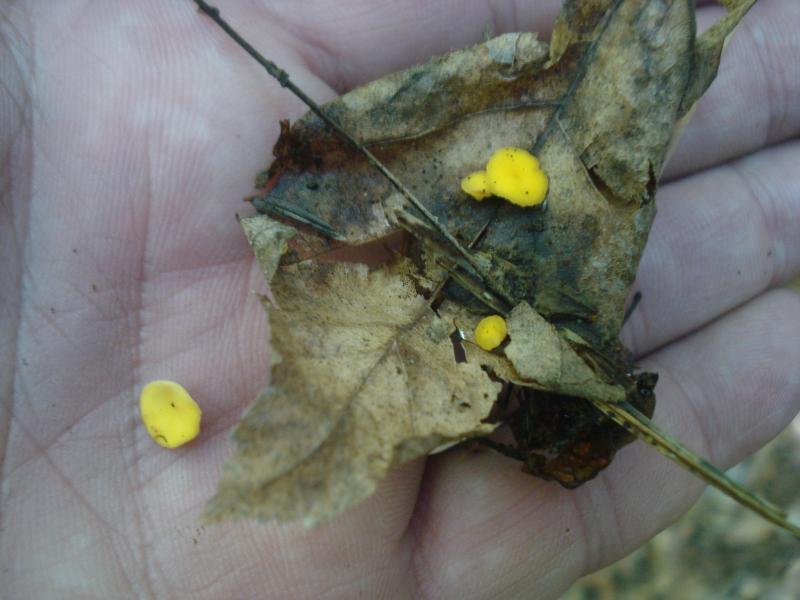
Hans-Otto Baral,
21-08-2015 09:16

Re : Phaeohelotium epiphyllum var. epiphyllum...?
The substrate is rather unimportant. P. epiphyllum grows on any kind of woody plant parts. Likewise P. monticola which has a more intense yellow colour and which I would more expect in your case.
Dave Wasilewski,
21-08-2015 15:42
Re : Phaeohelotium epiphyllum var. epiphyllum...?
Thank you Hans-Otto. According to Index Fungorum, the current name for Phaeohelotium monticola is Hymenoscyphus monticola. This pointed me in the direction of genus Hymenoscyphus, which I see includes many species, some of which grow on old leaves.
Hans-Otto Baral,
21-08-2015 19:15
Re : Phaeohelotium epiphyllum var. epiphyllum...?
Yes, but genetic results show that P. monticola is rather distant from Hymenoscyphus and may well be separated at the genus level. See my paper on Phaeohelotium terrestre agg.
Baral H.O., Galán R., Platas G., Tena R. (2013). Phaeohelotium undulatum comb. nov. and Phaeoh. succineoguttulatum sp. nov., two segregates of the Discinella terrestris aggregate found under Eucalyptus in Spain: taxonomy, molecular biology, ecology and distribution. – Mycosystema 32: 386–428.
Baral H.O., Galán R., Platas G., Tena R. (2013). Phaeohelotium undulatum comb. nov. and Phaeoh. succineoguttulatum sp. nov., two segregates of the Discinella terrestris aggregate found under Eucalyptus in Spain: taxonomy, molecular biology, ecology and distribution. – Mycosystema 32: 386–428.