
30-05-2026 21:12
Philippe PELLICIERSur branche de mélèze (Larix) près de la neige,
31-05-2026 10:35
Hulda Caroline HolteHello,I collected this species growing on a rather
25-05-2026 16:35
 Bernard CLESSE
Bonjour à toutes et tous,J'ai trouvé récemment,
29-05-2026 15:35
daniel FERREBonjour à tous,Je voudrais votre aide pour cette
28-05-2026 16:15
James MitchellHello,Does anyone have the original publication of
28-05-2026 11:06
Thomas Læssøehttps://svampe.databasen.org/observations/10596750
23-05-2026 11:44
 Charles Grapinet
Hello, I am having trouble identifying this copro
25-05-2026 16:44
François BartholomeeusenHi forum members,During an excursion organised by
26-05-2026 21:25
Dirk GerstnerHello everyone, I'm completely stumped by this li
26-05-2026 22:44
Ethan CrensonHi all, I think I have Incrucipulum capitatum her
Hymenoscyphus ombrophiliformis?
Åke Widgren,
26-03-2026 15:31
 Hello,
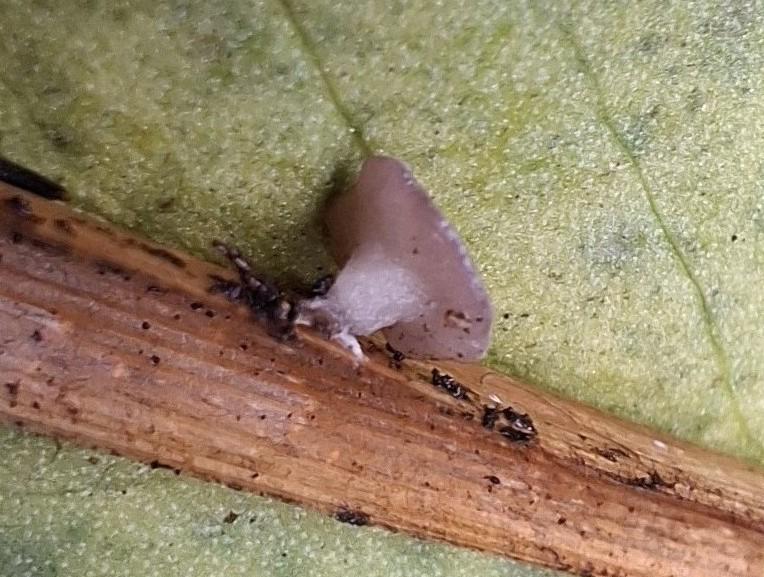
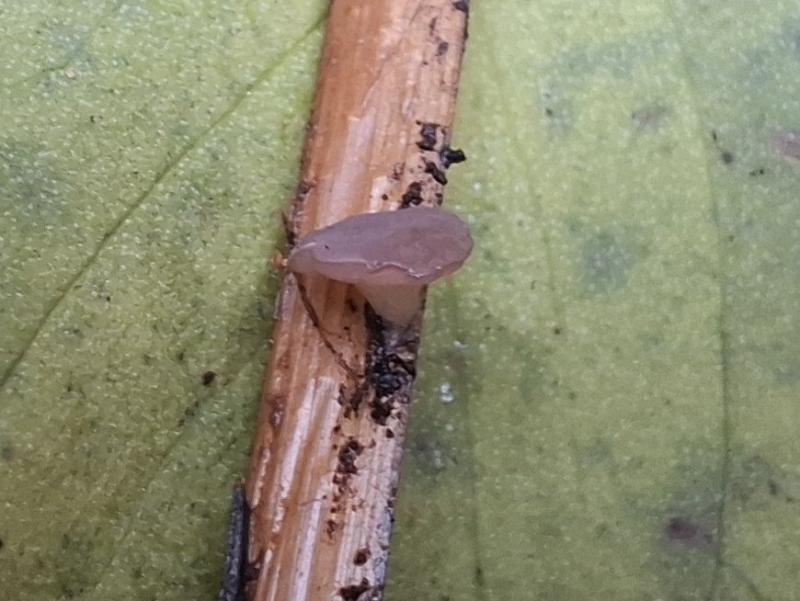
I found this one in October last year, on rutten leaves of Carex elata, on the bank of a small stream (Blekinge, southern Sweden). Unfortunately only a single fruit body, so I have microscoped just a small part of it. I´m quite sure it´s a Hymenoscyphus, and if so there are probably two alternatives - H. ombrophiliformis and H. syringaecolor. I think H. ombrophiliformis fits better, but the substrate maybe a bit odd? Are there any other alternatives?
Fb: about 4 mm wide, 2,5 mm high.
Color: purple
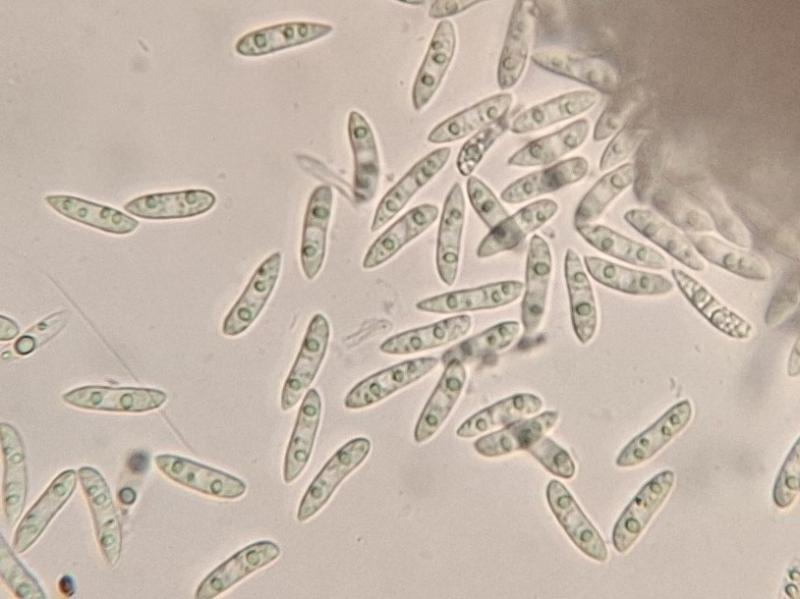
Spores: (17,9-) 19,3-21,5 (-22,5) x 4,5-5,0 um. Me = 20,4 x 4,8. Qe = 4,3.
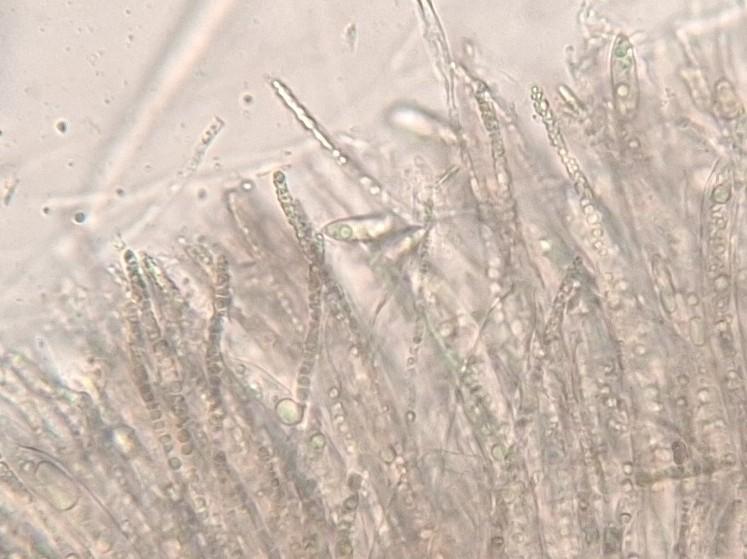
Asci: about 140-155 um long.
Paraphyses: filiform and septated, with small vacuoles.
I am grateful for your comments. Any help will be appreciated.
Best regards,
Åke
Michel Hairaud,
26-03-2026 15:58

Re : Hymenoscyphus ombrophiliformis?
Hi Ake,
Did you test IKI (Lugol) on asci apex ? This would give an essential character to a Hymenoscyphus possibility and would reject - or not - an Ombrophila species , which I suspect.
Amitié
Michel
Did you test IKI (Lugol) on asci apex ? This would give an essential character to a Hymenoscyphus possibility and would reject - or not - an Ombrophila species , which I suspect.
Amitié
Michel
Hans-Otto Baral,
26-03-2026 16:20

Re : Hymenoscyphus ombrophiliformis?
The spore areclearly scutuloid, so I am sure it is not an Ombrophila. Anyway, IKI reaction and croziers are essential. H. ombrohiliformis occurs on branches or pericarps of Fagus and has croziers. The similar H. syringaecolor, which has spore guttules very similar to this one here on Carex, occurs on Fagus leaves and lacks croziers.
Åke Widgren,
27-03-2026 10:18
Re : Hymenoscyphus ombrophiliformis?
Thanks for your comments!
I searched for croziers, and couldn't find any (but they are not always easy to see). Unfortunately I have no IKI, so I couldn´t check the reaction. Anyway - the substrate (Carex) is a bit confusing. There was a discussion about H. ombrophiloformis vs. syingaecolor in Ascomycetes of the world a year ago. Björn Wergen wrote that he was convinced that "there are additional undescribed species, growing on different substrates, all under the name 'H. syringaecolor'." Maybe that´s the problem? Now I will look for croziers a second time, and I´ll see if I can check the IKl reaction as well.
Regards
Åke
I searched for croziers, and couldn't find any (but they are not always easy to see). Unfortunately I have no IKI, so I couldn´t check the reaction. Anyway - the substrate (Carex) is a bit confusing. There was a discussion about H. ombrophiloformis vs. syingaecolor in Ascomycetes of the world a year ago. Björn Wergen wrote that he was convinced that "there are additional undescribed species, growing on different substrates, all under the name 'H. syringaecolor'." Maybe that´s the problem? Now I will look for croziers a second time, and I´ll see if I can check the IKl reaction as well.
Regards
Åke
Hans-Otto Baral,
27-03-2026 11:22
Re : Hymenoscyphus ombrophiliformis?
I d not know on which data Björn relies. H. syringaecolor is very rarely reported in the literature. Did he say which substrates he means to have similar species?
Åke Widgren,
27-03-2026 16:45
Re : Hymenoscyphus ombrophiliformis?
He just mentioned this:
"According to the key from Declercq, H. ombrophilaeformis has somewhat broader spores and grows on 'twigs and branches of Acer and Fagus in wet habitats'. I also have a collection of a Hymenoscyphus species growing on soil and buried wood."
In another discussion (with pictures) about the species, back in 2023, he wrote: "Hymenoscyphus cf. ombrophiliformis (also H. "ombrophilaeformis"), on plant debris on wet muddy soil, Schwarzwassertal (Austria), 28.08.22.fb 2-5 mm, with distinct stalk, purplish all over and somehow looking like a species of Ombrophila. spores (20.2) 20.5 - 23.9 (26.4) × (4.6) 4.7 - 5.2 (5.3) µm; Q = (3.9) 4 - 5 (5.4) ; N = 8. Me = 22.2 × 4.9 µm ; Qe = 4.5.
Asci without croziers, IKI+bb.
Any better ideas? Its a true Hymenoscyphus as far as I can see and there are only H. ombrophiliformis and H. syringaecolor described with such purplish colour, the latter one way smaller than the collection shown here."
Regards
Åke
"According to the key from Declercq, H. ombrophilaeformis has somewhat broader spores and grows on 'twigs and branches of Acer and Fagus in wet habitats'. I also have a collection of a Hymenoscyphus species growing on soil and buried wood."
In another discussion (with pictures) about the species, back in 2023, he wrote: "Hymenoscyphus cf. ombrophiliformis (also H. "ombrophilaeformis"), on plant debris on wet muddy soil, Schwarzwassertal (Austria), 28.08.22.fb 2-5 mm, with distinct stalk, purplish all over and somehow looking like a species of Ombrophila. spores (20.2) 20.5 - 23.9 (26.4) × (4.6) 4.7 - 5.2 (5.3) µm; Q = (3.9) 4 - 5 (5.4) ; N = 8. Me = 22.2 × 4.9 µm ; Qe = 4.5.
Asci without croziers, IKI+bb.
Any better ideas? Its a true Hymenoscyphus as far as I can see and there are only H. ombrophiliformis and H. syringaecolor described with such purplish colour, the latter one way smaller than the collection shown here."
Regards
Åke
Hans-Otto Baral,
27-03-2026 17:37
Re : Hymenoscyphus ombrophiliformis?
Can you provide a link to this species and discussion?
Åke Widgren,
27-03-2026 17:59
Re : Hymenoscyphus ombrophiliformis?
Åke Widgren,
31-03-2026 16:04
Re : Hymenoscyphus ombrophiliformis?
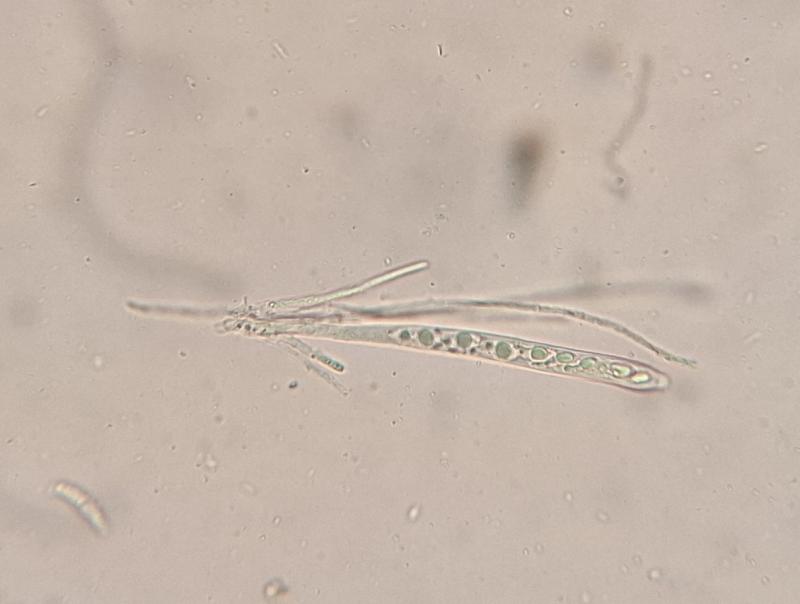
Now I have checked again for safe, and there are no croziers. I hope I can check the IKl reaction too. I'll write a message when it´s done.
Åke
Åke
Hans-Otto Baral,
31-03-2026 17:18
Re : Hymenoscyphus ombrophiliformis?
I have now looked at Björn's two finds. A third mentioned sample I did not see: from Bürser Schlucht (03.10.2023, on leaves of Fagus sylvatica).
In my opinion, the main difference between ombrophiliformis and syringicolor is the high OCI (4-5) in the former and relatively low OCI (2-3) in the latter.
I assume the third sample was syringicolor. The other two I would provisionally place in ombrophiliformis. Of course, they look quite different from each other, but when I look in my ombrophiliformis folder I also see quite a high variation in spore size and contents. To speak of different species is difficult, because for this we must be able to sort the finds accordingly.
Björn may be right, but I do not think he has a precise concept. The case seems to be quite problematic.