

30-05-2026 21:12
Philippe PELLICIERSur branche de mélèze (Larix) près de la neige,
31-05-2026 10:35
Hulda Caroline HolteHello,I collected this species growing on a rather
25-05-2026 16:35
 Bernard CLESSE
Bonjour à toutes et tous,J'ai trouvé récemment,
29-05-2026 15:35
daniel FERREBonjour à tous,Je voudrais votre aide pour cette
28-05-2026 16:15
James MitchellHello,Does anyone have the original publication of
28-05-2026 11:06
Thomas Læssøehttps://svampe.databasen.org/observations/10596750
23-05-2026 11:44
 Charles Grapinet
Hello, I am having trouble identifying this copro
25-05-2026 16:44
François BartholomeeusenHi forum members,During an excursion organised by
26-05-2026 21:25
Dirk GerstnerHello everyone, I'm completely stumped by this li
 I'd like your opinion on this Seynesia (¿?) species growing on Arundo donax stems at the sea level, at the north of Spain.
The blackish, roundish, inmersed perithecia, single or in pairs, are more or less roundish, up to 1 mm in diam., beneath a thin clypeus. Only the papilla is visible on the peridermis of the host, but it is not surrounded by teeth-like flanges as described for Seynesia nobilis.
The 8-spored asci have a wedge-shaped, amyloid, subapical apparatus. The living paraphyses are filled with a conspicuous, refractive, oily content that not dissapear in NH4OH. The ascospores are brownish at maturity, smooth-walled, two celled, constricted at the septum, with a full length germ slit in each cell, a thin mucilaginous sheath surrounding the ascospores and an obtuse or short cylindrical, not really conical, cap-like appendage at each pole of the spore.
I feel this species could be into the genus Seynesia, but I think it doesn't fit well with the somewhat known species of this genus (i.e. S. nobilis)
What is your opnion
Many thanks in advance
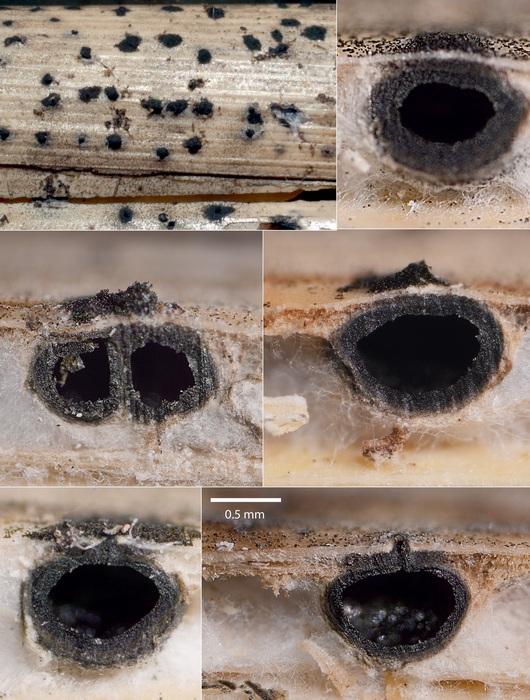
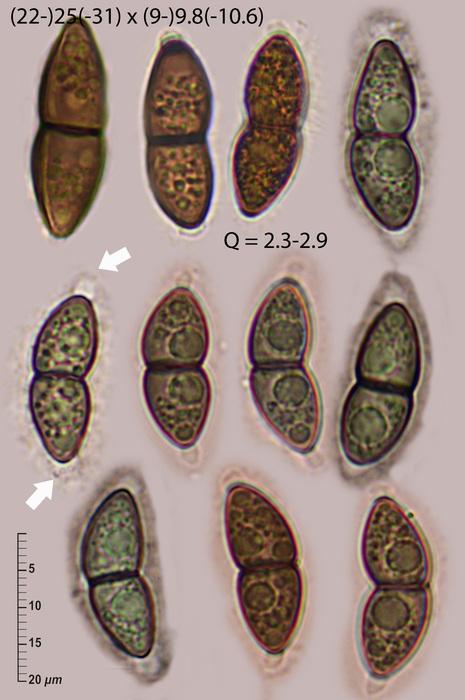
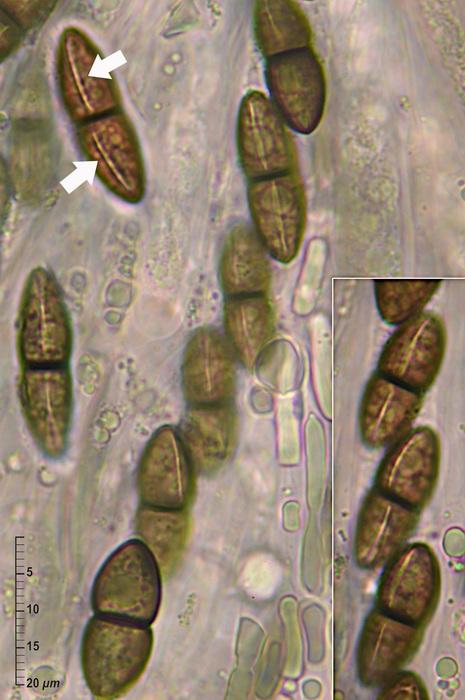
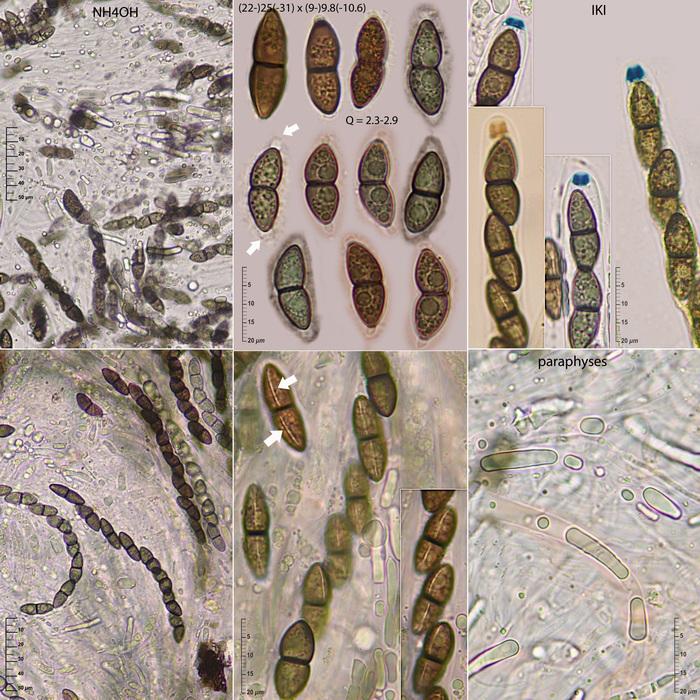

I was sure Arundo would give you nice suprises!
It's obviously a Seynesia and I find it fits fairly well in S. nobilis. Do you have Hyde's paper (1995) in Sydowia? He states that the teeth-like flanges around the clypeus are not always present, likely dependent on the texture of the host. Only the paraphyses with refractive content do not match.
I never encountered S. nobilis, thus I cannot discuss any more.
Saludos,
Jacques
Hi Jacques
Many thanks for your help and for advising me the study of Arundo