
02-06-2026 17:58
Louis DENYBonjour forum, Sur feuille de Populus tremula, en
02-06-2026 14:33
 Nicolas VAN VOOREN
Hello.I'm searching for a PDF copy of the followin

28-07-2011 18:31
 Alex Akulov
Dear FriendsToday I made the pdf file of Velenovsk
11-09-2025 16:57
 Jason Karakehian
Our revision of Marthamycetales (Leotiomycetes) is
12-11-2019 10:32
 Miguel Ángel Ribes
Hi againExactly at the same place than my previous
25-12-2019 17:54
Valencia Lopez Francisco JavierHola a todos/asEstas supuestas pezizas estaban en
12-07-2015 00:05
 Nedim Jukic
This one from the same locality as the previous on

30-05-2026 21:12
Philippe PELLICIERSur branche de mélèze (Larix) près de la neige,
 Hello forum,
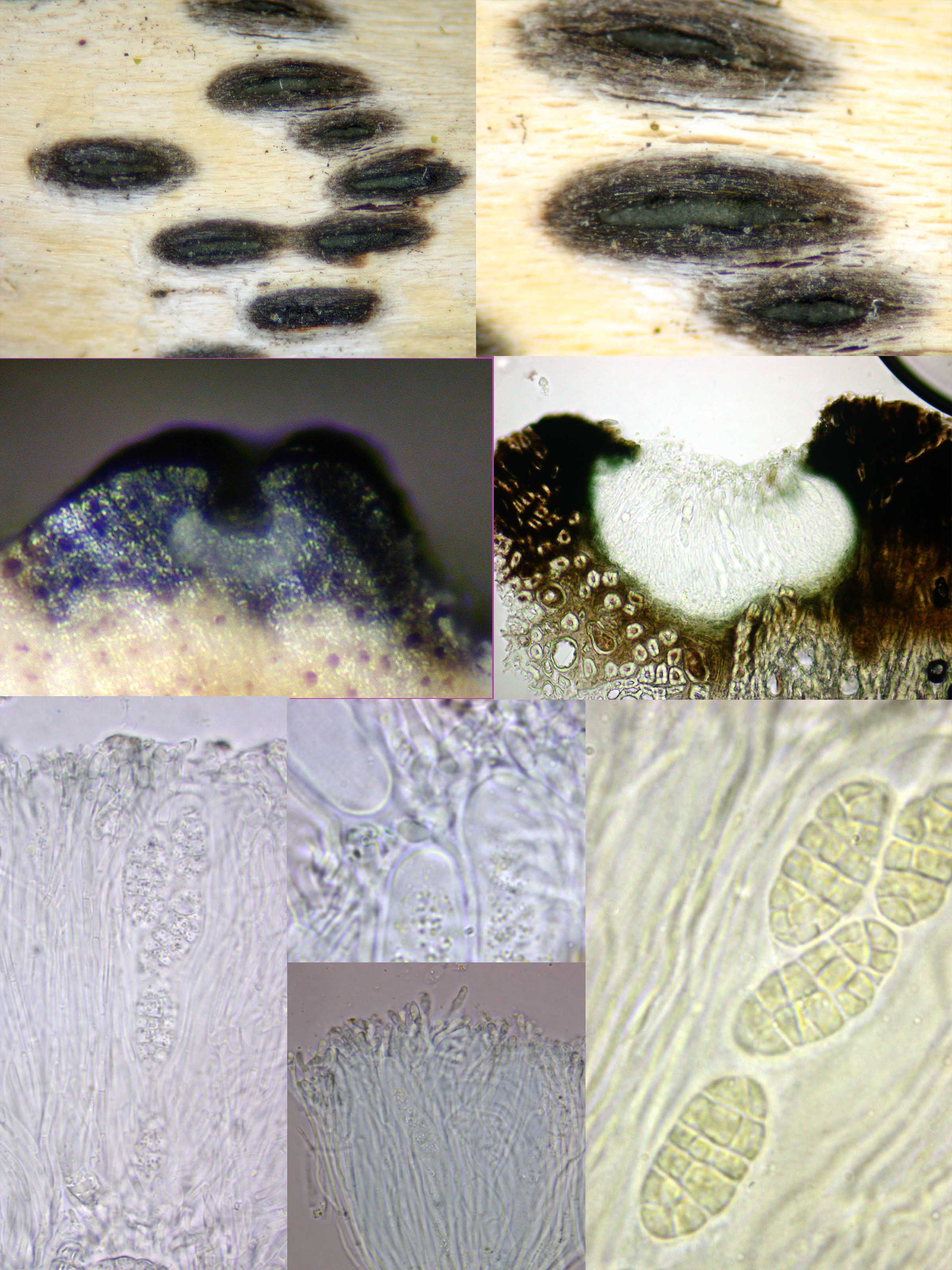
This ascomycete intrigues me. I found it on dead decorticated bleached twigs < 1cm diam of Buxus sempervirens, in a submediterranean environment, on a very dry and sun-exposed slope.
It appears as black erumpent hysterothecia, almost superficial at maturity, 1-1.2 mm long, with two thick black lips composed of wood cells and dark brown fungal tissue, opening over a dark grey elongated hymenium.
Hamathecium waxy, difficult to dissociate, composed of palisadic cellular pseudoparaphyses 1.8-2 µm diam, apically branched, with swollen tips coated with scattered greyish amorphous deposits, I-.
Asci few, likely bitunicate with a thin refractive ectoascus but lacking an ocular chamber and apparently not fissitunicate. They are clavate, subsessile, devoid of apical apparatus, 3-5-8-spored, I-.
Ascospores 16-21 x 8.5-10 µm, ellipsoid, hyaline, smooth, thin-walled, muriform, with 3-5 tranverse septa and 1-3 longitudinal or oblique septa in each cell, not constricted at septa, without slimy sheath.
I considered Patellarialles, especially because of the hamatecium anatomy but I failed to find a satisfactory genus in that order. This fungus is relatively conspicuous by its size and the contrast with the bleached wood, I hope someone will recognize it.
Thanks,
Jacques
 JF16038
it would probably be good to study immature dead asci for their possibly thick lateral and/or apical wall. In Patellariales I would expect bitunicate asci.
Zotto