
22-04-2026 20:54
 Enrique Rubio
Hi to everybody.This Pyrenopeziza grew in moist le
24-04-2026 03:16
 David Chapados
Found while looking at something else from wood in
22-04-2026 01:06
 Richard VALERI
Bonjour à tous.Je vous présente cette Nectria s.
22-04-2026 20:17
 Marian Jagers
Is anyone familiar with the Hyphomycetes genus Pse

21-04-2026 13:36
Gernot FriebesHi,I am out of ideas for this one. I collected Sal
Hyaloscypha auriella
Steve Clements,
21-07-2016 11:00
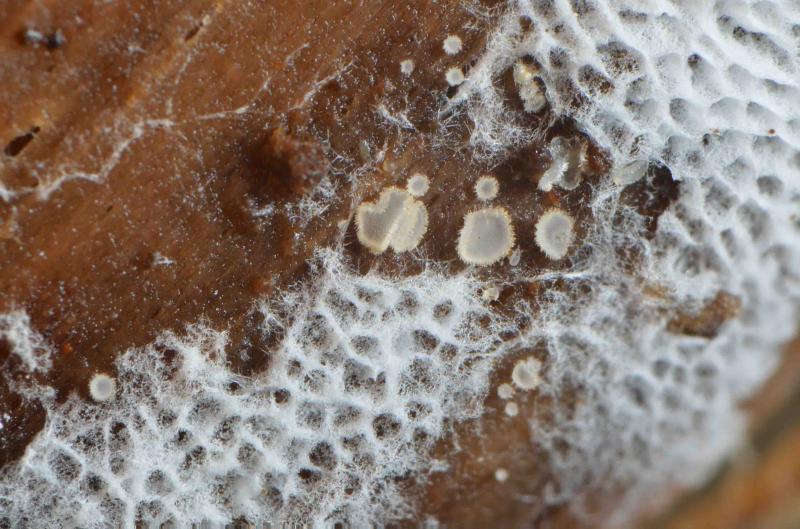
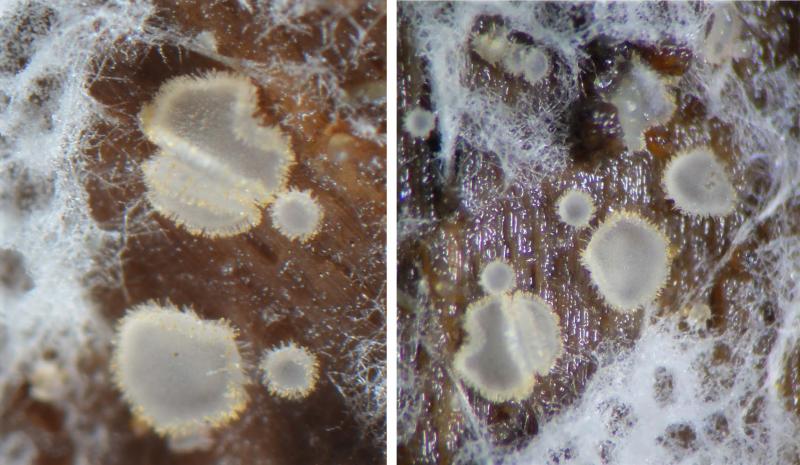
Nous avons trouvé cet disco sur un rondin de pin, avec le basidio Trechispora mollusca. Il est tres beau!
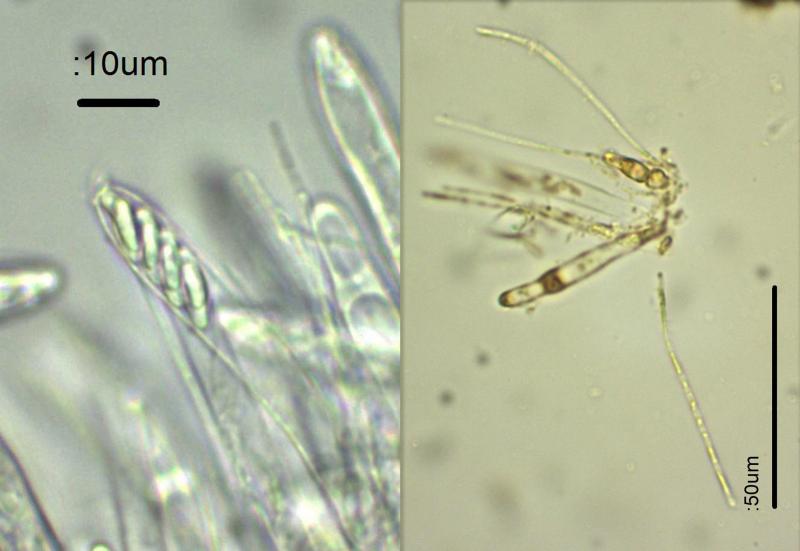
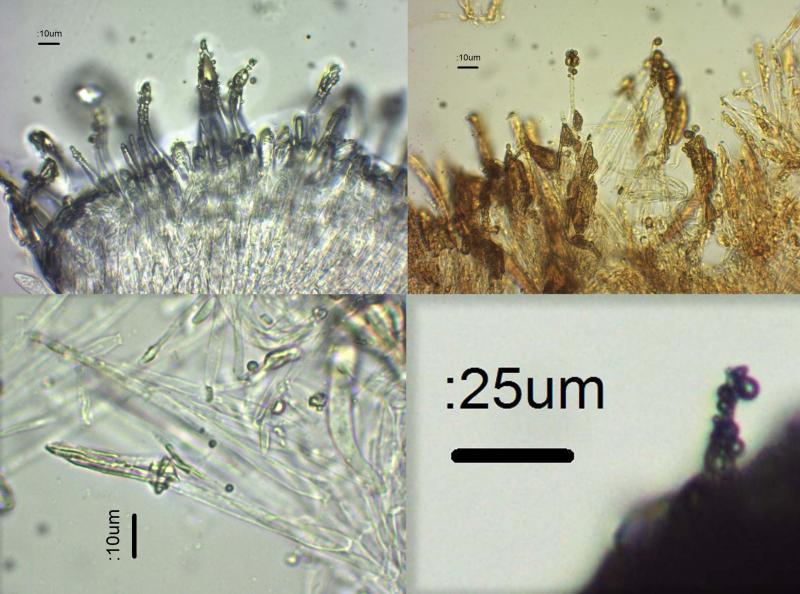
We found this tiny disco on a pine log growing with the basidiomycete resupinate fungus Trechispora mollusca. It was sessile, up to 6mm diameter. The most striking feature were the bright yellow tips to the hairs. These were difficult to see in a liquid mount as the encrustation tended to disperse. The hairs seem to be covered in droplets rather than crystals. From Peter Thompson's "Ascomycetes in Colour" I considered Hyaloscypha auriella, as the droplets could perhaps be what he describes as "pieces of resin". The hairs were however rather longer than he says, being over 50 um long. They were pointed.
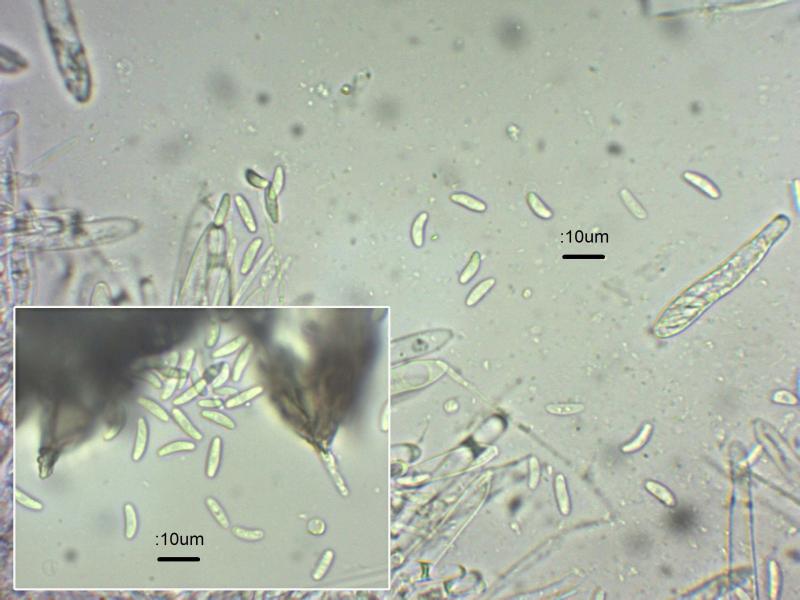
Spores were slighly curved, 8-11 x 2.5, hyaline, no obvious guttules noted.
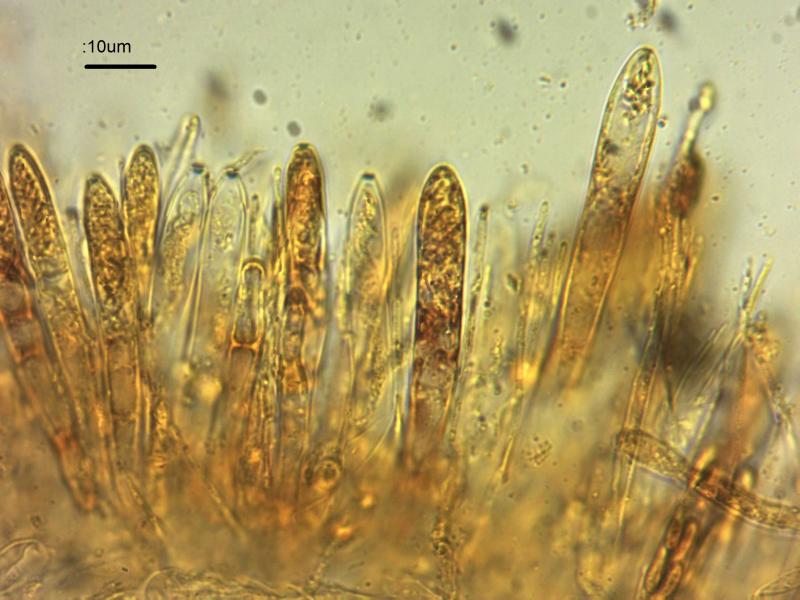
Asci were typically 45 x 7, biseriate, non-operculate, blueing in Lugol.
Paraphyses were thread-like, 1.5 wide.
Cordialement,
Steve
Hans-Otto Baral,
21-07-2016 11:33

Re : Hyaloscypha auriella
Yes, it is very typical H. aureliella. Indeed, the yellow substance is currently referred to as resinous. If you add Cresyl Blue this exudate stains turquoise, while in KOH it disappears/dissolves.
If you have these reagents please check.
I compared this exudate with that in Orbilia, which is very different in that it is inert to KOH. CRB gives a blue stain too, phloxin a bright pink stain, and Congo Red stains it red. The latter two reagents I never tested with this Hyaloscypha resin.
Zotto
If you have these reagents please check.
I compared this exudate with that in Orbilia, which is very different in that it is inert to KOH. CRB gives a blue stain too, phloxin a bright pink stain, and Congo Red stains it red. The latter two reagents I never tested with this Hyaloscypha resin.
Zotto
Steve Clements,
21-07-2016 20:38
Re : Hyaloscypha auriella
Thank you very much Zotto,
The pictures in Peter Thompson's book are not very good so I was very unsure - but it is still an excellent resource.
I have Cresyl Blue and KOH (as I have inherited a large collection of reagents),
With best regards,
Steve
The pictures in Peter Thompson's book are not very good so I was very unsure - but it is still an excellent resource.
I have Cresyl Blue and KOH (as I have inherited a large collection of reagents),
With best regards,
Steve