
05-06-2026 11:02
Thomas Læssøehttps://svampe.databasen.org/observations/10596691
07-06-2026 15:10
 William Slosse
Hello everyone,On 05-06-26, I found following asco
07-06-2026 12:43
Steve ClementsBojour. This was a strange find on a stick on my
07-06-2026 12:09
 François Freléchoux
Bonjour, Voici une brève description de ce qui m
12-07-2015 00:05
 Nedim Jukic
This one from the same locality as the previous on
06-06-2026 17:44
Steve ClementsBonjour, This disco was on planed wood 3 x 1.5 cm
14-08-2016 23:15
 Alex Akulov
Dear friendsCan you help me to find the descriptio

04-06-2026 11:36
Gernot FriebesHi,found on Vaccinium myrtillus.Asci: IKI –, 8-s
two Amicodisca
Kosonen Timo,
18-08-2016 10:13
 Hello,
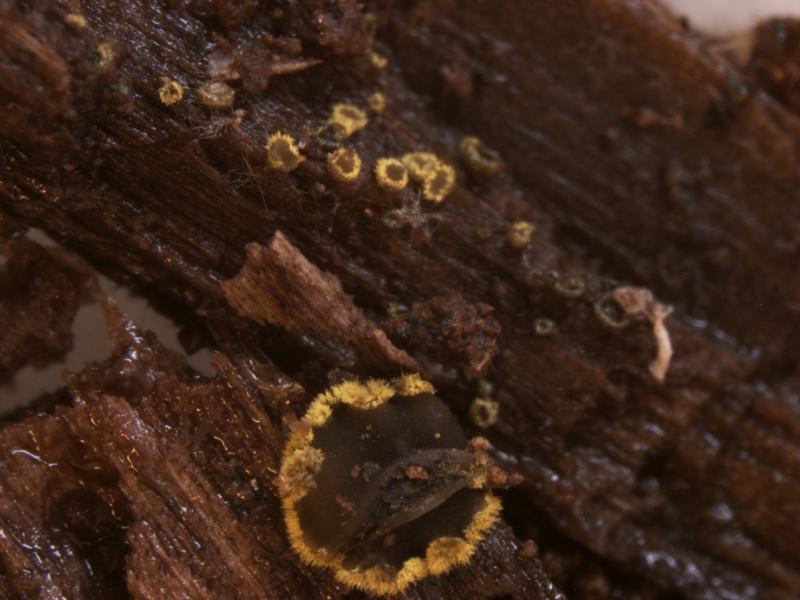
I recently found a very typical "Amicodisca habitat" with slightly dried out water ponds with wet small/medium sized deciduous wood debris. Amicodisca virella was plentiful, but there was also one population of Amicodisca svrcekii. A. svrcekii with clearly less than 15 um long spores with small bipolar vacuoles, so no doubt there.
I am not that familiar with svrcekii so my question is that are the apos really this different in size? The big one is svrcekii and the small ones virella. On the same piece of wood in this case actually.
Timo
Hans-Otto Baral,
18-08-2016 10:36

Re : two Amicodisca
I measured in A svrcekii 0.2-0.35 mm on ?Sambucus and 1 mm on Qurecus, and in A. virella 0.2-0.55(-0.7) mm in two samples on Salix. So I think apo size is variable and not correlated.
From A. svrcekii on Quercus (HB 7022) I have an ITS sequence, while Stip has ITS and LSU from A. virella.They cluster in a clade with rather high distance. So it would be great if we could compare these data with yours if you succeed with this.
Strains of Amicodisca sp. in genBank appear to belong to a Dematioscypha.
Zotto
From A. svrcekii on Quercus (HB 7022) I have an ITS sequence, while Stip has ITS and LSU from A. virella.They cluster in a clade with rather high distance. So it would be great if we could compare these data with yours if you succeed with this.
Strains of Amicodisca sp. in genBank appear to belong to a Dematioscypha.
Zotto
Kosonen Timo,
18-08-2016 11:09
Re : two Amicodisca
all right. I kind of thought that they would still overlap sometimes, good to know that it has been recorded. Svrcekii shot spores well and virella too, so we should have material to compare to fairly soon. Also Stip send us A.virella previously and it was exctracted succesfully.
Timo
Timo
Jason Karakehian,
19-08-2016 20:51

Re : two Amicodisca
I have a recent collection of A. svrcekii from Massachusetts, USA and one of A. virella from New Brunswick, Canada. If someone is working on these and wants North American material you are welcome to them.
Kosonen Timo,
22-08-2016 11:45
Re : two Amicodisca
Hello Jason,
I appreciate your offer! We (Karen Hansen, Seppo Huhtinen and I) are working on the systematics of "Hyaloscyphaceae". For now, our main focus is the "Hyaloscyphaceae sensu stricto". Arachnopezizas are getting some attention as well. American material is more than wellcome, it's all Eurasian so far - what a bias! I'll write you in lenght once back in the office.
Timo Kosonen
I appreciate your offer! We (Karen Hansen, Seppo Huhtinen and I) are working on the systematics of "Hyaloscyphaceae". For now, our main focus is the "Hyaloscyphaceae sensu stricto". Arachnopezizas are getting some attention as well. American material is more than wellcome, it's all Eurasian so far - what a bias! I'll write you in lenght once back in the office.
Timo Kosonen
Kosonen Timo,
22-08-2016 11:45
Re : two Amicodisca
Hello Jason,
I appreciate your offer! We (Karen Hansen, Seppo Huhtinen and I) are working on the systematics of "Hyaloscyphaceae". For now, our main focus is the "Hyaloscyphaceae sensu stricto". Arachnopezizas are getting some attention as well. American material is more than wellcome, it's all Eurasian so far - what a bias! I'll write you in lenght once back in the office.
Timo Kosonen
I appreciate your offer! We (Karen Hansen, Seppo Huhtinen and I) are working on the systematics of "Hyaloscyphaceae". For now, our main focus is the "Hyaloscyphaceae sensu stricto". Arachnopezizas are getting some attention as well. American material is more than wellcome, it's all Eurasian so far - what a bias! I'll write you in lenght once back in the office.
Timo Kosonen
Jason Karakehian,
22-08-2016 13:51
Re : two Amicodisca
Excellent. I also have a few species of Arachnopeziza, Proliferodiscus and others if you would like to use them as well.