
10-06-2026 21:16
 François Freléchoux
Bonsoir,Le dernier du jour, en attendant votre avi
11-06-2026 19:03
 Nicolas VAN VOOREN
Chers membres d'Ascofrance,Le site sera placé en
11-06-2026 19:01
 William Slosse
Hello all,In an attempt to make a culture of a sus

09-06-2026 18:32
Camille MertensSur morceau de roseau immergé 0,5 - 0,7 mm de dia
10-06-2026 12:54
Steve ClementsBonjour encore, Pouvez-vous m'aider, s'il vous pl
10-06-2026 21:07
François Freléchoux
Toutes les tiges de gentianes jaunes de l'an passÃ
10-06-2026 13:41
François Freléchoux
Bonjour à nouveau, Voici une trouvaille d'hier.
10-06-2026 11:53
Steve ClementsBonjour, This disco is abundant on dead stems of
"Le Gal (1939) described this form as D. morthieri (Cooke) Sacc., recorded it on Eupatorium (?) and Mentha silvestris but added that 'elle semblait n'être qu'une forme grêle de' D. nudipes. No Dasyscypha remains on Cooke's specimen of Peziza morthieri but his accompanying sketches show short cylindrical hairs bearing a large apical crystal mass and filiform paraphyses not exceeding the asci. A sketch of two cup-shaped apothecia is labelled "sulphur colour'. The collector's note reads 'Peziza ad caules Senecionis'. This is clearly not the fungus of Le Gal."
Wouldn't Lachnum nudipes var. minor Dennis be a better name for this taxon?
Thanks for any help, may be I have missed some more recent reference.
Eduard

indeed L. morthieri is a doubtful taxon. But I think that L. nudipes var. minor has never been reexamined from the type. I wonder whether it has croziers or not. L. nudipes is with croziers and a species that also grows on Filipendula and which I called "subnudipes" has much smaller spores and inamyloid asci without croziers. But I fear there exist more species. What I identified in 1976 as morthieri is such a third species, but I never clarified the croziers situation.
Did you document any collection?
Zotto
Thank you for your prompt reaction and comments. I have contacted the person who made the collection for further details and I will come back on this shortly.
Eduard
Ascomata 0,5 – 0,6 mm Ø, stipe 0,2 mm, hymenium and hairs pale yellow. Hairs 60-70 x 4-5 mu, encrusted, with single, striking large crystal on top (10-13 mu). Paraphyses beyond asci, lanceolate, width 5-6 mu. Spores (6-) 8-10 x2 mu, sometimes slightly curved, oil 1. Asci 40-50 mu, croziers not checked. Growing on herbaceous stem or twig.
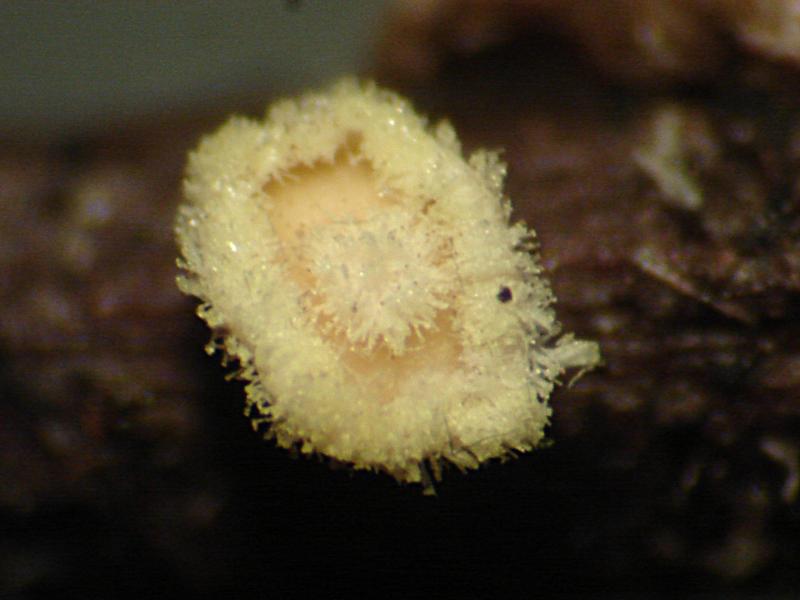
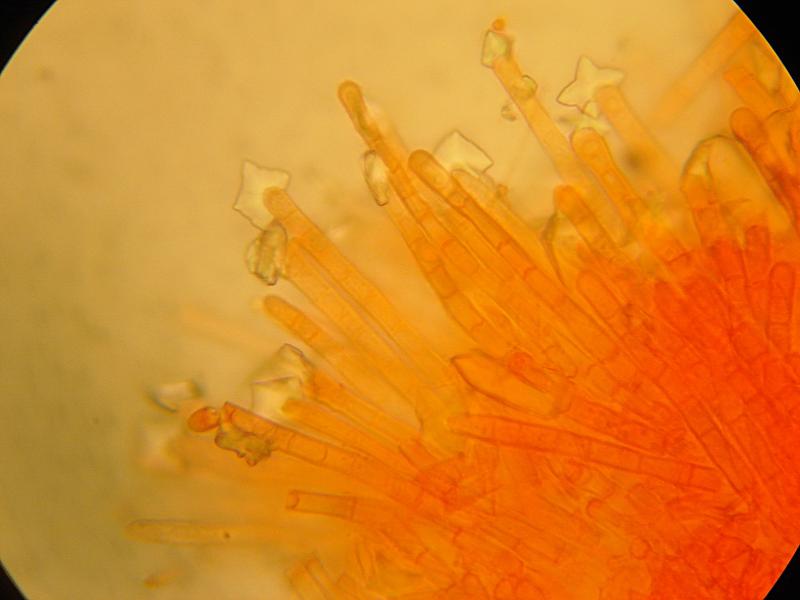
Sp. 6-11/1,2-1,5 µm, oil content 1, A. 40-50 µm long, Ap. 0,8-1 mm, stipe 0,3-0,5 mm
............................................................................................................... L. morthieri
Sp. 9-15/1,7-2,3 µm, oil content 0, A. 65-80 µm long, Ap. 0,7-2,2 mm, stipe 1-2,5 mm ............................................................................................................... L. nudipes
The material was collected in a regenerating peat bog area where the occurrence of Filipendula is unlikely, so this substrate can be excluded.
Eduard