31-03-2026 21:18
 Miguel Ángel Ribes
Good evening. oes anyone have the original descrip
31-03-2026 20:57
Stefan BlaserHello everybody, I hope somebody can help me with
26-03-2026 15:31
 Åke Widgren
Hello,I found this one in October last year, on r
31-03-2026 16:20
 Mlcoch Patrik
Hello, Please about help with determination. On
31-03-2026 08:19
 Bernard CLESSE
Bonjour à toutes et tous,Pourriez-vous m'aider à
30-03-2026 12:03
 William Slosse
Hello all,On 27/03/26, in Kraaiveld in Wingene (Be
25-03-2026 10:35
Hulda Caroline HolteHello,I collected this species growing on a dead b
 Récolté par Gwenael cartier sur du bois pourris à Montréal
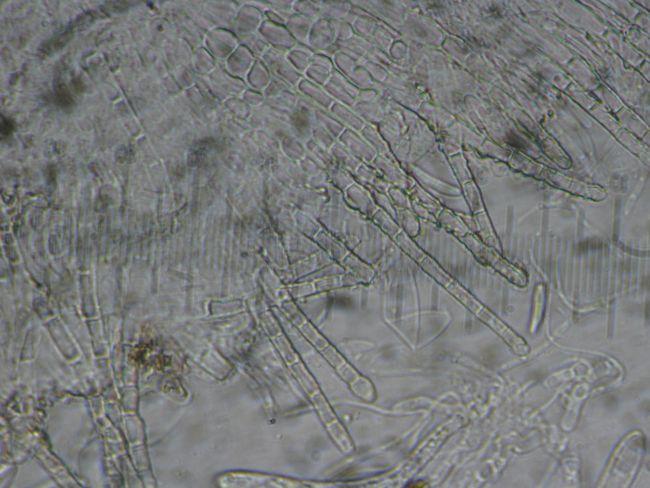
Périthèce orangé, clairement hirsute lorsque sec.
Asques jusqu'à 75µm de long par 8µ de large, octosporé, généralement unisérié ou partiellement bisérié amyloides au melzer et avec un crochet(?) à la base. les spores sont presque fusiforme, en général asymétrique, contient 0-1 septa au centre et mesure 12-16*(2.5)3-4.5µ (en moyenne 13.5-3.5 (K = 3.9). spores hyalines. Poils orange-brun, en touffe, ornamenté. Paraphyse simple, remplis de granule orangé et sont occasionnellement bifide. Textura du type prismatica.
En général la collection est relativement immature, ce qui pourrait indiqué l'absence des spores avec 2-3 septae
Selon Barral A. cornuta et A. trabinelloides sont synonymes avec le nom A. cornuta en priorité.
Quelqu'un pourrait confirmé l'identification s.v.p
photo:
https://c1.staticflickr.com/1/789/25997466207_5195faab59_b.jpg
Jonathan M.

Any fresh material anywhere? If no, you could soak one apothecio in water for awhile and then try to capture spores/asci/hairs with a camera.
Maybe the combination of dead state and immaturity makes it look odd, but there's something non-trabinelloides about the spores. A. cornuta I only know through descriptions and can't comment Zottos view. He's often right of course :-).
Was it literally _harvested_ or are there any chanches of seeing it in a more mature condition later?
Always a delight to pick an Arachnopeziza!
Timo

Zotto

I would have thought trabinelloides and cornuta different at least by macro colour, spore septation and also the spore appendages once seen by Korf as in the attached paper.
But I do not know of any drawing or picture showing this character. Neither do I know any macro picture of a fungus lately identified as A. cornuta.
Do you ?
Amitiés
Michel
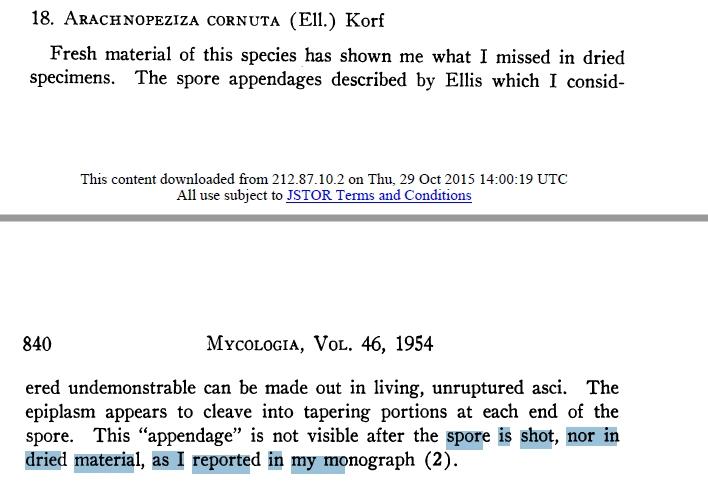
That was an interesting comment - from both you and Korf! -Hadn't seen that before. --Actually, very very recently I noticed there is one fresh (2009 if I recall right) A. cornuta collection in Stockholm herbarium. I should have an opportunity to study it soon. Otherwise I don't know of any "A cornuta" observations within last ten years.
My comprehension today is that in addition to A. aurelia there are atleast two other "yellow Arachnopezizas", mainly on hardwood logs. How trabinelloides, candidofulva/leonina and cornuta should be correctly aplied - that I am not yet 100% sure :-). My studies are in an "one more sample" phase.
timo
you may not know of newer collections of A. cornutalike species, but that does not mean, that they do not exist and even in Finland.
Marja