
27-04-2026 20:52
 Lothar Krieglsteiner
Found on hanging tiwg of Olea europaea in dried-ou
28-04-2026 22:51
 Bernard CLESSE
Bonsoir à toutes et tous,Pourriez-vous m'aider à
29-04-2026 08:01
Lothar Krieglsteiner
... on twig attached to small tree of Citrus auran
29-04-2026 10:44
Lothar Krieglsteiner
growing at moist, drying-out soil at the side of a
28-04-2026 20:33
Vitus SchäfftleinHello, I found Trochila ilicina on Ilex aquifoliu

28-04-2026 21:50
 Pablo Sandoval
Hola a todos,Espero se encuentren bien. Hace mucho
27-04-2026 18:05
Lothar Krieglsteiner
... still attached at standing tree. The green con
28-04-2026 20:07
Lothar Krieglsteiner
... on twig in the air at standing Ceratonia siliq
27-04-2026 18:48
Tony MoverleyCollected 23rd April 2026, Norfolk, EnglandSwarms
Searching Holwaya samples with morphological details and sequences
Quijada Luis,
13-09-2018 20:25
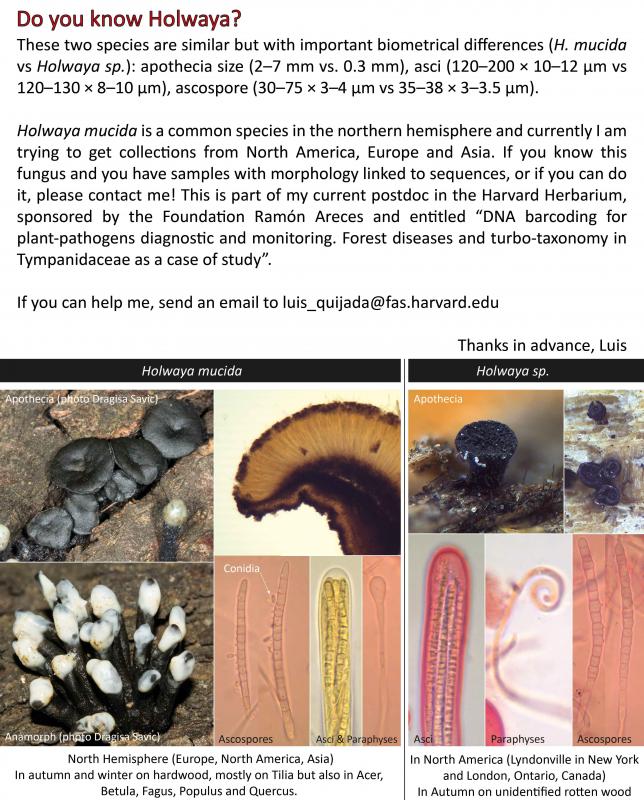
Hans-Otto Baral,
13-09-2018 21:32

Re : Searching Holwaya samples with morphological details and sequences
Hi Luis
are you sure with the spore measurements? Your Holwaya sp. has spores which look like having about the same l:w ratio as H. mucida, i.e. maybe 50 x 3.5 µm but not only 10x longer than wide.
Also the fungus looks larger than 0.3 mm to me, but here I may be wrong.
You figured a curled paraphysis, which seems a strong further difference between the two?
Did you try the wood anatomy? Is it an angiosperm?
Zotto
are you sure with the spore measurements? Your Holwaya sp. has spores which look like having about the same l:w ratio as H. mucida, i.e. maybe 50 x 3.5 µm but not only 10x longer than wide.
Also the fungus looks larger than 0.3 mm to me, but here I may be wrong.
You figured a curled paraphysis, which seems a strong further difference between the two?
Did you try the wood anatomy? Is it an angiosperm?
Zotto
Quijada Luis,
14-09-2018 15:48
Re : Searching Holwaya samples with morphological details and sequences
Hi Zotto,
the measures included they were taken from manuscripts. Each photo was enlarged or shortened only to show the morphology, not for comparison in the figure. Holwaya sp. is around 0.3 mm, the samples that I reviewed the size of the apothecia were around 200-300 um.
As you said, the main morphological difference is the paraphyses.
I cannot identify the wood of the samples under Holwaya sp. because I reviewed them years ago and I do not have the samples, but maybe I can ask to the herbarium if they can help me with that.
I am trying to find help to compare that samples from the northern hemisphere of H. mucida, I think this is something that would be interesting.
Best
Luis
the measures included they were taken from manuscripts. Each photo was enlarged or shortened only to show the morphology, not for comparison in the figure. Holwaya sp. is around 0.3 mm, the samples that I reviewed the size of the apothecia were around 200-300 um.
As you said, the main morphological difference is the paraphyses.
I cannot identify the wood of the samples under Holwaya sp. because I reviewed them years ago and I do not have the samples, but maybe I can ask to the herbarium if they can help me with that.
I am trying to find help to compare that samples from the northern hemisphere of H. mucida, I think this is something that would be interesting.
Best
Luis
Hans-Otto Baral,
14-09-2018 16:17
Re : Searching Holwaya samples with morphological details and sequences
Would be be helpful to clarify if it was an angiosperm or gymnosperm.
I meant the length:width ratio seems incorrect: when you measure the left spore of Holwaya sp. and take it as 38 µm long, then it has a width of maybe 2.5-2.7 µm, so I thought it could be longer than 38 µm to fit your width values.
I meant the length:width ratio seems incorrect: when you measure the left spore of Holwaya sp. and take it as 38 µm long, then it has a width of maybe 2.5-2.7 µm, so I thought it could be longer than 38 µm to fit your width values.
Blasco Rafael,
03-03-2025 13:32

Re : Searching Holwaya samples with morphological details and sequences
Hola. He recogido el estado imperfecto de Holwaya mucida, como se tiene que nombrar, Crinula caliciformis o Holwaya mucida.
Veo las dos referencias para el estado imperfecto, pero cual es el correcto ??
Un saludo
Rafael
Veo las dos referencias para el estado imperfecto, pero cual es el correcto ??
Un saludo
Rafael