
08-06-2026 10:16
 Spooren Marco
I don`t have a clou about this fungus,it is not in
08-06-2026 17:00
François BartholomeeusenGood day everyone, On June 5 2026, I collected de
07-06-2026 15:10
 William Slosse
Hello everyone,On 05-06-26, I found following asco
05-06-2026 11:02
Thomas Læssøehttps://svampe.databasen.org/observations/10596691
07-06-2026 12:09
 François Freléchoux
Bonjour, Voici une brève description de ce qui m
07-06-2026 12:43
Steve ClementsBojour. This was a strange find on a stick on my
12-07-2015 00:05
 Nedim Jukic
This one from the same locality as the previous on
06-06-2026 17:44
Steve ClementsBonjour, This disco was on planed wood 3 x 1.5 cm
14-08-2016 23:15
 Alex Akulov
Dear friendsCan you help me to find the descriptio
Hymenoscyphus
Andgelo Mombert,
28-09-2018 19:19
 Bonsoir,
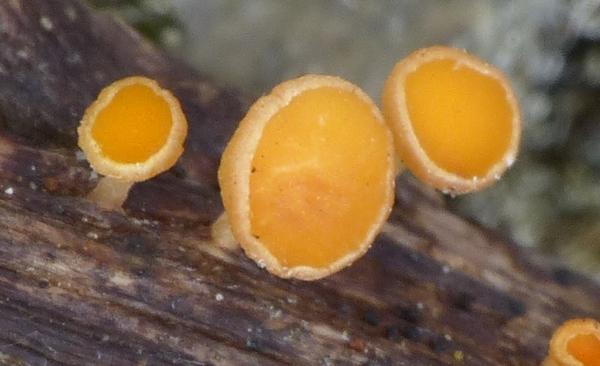
Un bel Hymenoscyphus jaune sur tige morte herbacée. Jura, France, le 28-09-2018.
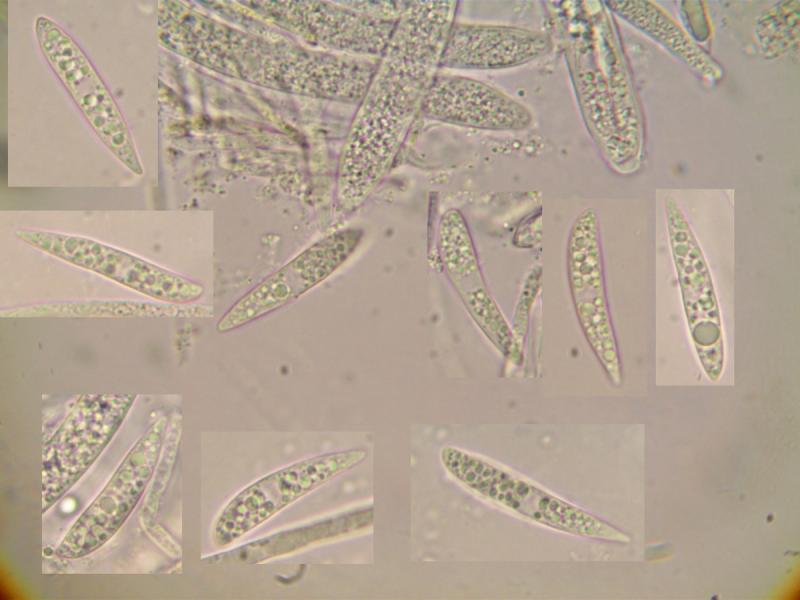
Spores : 28-34 x 4-5,5 µm, scutulées, garnies de gouttelettes, sans soie
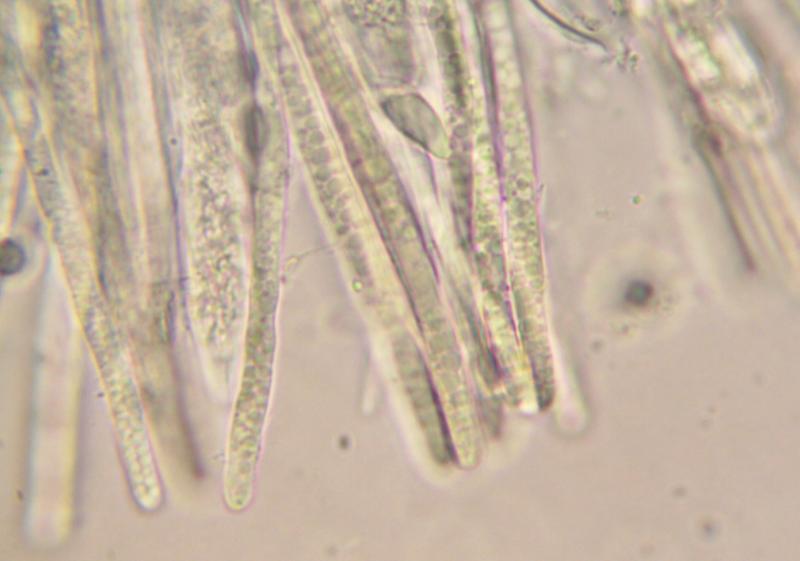
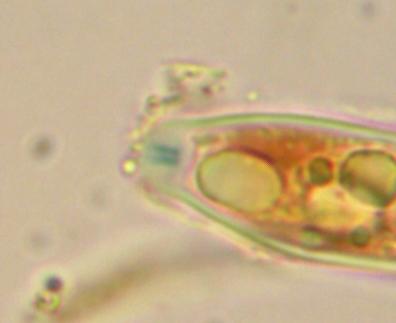
Asques : cylindriques, à sommet amyloïde, avec crochet (?), contenant 8 spores bisériées.
Paraphyses : cylindriques, remplies de gouttelettes.
Il s'agit du groupe de H. scutula mais les spores très grandes me gènent.
Merci pour votre aide !
Andgelo
Hans-Otto Baral,
28-09-2018 21:20

Re : Hymenoscyphus
Hi Andgelo
this requires in fact a clear image of the croziers. If they are present it is H. fucatus, if they are absent it is an unnamed species close to H. scutula or a long-spored variant of it.
Zotto
this requires in fact a clear image of the croziers. If they are present it is H. fucatus, if they are absent it is an unnamed species close to H. scutula or a long-spored variant of it.
Zotto
Andgelo Mombert,
28-09-2018 21:56
Re : Hymenoscyphus
Formidable !
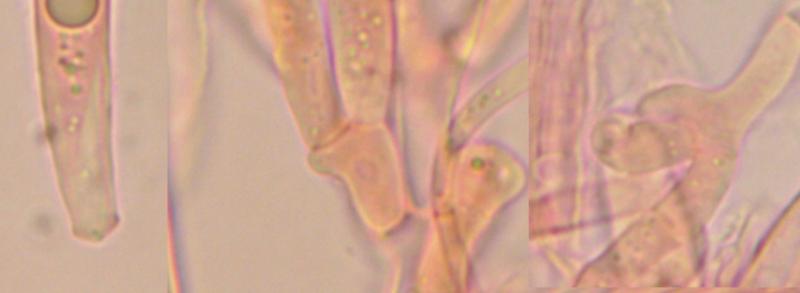
Je pense qu'il y a des crochets.
H. fucatus ne semble pas très courante... Est-ce une espèce réputée tardive ?
Je pense qu'il y a des crochets.
H. fucatus ne semble pas très courante... Est-ce une espèce réputée tardive ?
Hans-Otto Baral,
28-09-2018 22:06
Re : Hymenoscyphus
Oh this is ambiguous. The middle element is clearly without crozeirs. Left looks lke with but one septum could belong to a protubenance, although these usually do not break. Complete croziers are necessary to see in order to be sure.
Not clear what you men with tardive. Late in the year? H. fucatus was rarely collected. Hengstmengel 1996 says July-September, mainly on Polygonum.
Not clear what you men with tardive. Late in the year? H. fucatus was rarely collected. Hengstmengel 1996 says July-September, mainly on Polygonum.
Andgelo Mombert,
28-09-2018 22:31
Re : Hymenoscyphus
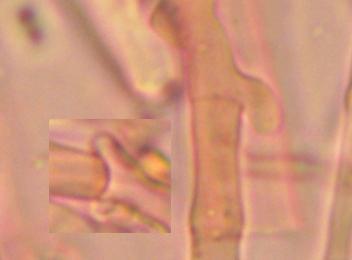
Pas simple donc... Ici on voit des crochets ou plutôt des protubérances ?
Hans-Otto Baral,
28-09-2018 22:36
Re : Hymenoscyphus
Right is protuberance. Left is unclear, it depends what is top and what bottom.
Andgelo Mombert,
28-09-2018 23:03
Re : Hymenoscyphus
Pour la photo de gauche, c'est la partie du haut qui appartient à l'asque.
Hans-Otto Baral,
29-09-2018 08:09
Re : Hymenoscyphus
So I think the ascus points to the left, and then this is not a protuberance but a young branch that would lead to a further ascus. If this is true, it is again a proof for simple septate asci.
Andgelo Mombert,
29-09-2018 21:13
Re : Hymenoscyphus
Ok, pas de crochets donc. Il y avait beaucoup de bases d'asques simples mais je voulais m'assurer que les choses que je voyait n'étaient pas des crochets.
Sur ton google drive, y a un Hymenoscyphus aff. fucatus (H-) qui ressemble très bien à ma récolte.
Sur ton google drive, y a un Hymenoscyphus aff. fucatus (H-) qui ressemble très bien à ma récolte.
Hans-Otto Baral,
29-09-2018 21:23
Re : Hymenoscyphus
Yes, this is my idea.
Andgelo Mombert,
29-09-2018 21:39
Re : Hymenoscyphus
OK merci Zotto !