
11-04-2026 10:19
 Michel Hairaud
Chers amis d'Ascofrance , voici une très bonne no
11-04-2026 10:10
Michel Hairaud
Dear Ascofrance members, here is some very good ne
10-04-2026 23:22
Gernot FriebesHi,ascospores are 1- to 3-septate, approximately
10-04-2026 15:51
 William Slosse
Hello everyone, On 08/04/26, I found a growth sit
09-04-2026 15:25
Jac GelderblomOn bare soil between mosses Ifound an asco I deter
09-04-2026 13:55
Thomas Læssøehttps://svampe.databasen.org/observations/10589176
09-04-2026 10:12
Thomas Læssøehttps://svampe.databasen.org/observations/10587061
08-04-2026 20:33
 Vasileios Kaounas
Found 07-04-26, in Abies cephalonica. Diameter 1,
08-04-2026 10:39
FRANCIS FOUCHIERBonjour , je recherche en pdf cet article: KORF R

 Hi again
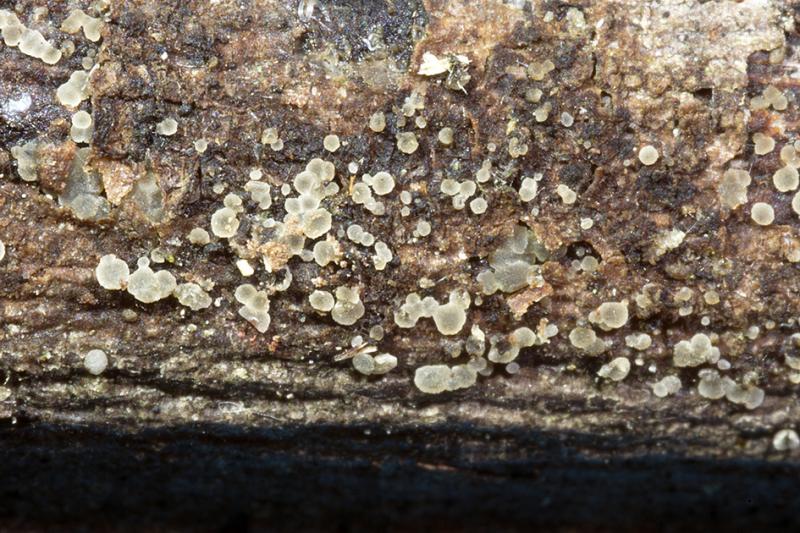
This Mollisia grew on corticated branches of Cornus, 2 cm thick, lying on the ground. The apothecia are minute, coalescent, whitish, amber colour or grayish when old.
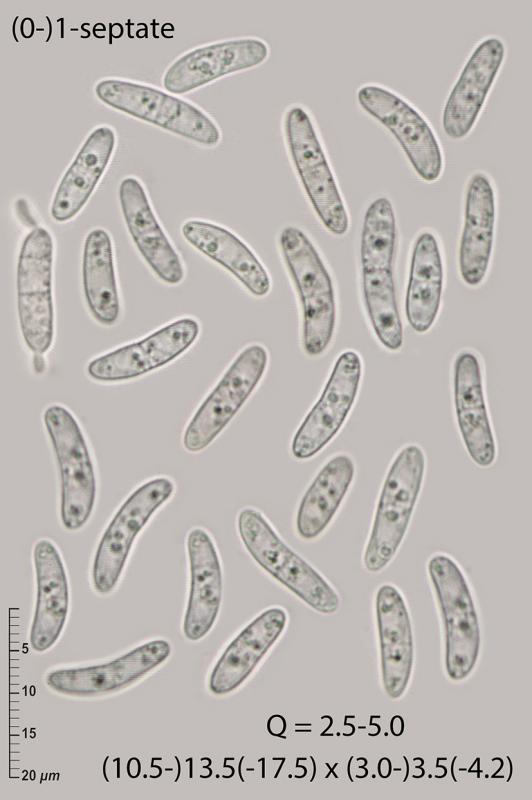
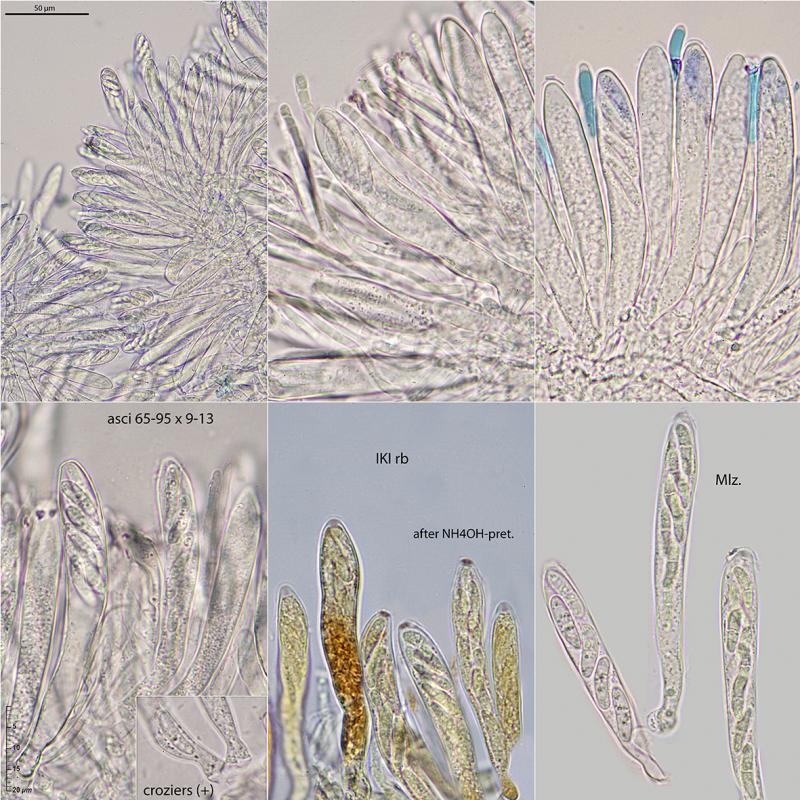
The ascospore are (0-)1-septate, even inside the living asci, arising from croziers, with an apical pore dirty red, rb, even after NH4OH-pret. (I didn't have KOH to do it).
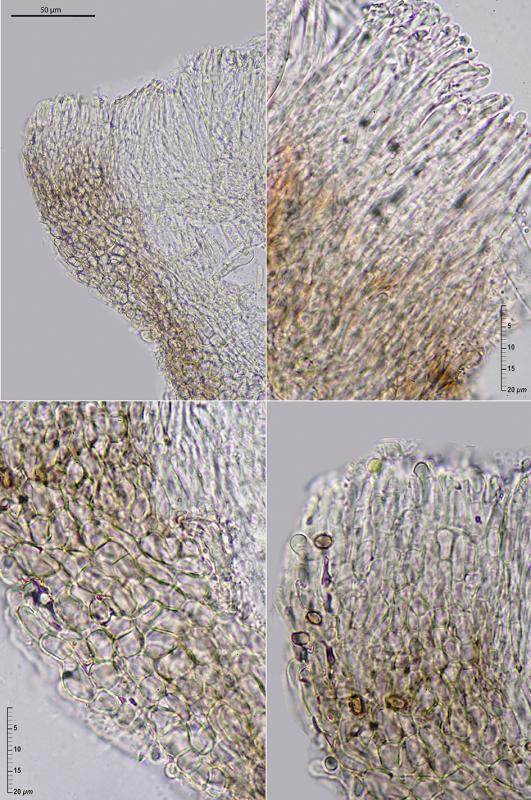
The paraphyses, as the narrowly clavate marginal cells, have somewhat inconspicuous refractive VBs that stain in cresyl blue. Ectal excipulum with pale brownish textura angularis.
Do you have any ideas that might help me?
Bonjour Enrique,
The macro suggests that there would be a short stipe and the excipulum has some prismatica textura , at least under the margin. My first guess would go for a Calycina. Did you exclude this genus ?
Amitiés.
Michel
Non. Je n'exclude pas Calycina. Je pense que c'est une bonne alternative. Mais l'excípulum est formé par des cellules plutôt polygonales, seulement plus prismatiques vers les flancs de la fructification. Et en plus, tout l'excípulum possède pigmentation et pas seulement la partie la plus basale du même, comme il arrive habituellement en Calycina.

I would exclude Mollisia, because the shape of the vacuoles in the paraphyses does not fit Mollisia and also the spores bearing conidia is in my experience not known in Mollisia. The excipular structure doesn't fit well too.
Calycina would also be my first choice to search.
best regards,
Andreas

Do you have literature on Leptodontidium? For example the generic definition of the genus, Leptodontidium de Hoog, that seems to be in Taxon 28(4): 347 (1979)