
10-06-2026 21:16
 François Freléchoux
Bonsoir,Le dernier du jour, en attendant votre avi
11-06-2026 19:01
 William Slosse
Hello all,In an attempt to make a culture of a sus
11-06-2026 19:03
 Nicolas VAN VOOREN
Chers membres d'Ascofrance,Le site sera placé en

09-06-2026 18:32
Camille MertensSur morceau de roseau immergé 0,5 - 0,7 mm de dia
10-06-2026 12:54
Steve ClementsBonjour encore, Pouvez-vous m'aider, s'il vous pl
10-06-2026 21:07
François Freléchoux
Toutes les tiges de gentianes jaunes de l'an passÃ
10-06-2026 13:41
François Freléchoux
Bonjour à nouveau, Voici une trouvaille d'hier.
10-06-2026 11:53
Steve ClementsBonjour, This disco is abundant on dead stems of
Cf. Byssonectria deformis ?
Collection 1, 10/12/2025
Seven specimen
Garden, Burgweg 19, Veurne Belgium
On bare ground
Macroscopie
? Apothecia: pale yellow to cream collared, disc-shaped, with smooth margin, not discolouring when touched/damaged, without subiculum, 2-4 mm Ø
Microscopie
? Asci: cylindrical, operculate, J-, 171,5-196 x 9,8-13(-13,3) µm
? Sporen: hyaline, ellipsoid, lead, multi-guttulate, 14-16,6(-18) x 7,5-10,5 µm, Me = 15,48 x 8,58 µm, N = 10, Q = 1,80
? Parafysen: hyaline, cylindrical/filiform, 1,8-2,2 µm Ø, narrow clavate at the apex up to 4 µm Ø, with straight to curved apex
Collection 2, 17/12/2025
Twenty specimen
? Sporen: hyaline, ellipsoid, smooth, multi-guttulate, 14-17,5(-18,2) x 7,5-10,5 µm, Me = 16,15 x 9,14 µm, N = 12, Q = 1,76
? Parafyses: hyaline, cylindrical/filiform, 1,5-2 µm Ø, narrow clavate at the apex up to 3,5 µm Ø, with straight to curved apex
Any help for determination will be appreciated.
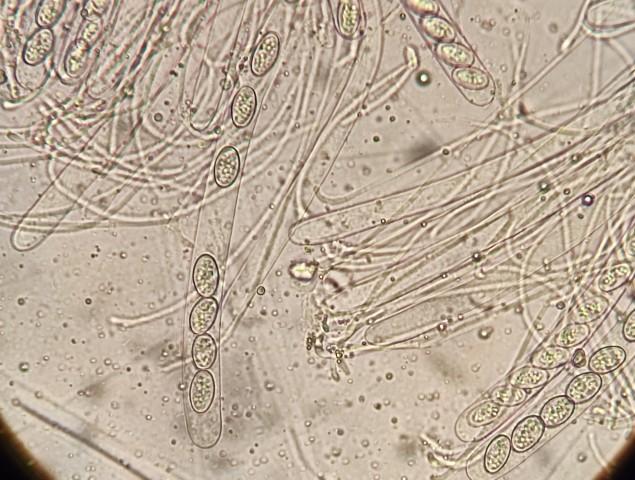

Boubovia ovalispora?
Thanks for your proposal and maybe/probably you are right but on "https://svampe.databasen.org/observations/10208492" the spores of B. ovalispora are ellipsoid, smooth, multiguttulate and measure 12,6-13,2 x 7,6-8,4 µm, which is shorter than 14-16,6(-18) x 7,5-10,5 µm in my found. That makes me a bit doubtful.
I would be grateful to recieve a key of the genus Boubovia.
pol.debaenst@msn.com
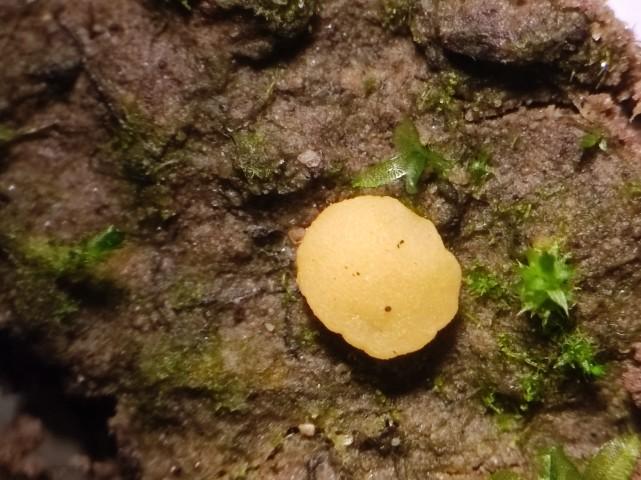

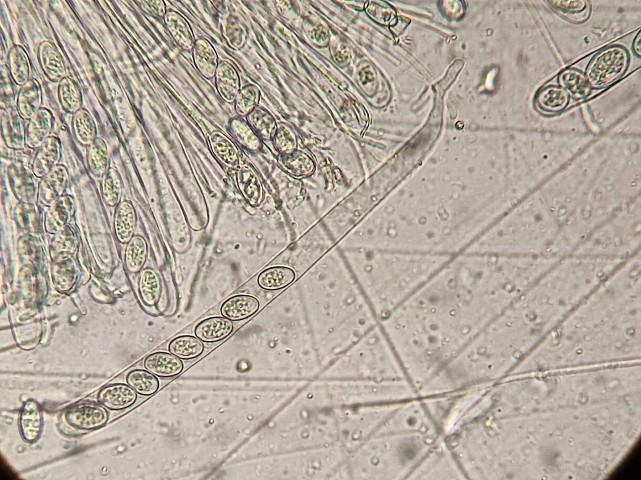
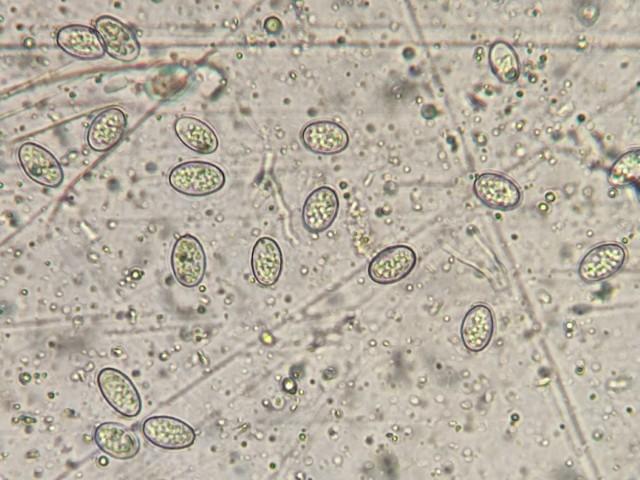
https://www.centrodeestudiosmicologicosasturianos.org/?p=48180

I remember that you lately posted Pictures of Pseudopithyella minuscula.
In our area (Center west of France) it is often collected with Pesudoboubobia benkertii. Some features of your collection would match but for the substrate . P. benkertii lies on woodchips or dead leaves of Cupressus macrocarpa.
Amitiés. Michel
Thank you very much for the identification. In my garden it was also found nearby Pseudopithyella minuscula.
Kind regards and happy new year.
Pol