
14-08-2016 23:15
 Alex Akulov
Dear friendsCan you help me to find the descriptio

05-06-2026 11:02
Thomas Læssøehttps://svampe.databasen.org/observations/10596691
04-06-2026 11:36
Gernot FriebesHi,found on Vaccinium myrtillus.Asci: IKI –, 8-s
05-06-2026 12:10
 François Freléchoux
Capitotricha sp. sur Lonicea caerulea Caractères
19-05-2026 10:27
Patrice TANCHAUDBonjour, récolte récente sur terre retournée i
04-06-2026 18:39
Gernot FriebesHi,I collected this species in two different locat
22-05-2026 13:29
Gernot FriebesHi,I am curious to hear your opinion on this mater
Orbilia with 'hyphomycete'
Chris Yeates,
05-08-2013 19:28
 Bonsoir tous
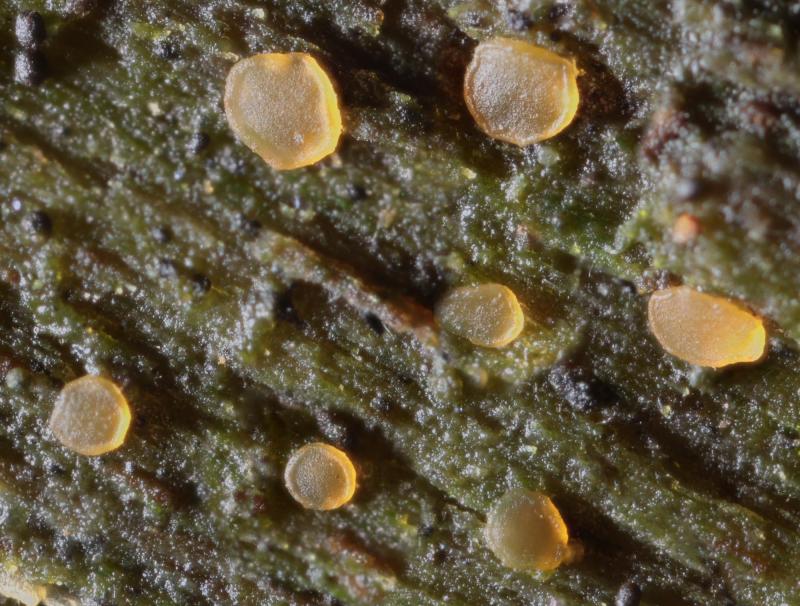
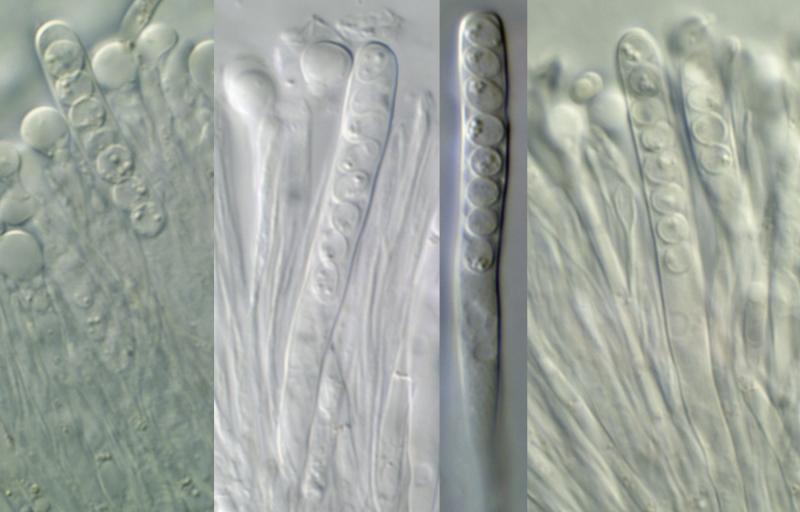
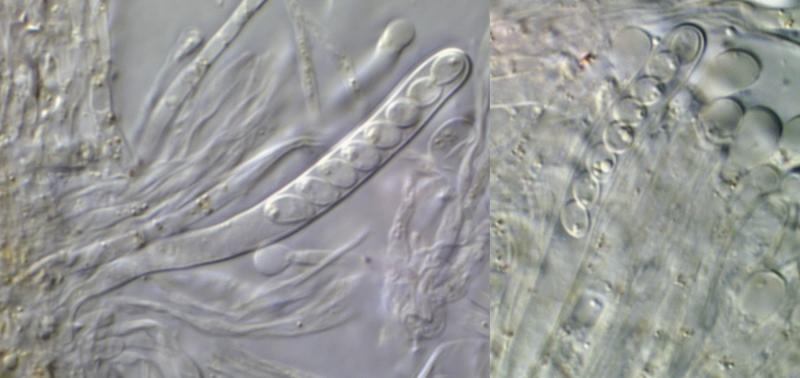
yesterday I collected a damp rotten decorticated branch (probably Taxus); there are several species of fungi on it; one is an Orbilia which I feel reasonably confident is O. eucalypti - I have collected this species in this wood before, though on a different substrate (see: http://www.ascofrance.com/search_forum/21451 )
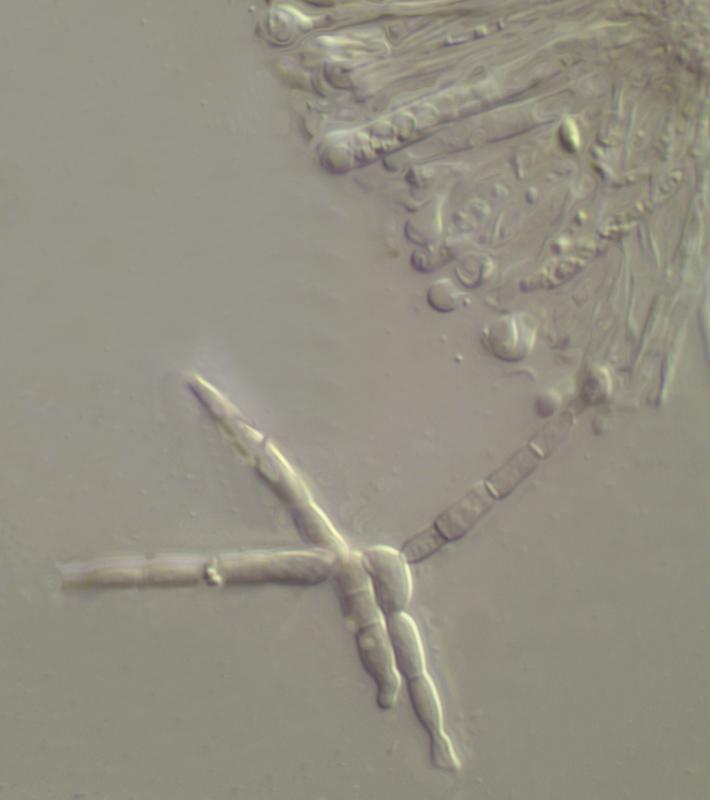
Of interest was a conidium of a sort one often associates with aquatic, Ingoldian, fungi - we have had a lot of rain recently and I have noticed conidia normally though of as primarily aquatic in wet terrestrial habitats). The conidium a strong resemblance to Tripospermum camelopardus, although it has an extra "neck" - because of the three-dimensional nature of the condium I have tried (not entirely successfully I fear)? to use stacking software to give an idea of its size and point of attachment (it is the upper left "neck" in the attached image). If it is a Tripospermum, then there clearly is no link between the two fungi (that genus is anamorphic Capnodiaceae); but I may be wrong in assigning it there. I know Zotto is interested in putative anamorphs of Orbilia (some of which do have potentially aquatic anamorphs). Others may be interested too, so I post this find here.
Cordialement
Chris
Hans-Otto Baral,
05-08-2013 21:52

Re : Orbilia with 'hyphomycete'
Hi Chris
the conidium does not look orbiliaceous. The kind of branching is unusual. The filament to the right is the conidiophore? Dies it have a faint colour or is it from Congo red?
Yes, this is the sublobose-spored variant of eucalypti, certainly geneticaly not different because sometimes also normal asci and spores are found in the same population.
Zotto
the conidium does not look orbiliaceous. The kind of branching is unusual. The filament to the right is the conidiophore? Dies it have a faint colour or is it from Congo red?
Yes, this is the sublobose-spored variant of eucalypti, certainly geneticaly not different because sometimes also normal asci and spores are found in the same population.
Zotto
Chris Yeates,
05-08-2013 22:34
Re : Orbilia with 'hyphomycete'
Thanks for the confirmation Zotto; with regard to the conidium, no, all the "arms" are part of it (and no stain, must be an artefact - it was difficult to render this in 2 dimensions); I have since checked Prof. Ingold's protologue for Tripospermum camelopardus (see attached); this conidium quite strongly resembles his undescribed T. sp. As you can see the original point of attachment is the shorter of the "giraffe's" two legs.
So certainly an unconnected stray . . . .
best wishes
Chris
So certainly an unconnected stray . . . .
best wishes
Chris
 1968-v51-p51-0001.pdf
Hans-Otto Baral,
05-08-2013 22:37
Re : Orbilia with 'hyphomycete'
Yes, you are certainly right!
Zotto
Zotto
Esquivel-Rios Eduardo,
05-08-2013 23:20
Re : Orbilia with 'hyphomycete'
"Tripospermun myrti (Lind). Hughes. 1951. Mycol. pap. 46:17-18
Conidia with stalk cell 6-10 x 4- 7 mu, arms up t0 30 mu long, 4-8 thick at the base,tapering 1-2 mu, 1 - 4 septate, often constricted at the septa; one of the arms in this species usually lies parallel to the stalk cell"
Conidia with stalk cell 6-10 x 4- 7 mu, arms up t0 30 mu long, 4-8 thick at the base,tapering 1-2 mu, 1 - 4 septate, often constricted at the septa; one of the arms in this species usually lies parallel to the stalk cell"