
12-06-2026 14:50
 François Freléchoux
Bonjour, Voici la brève description d'une Mollis
10-06-2026 21:16
François Freléchoux
Bonsoir,Le dernier du jour, en attendant votre avi
11-06-2026 19:01
 William Slosse
Hello all,In an attempt to make a culture of a sus
11-06-2026 19:03
 Nicolas VAN VOOREN
Chers membres d'Ascofrance,Le site sera placé en

09-06-2026 18:32
Camille MertensSur morceau de roseau immergé 0,5 - 0,7 mm de dia
10-06-2026 12:54
Steve ClementsBonjour encore, Pouvez-vous m'aider, s'il vous pl
10-06-2026 21:07
François Freléchoux
Toutes les tiges de gentianes jaunes de l'an passÃ
10-06-2026 13:41
François Freléchoux
Bonjour à nouveau, Voici une trouvaille d'hier.
Psilachnum dans les pieds de Helleborus viridis
Enrique Rubio,
08-06-2007 20:36
 Je vous prie, nouvellement, une opinion sur cet Psilachnum (?) que croit sur les pieds morts de Helleborus viridis a 1500 m.
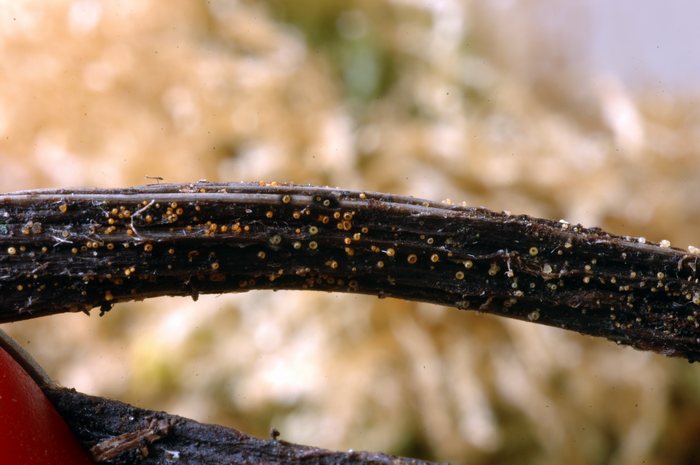
Il est minuscule, urceolée puis cupulée, marge blanc et fimbriée, sessile; blanc, puis jaune et finallement rouge. Les vapeurs de NH4OH le changent avec violence au rouge.
Spores 6-10 x 1.7-2.4. Asques avec crochets, IKI bb. Poils septées (1-3), apex obtuse, hyalines. Ectal excipulum angularis. Le IKI provoque l'aparition d'un couleur bleuatre (amyloide) sur les poils et la base des memes. Ps. rubrotinctum Graddon, une spece que je ne connais pas des Filipendula et Cirsium, a les spores (selon la Literatture) plus petites.
Avez vous une idée sur cet champignon?
Merci beaucoup a tous par votre aide.

Enrique Rubio,
08-06-2007 20:37
Re:Psilachnum dans les pieds de Helleborus viridis
Autre image
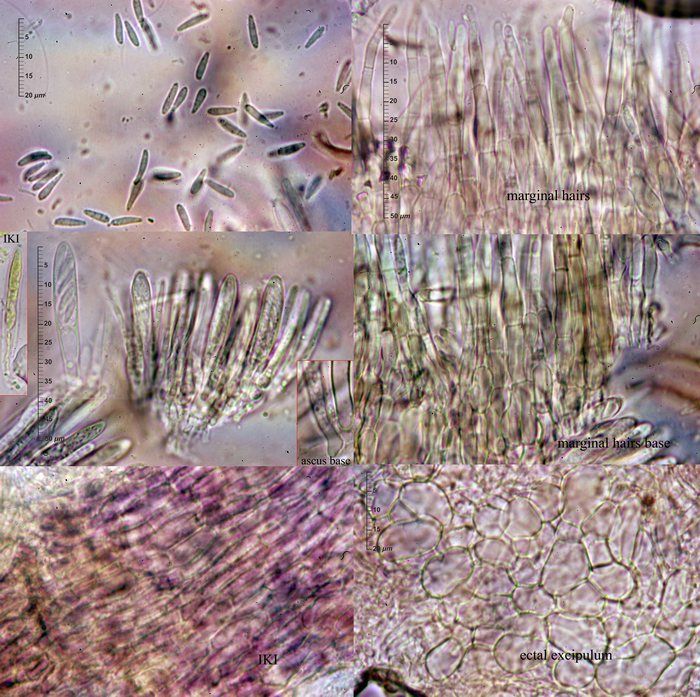
Enrique Rubio,
08-06-2007 20:37
Re:Psilachnum dans les pieds de Helleborus viridis
Une autre
Jacques Trimbach,
08-06-2007 21:40
Re:Psilachnum dans les pieds de Helleborus viridis
Je trouve un Hyaloscypha hellebori Vel. dans la Monogr.Disco.Bohem. qu'il dit "melinus" (couleur de coing), qui a des poils et spores un peu rapprochants (un bout pointu et l'autre arrondi) et qui pousse sur débris de hellebore. Mais Huhtinen dit qu'il n'y a pas de type et ne donne ni déscription, ni avis.
Hans-Otto Baral,
08-06-2007 23:55

Re:Psilachnum dans les pieds de Helleborus viridis
You are probably right with the genus Psilachnum. The species should be "Orbilia" rubicunda = "O." rozei, known from leaves of Helleborus, although the spores are a bit wider in the types and a fresh collection I have seen. See on the DVD, perhaps in dir. Psilachnum, for HB 7794 and 7268. But I am unaware of an amyloid (violet) reaction of the hairs. It is possible that the VBs inside the hairs cause a violet reaction with IKI, and that perhaps only as long as they are alive. "Orbilia" rubicunda grows on the petioles as well as on the upper parts of the leaves.