
08-06-2026 10:16
 Spooren Marco
I don`t have a clou about this fungus,it is not in
08-06-2026 17:00
François BartholomeeusenGood day everyone, On June 5 2026, I collected de
07-06-2026 15:10
 William Slosse
Hello everyone,On 05-06-26, I found following asco
05-06-2026 11:02
Thomas Læssøehttps://svampe.databasen.org/observations/10596691
07-06-2026 12:09
 François Freléchoux
Bonjour, Voici une brève description de ce qui m
07-06-2026 12:43
Steve ClementsBojour. This was a strange find on a stick on my
12-07-2015 00:05
 Nedim Jukic
This one from the same locality as the previous on
06-06-2026 17:44
Steve ClementsBonjour, This disco was on planed wood 3 x 1.5 cm
14-08-2016 23:15
 Alex Akulov
Dear friendsCan you help me to find the descriptio
Diaporthe or Similar on Hedera helix
Peter Thompson,
14-11-2013 10:15
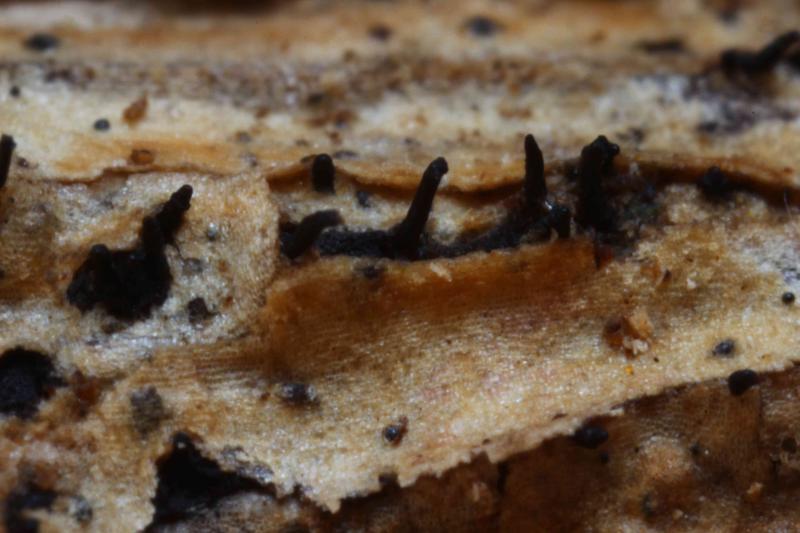
I recently found an ascomycete growing on dead stems of Hedera helix. It most closely resembles a Diaporthe species, with long, black ostioles, blackened host tissue around the fruit bodies and a black, stromatic line running through the host.
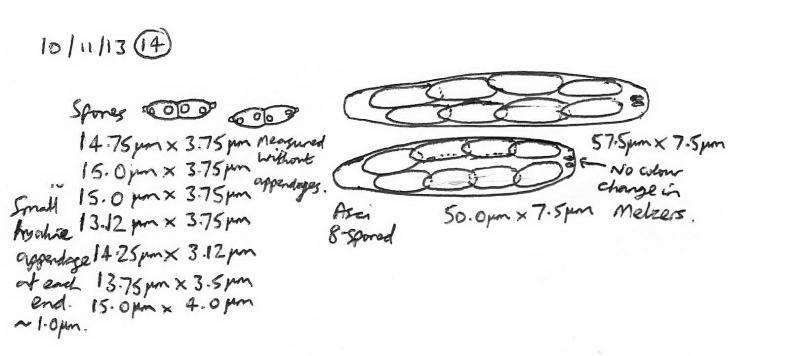
The microscopy shows spores with small, hyaline appendages at each end, which seem to rule out common Diaporthe species which would grow on Hedrea.
I have attached an image of the fruit bodies and a sketch of the microscopy.
I wonder if anyone has any idea as to what I have found?
Thank you,
Peter.
Yannick Mourgues,
14-11-2013 10:52

Re : Diaporthe or Similar on Hedera helix
Diaporthe hederae Wehmeyer ?
Mais les spores mesurées semblent un peu longues pour cette espèce et de plus, je ne me rappelle pas que D. hederae ait ces appendices à chaque extrémités.
Yannick
Mais les spores mesurées semblent un peu longues pour cette espèce et de plus, je ne me rappelle pas que D. hederae ait ces appendices à chaque extrémités.
Yannick
Peter Thompson,
14-11-2013 11:44
Re : Diaporthe or Similar on Hedera helix
Hello Yannick,
Thanks for your reply.
I did consider D. hederae (and D. pulla), but was not happy with either of them, in particular because of the appendages. Other species such as D. eres which grows on many hosts also looks wrong for the same reason.
With Best Wishes,
Peter.
Thanks for your reply.
I did consider D. hederae (and D. pulla), but was not happy with either of them, in particular because of the appendages. Other species such as D. eres which grows on many hosts also looks wrong for the same reason.
With Best Wishes,
Peter.
Paul LEROY,
14-11-2013 19:25
Re : Diaporthe or Similar on Hedera helix
Hello Peter,
La détermination sur une photo et un dessin est un peu aléatoire. Toutefois d'après les
détails fournis ce spécimen ne semble convenir ni pour D. hedera ni D. pulla, espèces
inféodées à ce support. A mon avis il s'agit probablement de Diapothe eres, espèce très
commune se développant sur hôtes variés.
Cordialement
Paul
La détermination sur une photo et un dessin est un peu aléatoire. Toutefois d'après les
détails fournis ce spécimen ne semble convenir ni pour D. hedera ni D. pulla, espèces
inféodées à ce support. A mon avis il s'agit probablement de Diapothe eres, espèce très
commune se développant sur hôtes variés.
Cordialement
Paul
Peter Thompson,
14-11-2013 20:23
Re : Diaporthe or Similar on Hedera helix
Hello Paul,
Thank you for your reply.
I did consider Diaporthe eres, but thought that the tiny appendages were wrong.
Perhaps this is one which will only be determined to genus level.
With Best Wishes,
Peter.
Thank you for your reply.
I did consider Diaporthe eres, but thought that the tiny appendages were wrong.
Perhaps this is one which will only be determined to genus level.
With Best Wishes,
Peter.
Yannick Mourgues,
17-11-2013 18:29
Re : Diaporthe or Similar on Hedera helix
Hi Peter.
All your spores have appendages ? Have tou got a photo of that ?
Y
All your spores have appendages ? Have tou got a photo of that ?
Y
Peter Thompson,
18-11-2013 15:16
Re : Diaporthe or Similar on Hedera helix
Hello Yannick,
I am probably in the minority now of those who are not equipped to photograph down the microscope.
In a water mount, I could see tiny appendages at both ends of the spores. They looked almost square and were about 1um long.
With Best Wishes,
Peter.
I am probably in the minority now of those who are not equipped to photograph down the microscope.
In a water mount, I could see tiny appendages at both ends of the spores. They looked almost square and were about 1um long.
With Best Wishes,
Peter.