
22-05-2026 21:35
Steve ClementsBonjour, I expected this find on old wood on our
22-05-2026 18:12
 Lothar Krieglsteiner
... in moist chamber from Portugal.As the fungus s
22-05-2026 20:08
Ethan CrensonHello all, Yesterday in NYC I was visiting an e
11-01-2022 16:36
 Jason Karakehian
Hi does anyone have a digital copy of Raitviir A (
20-05-2026 17:47
Margot en Geert VullingsWe found this Mollisia on dead Juncus stems mown l
22-05-2026 14:47
Gernot FriebesHi,superficial ascomata collected on bark of a liv
22-05-2026 14:44
Lothar Krieglsteiner
in unripe condition citrine yellow, then soon fadi
22-05-2026 13:29
Gernot FriebesHi,I am curious to hear your opinion on this mater
22-05-2026 10:59
 Nicolas VAN VOOREN
Trouvé sur Phragmites, ce que je pense être un L
20-05-2026 21:49
Margot en Geert VullingsWe found this Lachnum on Juncus stems mown last ye
FOUND IN ARECACEAE INFLORESCENCE
Francisco Calaça,
06-01-2014 23:20
 Hello to all,
I found this Ascomycete in dry inflorescence of Arecaceae, does anyone have any idea?
Could share with me?
Thanks in advance,
Francisco.
ASCOSPORES:
28,5-34 X 15,5-18,2 µm. Septate.
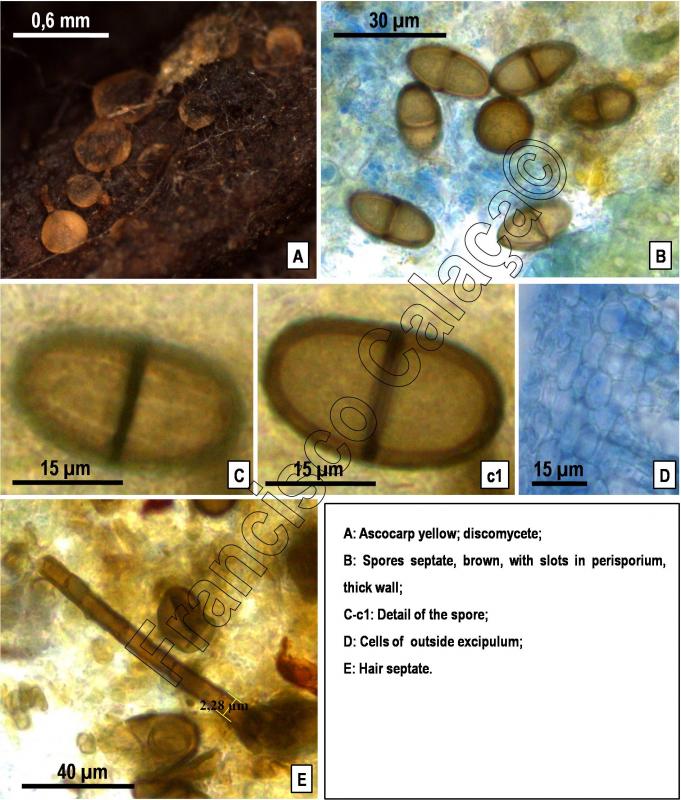
Hans-Otto Baral,
07-01-2014 09:35

Re : FOUND IN ARECACEAE INFLORESCENCE
dEAR fRANCESCO
Are you sure that these brown spores were formed in asci? Did you see the asci?
Zotto
Are you sure that these brown spores were formed in asci? Did you see the asci?
Zotto
Francisco Calaça,
07-01-2014 10:05
Re : FOUND IN ARECACEAE INFLORESCENCE
Dear Zotto, hello
not visualized the asci, but there were only these spores in the material seen under a microscope... I found it very strange...
not visualized the asci, but there were only these spores in the material seen under a microscope... I found it very strange...
Hans-Otto Baral,
07-01-2014 10:13
Re : FOUND IN ARECACEAE INFLORESCENCE
Apos look a bit like an Orbilia, and the brown elements like a hyphomycete, but I am not sure
Francisco Calaça,
07-01-2014 10:20
Re : FOUND IN ARECACEAE INFLORESCENCE
I had thought to Orbilia, but the absence of asci is confusing. You have some work about the genus Orbilia? Could share?
Thanks.
Thanks.
Hans-Otto Baral,
07-01-2014 10:41
Re : FOUND IN ARECACEAE INFLORESCENCE
400 species of Orbilia exist at least. Asci are often rather small and spores always hyaline. Maybe your apos are overmature or immature, or you overlooked them.