
11-01-2022 16:36
 Jason Karakehian
Hi does anyone have a digital copy of Raitviir A (
22-05-2026 20:08
Ethan CrensonHello all, Yesterday in NYC I was visiting an e
22-05-2026 18:12
 Lothar Krieglsteiner
... in moist chamber from Portugal.As the fungus s
20-05-2026 17:47
Margot en Geert VullingsWe found this Mollisia on dead Juncus stems mown l
22-05-2026 14:47
Gernot FriebesHi,superficial ascomata collected on bark of a liv
22-05-2026 14:44
Lothar Krieglsteiner
in unripe condition citrine yellow, then soon fadi
22-05-2026 13:29
Gernot FriebesHi,I am curious to hear your opinion on this mater
22-05-2026 10:59
 Nicolas VAN VOOREN
Trouvé sur Phragmites, ce que je pense être un L
20-05-2026 21:49
Margot en Geert VullingsWe found this Lachnum on Juncus stems mown last ye
21-05-2026 17:01
Pierre RepellinBonjour à toutes et à tous,Je recherche l'articl
 Hello,
I wonder if this collection on branch of Acer pseudoplatanus is Tubercularia vulgaris.
Data:
Conidiomata in effuse colonies, long stipitate, 1,3-1,6 mm high, 0,2 mm diam., black with white pruinae, conidia aggregated in an orange subglobose, slimy head of 0,5 mm diam., rarely branched.Conidia oblong-ellipsoid, 4-7x2,5-3 µm, biguttulate, smooth, hyaline, originating from phialides with collarette.
Most Nectria cinnabarina collections collected in out region on Acer have pink sessile to subsessile conidiomata.
Your comments are welcome.
Bernard
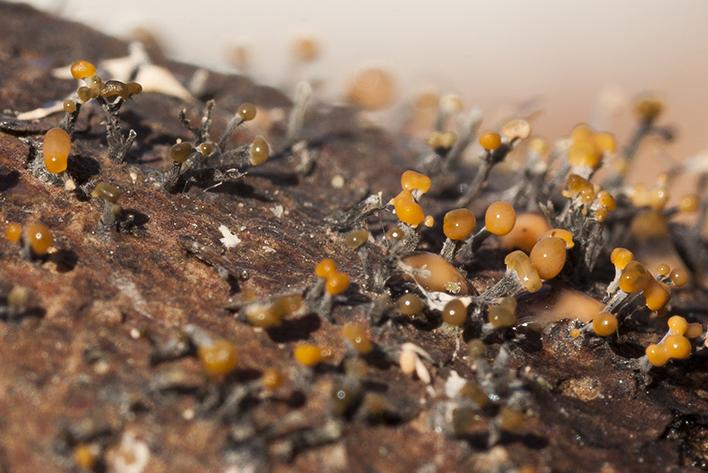
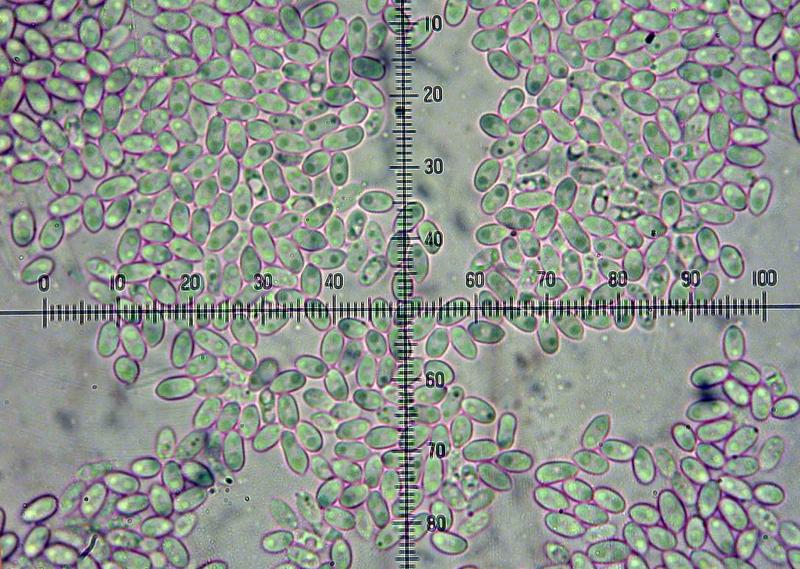

This is obviously not T. vulgaris (official name now only Nectria cinnabarina), but a species of Stilbella. You can identify this w ith Seifert, Studies iin Mycology 27, 1985. But you will need some further observations, especially marginal cells of the stipe and conidiogenous cells (in Tubercularia vulgaris these would have a characteristic acro-pleurogenous pattern, i.e. several short lateral branches in the conidiophore producing conidia).
Cheers Walter

ce qui est certain c'est que ce n'est pas N. cinnabarina et ce n'est peut-être pas une Hypocreales
Christian
Unfortunately I am missing following probably most interesting work:
Seifert, K.A. 1985. A monograph of Stilbella and some allied Hyphomycetes. Studies in Mycology. 27:1-235.
Does anyone have this study for me or is this somewhere available on the internet?
Thanks in advance,
Bernard
Groetjes Walter
I observed a stipe surface composed of blackish textura porrecta covered by hyaline, verrucose to echinulate, clavate to subglobose cells 3-5 µm wide and with walls up to 1 µm thick
According Seifert (1985), this should be (Stilbella clavulata or) the anamorph of Stilbocrea gracilipes (Tul. & C. Tul.) Samuels & Seifert.
Thanks once again, Walter.
Et merci aussi à Christian qui, grace à Ascofrance, rend ces échanges fructueuses possible.
Bernard
Hi Bernard,
If you have trouble finding the Siefert paper, please email me as I have the full thing as a pdf
Peter