
05-06-2026 12:10
 François Freléchoux
Capitotricha sp. sur Lonicea caerulea Caractères
05-06-2026 11:02
Thomas Læssøehttps://svampe.databasen.org/observations/10596691

04-06-2026 11:36
Gernot FriebesHi,found on Vaccinium myrtillus.Asci: IKI –, 8-s
19-05-2026 10:27
Patrice TANCHAUDBonjour, récolte récente sur terre retournée i
04-06-2026 18:39
Gernot FriebesHi,I collected this species in two different locat
22-05-2026 13:29
Gernot FriebesHi,I am curious to hear your opinion on this mater
04-06-2026 10:50
François Freléchoux
Bonjour, J'ai trouvé hier un petit asco observé
On leaf petiole of linden. Some Diaporthales, maybe Apiognomonia.
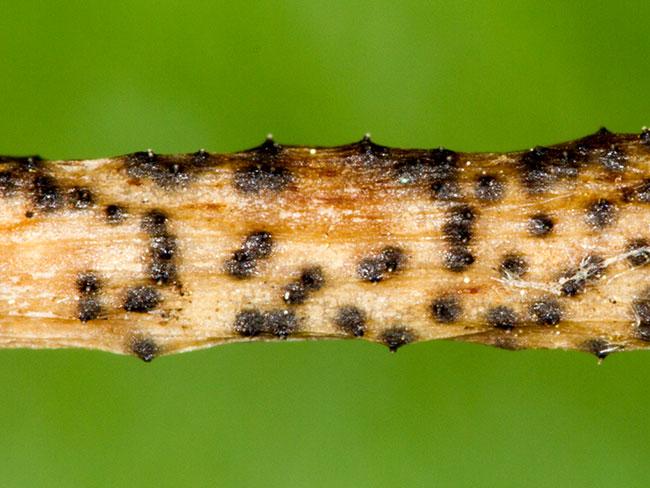
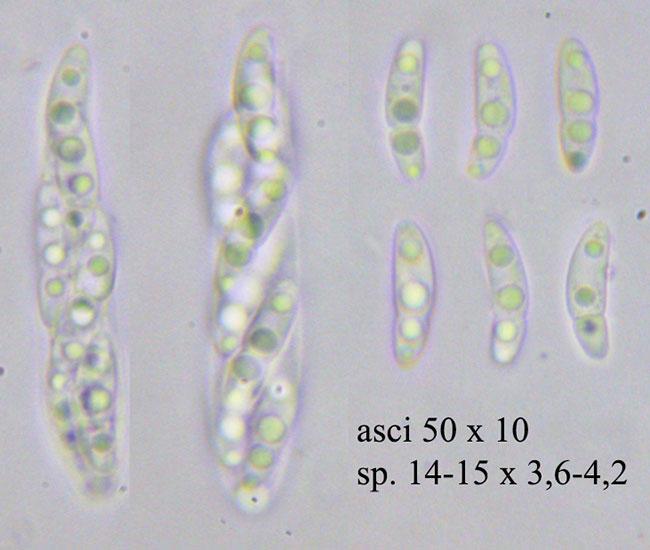

Hi,
Yes that's good : probably Apiognomonia errabunda, please compare.
Alain

If possible, check Apiognomonia petiolicola. It has biguttulate spores,
smaller cell of the spores is orientented towards the apical annulus, septum is situated nearly at 1/3 of the spore length. Apical ring of the asci is ca. 2-2.5 micrometers long. Exclusively grown on dead petioles of Tilia.
While in A. errabunda the apical ring is somehat bigger - about 3-3.5(-4) micrones; the septum is between 1/4 to 1/6 of the spore lenght.
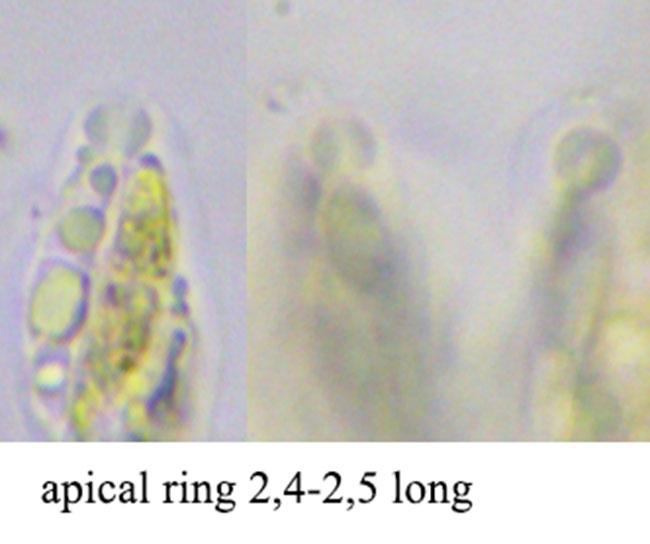
Hi Dimitar,
It's a good suggestion (we don't observe it in France, so I forgot it !), but ascospores size doesn't fit. I agree with the 2 features you mentioned.
Best wishes,
Alain
I read Sogonov & al (2007). They don't talk about arrangement of ascospores in ascus, but in the plate concerning A. errabunda (Fig. 2), one can see in photo H the smaller cell oriented towards the top of ascus (unlike in photo G). Molecular sequences have been obtained, and inp. G & H, it is A. errabunda. Could we think that orientation of ascospores is not a constant feature ?
On the other hand, they give apical ring size : 2,5-4,5 µm.
Please Savic, check all these features with several ascomata and tell us your conclusion. Interesting.
Alain
Oh yes, with pleasure.
Alain Gardiennet
14 rue roulette
21260 VERONNES (France)
According to the species's descriptions the apical ring of A. petiolicola is 2.5 micrones in length (Monod 1983 ), while in A. errabunda is above (2.5-4.5 in diam.).
I agree that the fungus fits more towards A. errabunda sensu Sogonov et al. (2007), however the guttules in the spore cells are qiute big - in the sence of A. petiolicola (see Monod 1983), and those on every photo taken by Dragisa here in are qiute big too!
A. errabunda is similar, according to Monod (1983) & Sogonov et al. (2007) in morphological features, to A. veneta, and both species posess qiute small (petite) guttules.
Best wishes,
Dimitar
I send sample to Alain, we will see his analysis.
Hi,
The letter is at last arrived the 22 july ! 4 months to come, the postmen are not ready for olympic games...
I studied it and confirm Dimitar's proposal.
Probably there is a mistake in the plate of Monod, as I mentionned. The orientation of ascospores in asci is a important feauture and here I verifie that ascospores are always oriented towards apical ring, in evry asci.
I measured free ascospores : 13-13,5 - 3,3-3,6 µm, with a septum located at 1/3 to 1/4 spore length, so closer to petiolicola than errabunda.
Other features, already mentioned, fit well with A. petiolicola.
Next spring, it woul be a good idea to get molecular data for this fungus.
Best wishes,
Alain
I'll try to find more samples next spring.