
05-06-2026 12:10
 François Freléchoux
Capitotricha sp. sur Lonicea caerulea Caractères
05-06-2026 11:02
Thomas Læssøehttps://svampe.databasen.org/observations/10596691

04-06-2026 11:36
Gernot FriebesHi,found on Vaccinium myrtillus.Asci: IKI –, 8-s
19-05-2026 10:27
Patrice TANCHAUDBonjour, récolte récente sur terre retournée i
04-06-2026 18:39
Gernot FriebesHi,I collected this species in two different locat
22-05-2026 13:29
Gernot FriebesHi,I am curious to hear your opinion on this mater
04-06-2026 10:50
François Freléchoux
Bonjour, J'ai trouvé hier un petit asco observé
once again I did not find a solution, when looking for a determination to my finding.
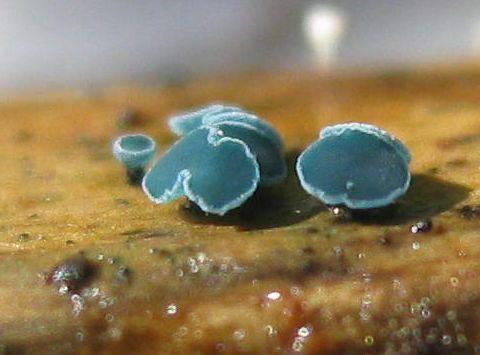
These bluish ones color the stem of Filipendula blue and are short stipate, up to 0,7 mm wide.
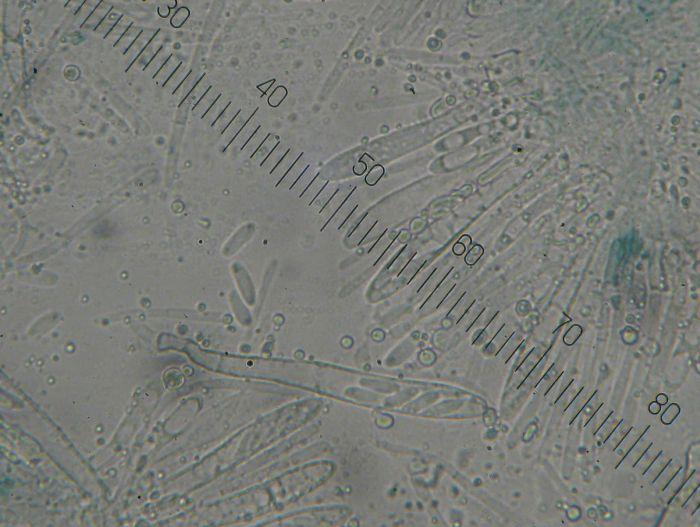
The spores are about 7-9x2-3 and have a couple of small droplets.
The asci are about 55-70x7-8, IKI- and paraphyses are septate, about 2 micrometers wide.
NM1 tells, that Chlorociboria are found on woody substrates and should have amyloid asci, but to my seeing these were not. So, is there some other genus fitting better or different species in Chlorociboria?
Curiously: Marja

Dear Marja,
this should be C. aeruginella. I found it once in Germany and published about it. It also grew on Filipendula, but it seems to grow on other substrates, too. Surely a rare species.
Best regards from Lothar
 Chlorociboria.-Boletus-2002-0001.pdf
I just see my spores and asci were a bit larger than your measurements are. Did you examine living material?
Best regards fom Lothar

thank you.
I have found C. aeruginella on Salix leaves ealier, but the species is not included in NM1, so I have no description of it.
Lothar, I study only fresh ascomycete specimen in snowless season and interesting ones as soon as possible, the substrate made this interesting ;)
Marja